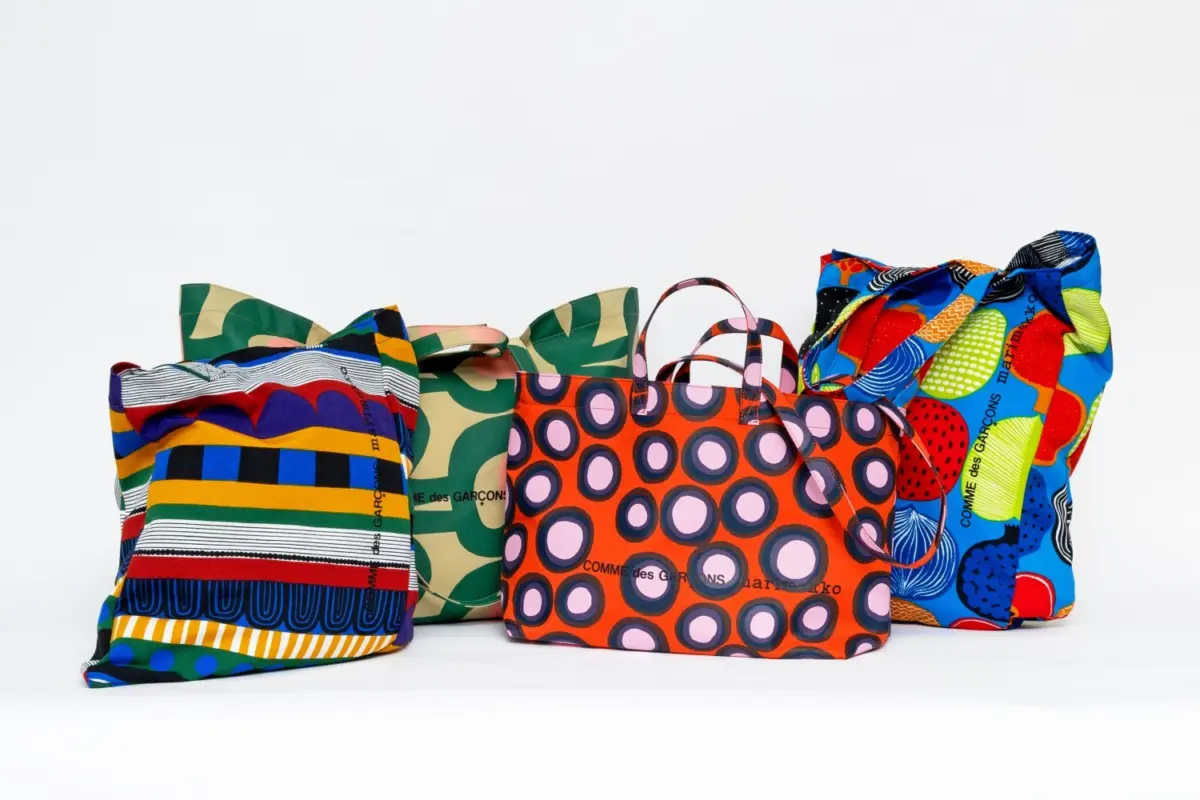
PARIS — Finnish design label Marimekko has joined forces with Comme des Garçons for a limited-edition collaboration landing in stores for the holidays, blending the Helsinki-based brand’s bold, historic prints with the avant-garde sensibilities of its
Japanese partner.
Consisting of four shopper bags in its signature colorful patterns, the capsule line will officially launch on Dec. 1. Available in two distinct sizes, the bags will be sold exclusively in Comme des Garçons boutiques worldwide. This exclusive retail rollout spans 26 locations in Japan alongside key international stores in Seoul, Hong Kong, Singapore, Manila, Bangkok, São Paulo, and Berlin.
The print selections chosen for the holiday collaboration span six decades of design, ranging from 1963 to 2022. The capsule features iconic patterns created by legendary Marimekko designers Annika Rimala, Maija Louekari, Aino-Maija Metsola, and Antti Kekki, highlighting the enduring relevance of the Finnish house’s extensive archival graphics.
Marimekko is increasingly utilizing targeted collaborations, immersive pop-ups, and exhibitions to drive brand awareness as it steadily expands its retail network. The strategy is particularly pronounced in the Asia-Pacific region, where the brand recently crossed the significant threshold of 100 boutiques operating with franchise partners, according to Tiina Alahuhta-Kasko, president and chief executive officer of Marimekko.
“This year our plan is to open 15 to 20 new Marimekko stores or shops-in-shop, most of them located in Asia,” she said, noting that the brand also successfully entered two entirely new international markets this year—Indonesia and the Philippines—bringing its total footprint to more than 180 locations worldwide.
The partnership with Comme des Garçons follows a series of recent high-profile tie-ups designed to keep the heritage brand culturally resonant. Recent collaborative efforts include a limited-edition sneaker collection with footwear brand Veja and a creative partnership with chocolate-maker Godiva in Japan, which featured a special themed café menu.
Collaborations are deeply rooted in the history of the Helsinki-based brand, which is celebrating its 75th anniversary this year. Founder Armi Ratia originally built Marimekko into an interdisciplinary lifestyle brand, forging a tradition of working with everyone from fine artists to visionary architects across various creative disciplines.

Marimekko was notably among the first design labels to work directly with high street fashion chains, joining forces with H&M in 2007 and subsequently releasing a successful series of collections with Uniqlo between 2018 and 2025. At the same time, the company has consistently partnered with edgier, design-forward brands like Junya Watanabe and Finnish jeweler Kalevala, while also branching out into hospitality last year through a partnership with Blue Bottle Coffee.
Alahuhta-Kasko credited this remarkable versatility to Marimekko’s distinct visual identity, which has been forged over decades through its archive of almost 4,000 unique prints. This visual foundation is combined with the company’s inclusive values and its long-standing history as a comprehensive lifestyle brand offering products that range from homewares and interior textiles to fashion accessories and ready-to-wear apparel.
“It’s very authentic for us, but we’re also very careful in choosing with whom we want to collaborate. We want to be quite selective, and we have high ambitions and demands to ensure that every single collaboration brings a new element, a new angle, and that it doesn’t become repetitive,” she explained.
“We really want to push the boundaries and this way, also, philosophically expand our creative community,” Alahuhta-Kasko added. “This, of course, in our view, helps us build brand equity, brand desirability and brand awareness.”
While the brand has occasionally opened pop-up cafés in cities stretching from Helsinki to Melbourne to support specific retail moments, Alahuhta-Kasko emphasized that Marimekko is not looking to branch out permanently into the food and beverage industry as a primary business model.
“Definitely the extension of our lifestyle into hospitality or café-restaurant spaces is interesting, but maybe not as a business model,” the executive said. “At the moment, we don’t have any plans to make a bigger push when it comes to Marimekko-branded cafés.”
Instead, the company remains intensely focused on updating its physical retail experience and staging temporary, high-impact events. A prime example was the pop-up exhibition of historical archive dresses curated by Marimekko’s creative director Rebekka Bay, which was held at the brand’s Paris store in March to coincide with the Matter and Shape design fair.
“We are very focused on constantly pushing the boundaries and evolving our store concept,” Alahuhta-Kasko said. “The one that we have in Paris is the newest one, inspired by the architecture of our textile printing factory in Helsinki.”

While she declined to discuss the specific financial performance of the flagship store located in the Marais district of the French capital, the CEO declared herself thoroughly satisfied with the first year of business at the prominent European location.
“We’re still extremely excited about having found that particular location,” she said. “We feel that that really captures our brand and how we want to build our community, so we’re very happy about it and, of course, we’re still developing the way that we build up our brand following and culture here.”
The brand’s broader financial results underline the strength of its international retail strategy. Marimekko recently reported that net sales rose 3 percent to 52.1 million euros in the third quarter. International sales jumped a notable 16 percent during the period, offsetting a 9 percent decline in domestic sales in Finland.
“In Finland, our home market, the operating environment has been challenging for quite a few years already,” Alahuhta-Kasko noted. “We’re actually navigating it quite well, overall.”
The robust double-digit growth observed in international markets has given the company the confidence to maintain its guidance for the year, targeting steady net sales growth and a comparable operating profit margin of between 16 and 19 percent.
“Despite all the volatility in the world, we’re constantly investing in our growth, further reinforcing our collections. We’re doing a lot of different brand initiatives, really building the brand love. During times like these, when it’s tougher for the whole industry, we very much believe that the brands that are able to do that will come out as winners,” Alahuhta-Kasko concluded.