Full-frame mirrorless cameras have traditionally required a four-figure investment, keeping them out of reach for many budget-conscious enthusiasts and hobbyists transitioning from smartphones or older digital single-lens reflex (DSLR) bodies. However, that barrier to entry has shifted dramatically as Nikon’s entry-level full-frame mirrorless camera has dropped below the $800 threshold for the very first time on record.
Retailers have slashed the price of the Nikon Z5, bringing it down to $796.95. This represents a substantial markdown of $652 from its previous price point of $1,448.95. For photographers who have long eyed the benefits of a full-frame sensor without wanting to incur heavy financial debt, this historical discount marks a watershed moment in the current retail landscape for digital imaging equipment.
Originally launched in 2020, the Z5 serves as Nikon’s most accessible entry point into the full-frame mirrorless ecosystem. Although Nikon has since introduced its successor, the Z5 II, the original model has remained actively available on the market as a formidable and highly economical alternative for photographers who do not require the latest high-speed processing engines or advanced autofocus tracking algorithms.
At its core, the Nikon Z5 houses a 24.3-megapixel full-frame sensor. Remarkably, with this current discount applied, the full-frame camera now sits at a lower price point than Nikon’s crop-sensor model, the Z50 II. This pricing anomaly offers a distinct advantage for buyers, as the larger physical dimensions of a full-frame sensor allow the camera to gather significantly more light per pixel and produce shallower depth-of-field effects, resulting in smoother background blur—often referred to as bokeh—compared to smaller crop-sensor or APS-C alternatives.
Despite occupying the entry-level tier within Nikon’s mirrorless lineup, the Z5 eschews the stripped-down, plastic-heavy construction often associated with budget-friendly electronics. Instead, it carries several design and hardware attributes typically reserved for higher-end, more expensive professional bodies. The build quality feels decidedly premium in the hand, offering weather sealing and ergonomic handling that inspires confidence during outdoor shoots. Furthermore, the Z5 retains practical features that even some modern mid-range cameras omit, including a tilting LCD screen for high- and low-angle shooting convenience, as well as dual memory card slots that allow photographers to instantly record simultaneous backups or overflow data, a crucial safeguard for professional and semi-professional event shooters.
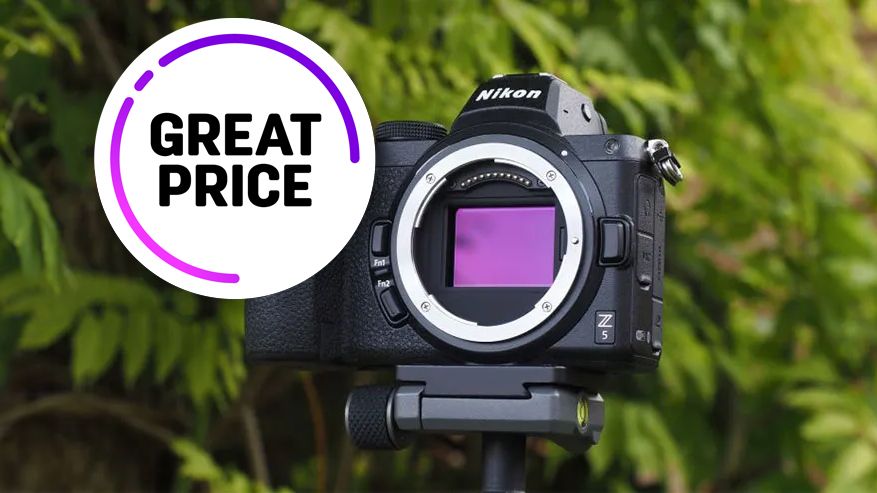
Finding a brand-new, in-box full-frame mirrorless camera for under $1,000 remains a rarity in the modern camera market. In this specific price bracket, the Z5 has historically faced direct competition from models like the Canon EOS RP. While the Canon alternative offers certain advantages in autofocus specifications, it lacks in-body image stabilization, relies entirely on an electronic shutter mechanism in certain modes, and is limited to a single memory card slot, making the Nikon Z5 a more robust tool for shooters prioritizing stability and data redundancy.
According to historical price tracking data, the $796.95 tag represents the absolute lowest price recorded for the Z5 since its introduction. Major photographic equipment retailers, including B&H Photo, have featured the promotional pricing, while other prominent outlets such as Adorama and Amazon have also adopted the reduced pricing structure, making the deal widely accessible to buyers across the retail landscape.
The Nikon Z5 II Is the Better Buy for Action and Low Light
While the original Nikon Z5 stands out as an exceptional value proposition for photographers shopping with a tight budget under $1,000, industry analysts and gear reviewers note that there are compelling reasons for certain users to stretch their budgets and invest in the newer Z5 II, which has also seen promotional discounting bringing it to $1,596.95.
The primary justifications for opting for the newer Z5 II center on raw processing speed and vastly superior autofocus capabilities. While the original Z5 is well-suited for deliberate, stationary subjects, its continuous shooting speed tops out at a relatively modest 4.5 frames per second. By contrast, the Z5 II dramatically increases burst performance, capable of reaching up to 30 frames per second for JPEG captures and 11 frames per second for uncompressed 14-bit RAW files.
Additionally, the Z5 II incorporates a generational leap in autofocus technology. It features advanced subject-detection algorithms and a dedicated low-light autofocus sensitivity that performs more than twice as effectively as the system found in the first-generation Z5. This makes the newer model significantly more reliable when tracking moving subjects, wildlife, sports, or shooting in challenging, dimly lit indoor environments.
Further differentiating the two models are improvements in video capabilities and hardware responsiveness. The Z5 II extends continuous video recording capabilities to over two hours, whereas the original Z5 automatically halts internal recording after 30 minutes to manage thermal output. The resolution and responsiveness of the touchscreen interface have also been noticeably upgraded in the second-generation body.
For photographers whose primary genres involve fast-moving action, sports, or frequent low-light conditions, bypassing the discounted Z5 in favor of saving up for the Z5 II is widely recommended. However, for practitioners of landscape, architectural, portrait, or street photography—where subjects are largely stationary or slow-moving—the performance gap between the two generations narrows significantly. In those scenarios, the immense light-gathering capability of the Z5’s large sensor, combined with its current record-breaking low price, becomes exceptionally difficult to ignore.
Beyond its financial advantage, the original Z5 retains a few unexpected practical benefits over its successor. It is slightly lighter than the Z5 II and actually delivers superior battery efficiency, rated for approximately 470 shots per charge using the EN-EL15c battery, compared to the 380-shot rating of the Z5 II.
While the Nikon Z5 may no longer hold the crown as Nikon’s most technologically advanced or feature-rich mirrorless camera, its unprecedented price drop positions it as one of the most compelling deals currently available in the digital photography market for shooters who prioritize physical sensor size and overall cost-effectiveness over blistering burst speeds and cutting-edge artificial intelligence-driven autofocus tracking.