By Adam Savage
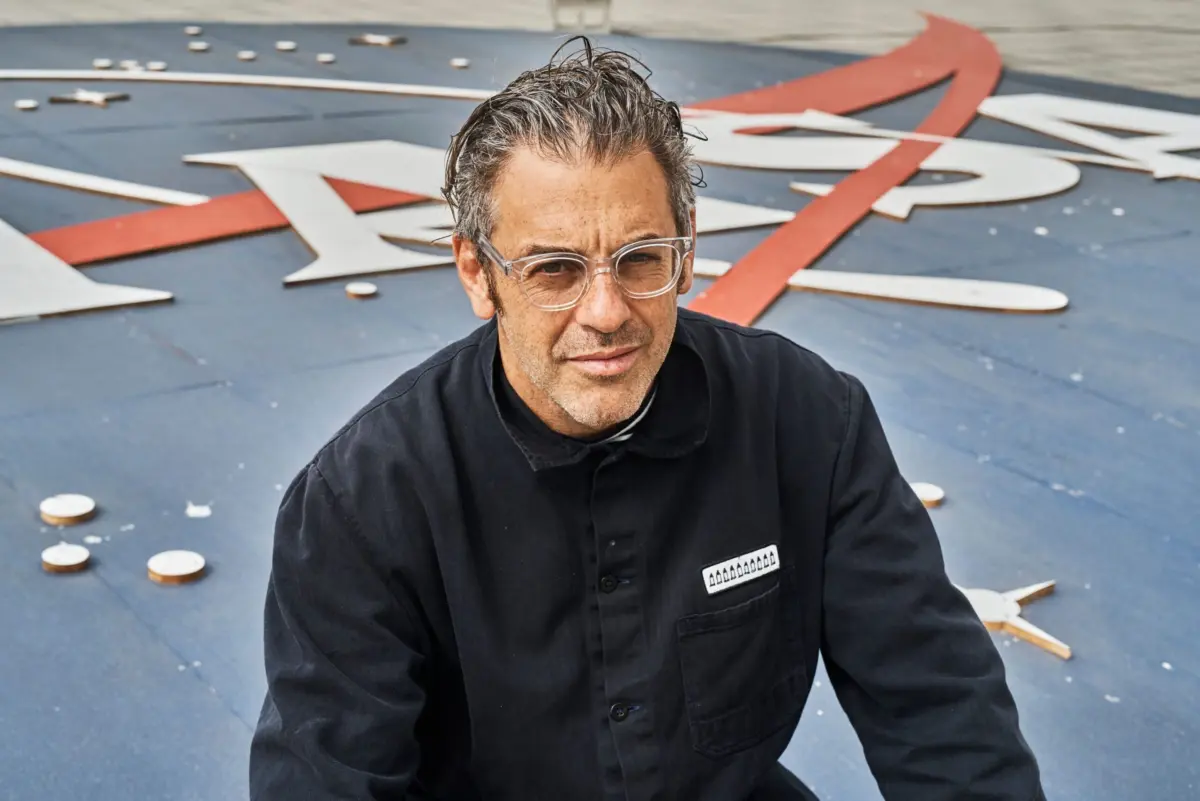
Tom Sachs’s workshop in lower Manhattan is a labyrinth of rooms packed to capacity with customized cabinets, meticulously arranged shelves, heavy-duty work tables, and complex sorting systems. Even the humble drill press has been thoroughly reimagined: two machine lamps spider off its top, a specialized brush on a retracting cord sweeps away stray debris, and a chuck key along with a center punch are magnetically secured to the machine’s face. These obsessive rituals, taken together, form the foundation of a workshop’s underlying philosophy of work.

Sachs is a sculptor by trade, but he prefers to describe himself as a bricoleur—someone who cobbles together functional contraptions out of collected or received materials. A decade ago, gallery owners and museum curators began taking notice of his provocative, highly tactile sculptures: a cardboard hand grenade tucked inside a mock Hermès box, or a Glock pistol branded and decorated in the unmistakable style of Tiffany & Co. Today, Sachs and his twelve-person team mount elaborate, large-scale exhibitions in major museums around the world, and dedicated art collectors fiercely track his output.
On the day of the studio visit, Sachs and his crew are deep in preparation for a massive installation at San Francisco’s Yerba Buena Center for the Arts. The project, opening in September, is designed to send two "astronauts"—played by studio assistants—inside a plywood mock-spaceship on a simulated mission to Europa, the Jovian moon that scientists theorize might harbor extraterrestrial life. It marks the third installment in Sachs’s ongoing Space Program series. As visitors tour the bustling studio, Sachs’s assistant, Sam Ratanarat, works carefully to stabilize a mobile cart that the astronauts will wheel out onto the simulated alien surface, a task that requires her to weld the titanium rods holding the frame together.

Sachs pauses to inspect the work, telling Ratanarat that her initial weld looks exceptional. "Talk about material bragging rights," he remarks. "Titanium is up there!"
However, Sachs finds himself less impressed with their aging MIG welder, which is battered and worn from years of heavy use. "Can we get rid of this?" he asks.

"We use it," Ratanarat replies protectively.
Sachs himself is busy working on something far edgier for the upcoming mission. "When we went to the moon, Spyderco made us white Delicas," he recalls, referencing the folding knife popular among enthusiasts, which Sachs previously engraved with NASA’s iconic 1970s worm logo.

Europa, he argues, demands an entirely different instrument. "Europa is a mission about imperialism. We go to another planet, find some Europans, and abduct them," Sachs explains. "So what’s the knife of colonialism? A machete!" True to form, he is currently milling his own from a salvaged Japanese lawn-mower blade.
With three concurrent shows running in New York and the Europa landing imminent at Yerba Buena, Sachs stands at the peak of a two-decade career. His cobbled-together, rough-edged, and joyful contraptions have solidified his reputation as arguably the most famous bricoleur working in the contemporary art world.

Reflecting on his path, Sachs admits he was a peculiar kid. He bought his clothes at Goodwill and had them tailored, struggled academically as a solid D-minus student, felt deeply unpopular, and even had to repeat the ninth grade. Somehow, he managed to secure admission to Bennington College, where he met Babs, a senior who taught him the fundamentals of welding and introduced him to the work of Constantin Brancusi and Richard Serra. He quickly fell in love.
"She promptly dumped my ass for a trust-fund kid with dreads," Sachs recalls. "But she showed me a more complex way of working, to make these objects and talk about them politically, socially, how objects could be used in the rituals of our lives." He nursed his broken heart with an angle grinder.

Years later, in 2012, a video crossed the screen of fellow space enthusiast Tom Hanks, depicting a replica Lunar Excursion Module on a simulated mission to a fake Mars. Hanks, recognizing the artistry immediately, introduced the work to author and maker Adam Savage. That connection sparked a unique friendship and professional kinship between Sachs and Savage, who found they shared an obsessive approach to organizing, building replicas, and constructing workshop infrastructure whenever creative blocks arose.
When Savage eventually visited Sachs’s studio and examined his previous monumental installations—including the 2007 moon mission at the Gagosian Gallery in Beverly Hills and the 2012 Mars mission at the Park Avenue Armory in New York—the parallels were striking. Sachs had previously created a blue Tiffany Glock, an orange Hermès hand grenade, a Chanel chainsaw, a Prada toilet, and a foam-core R2-D2. The shared ethos of building physical narratives through meticulous replica-making bridged their backgrounds in DIY craft and high art.

That shared passion extended directly into performance art and experiential installations, notably during a traditional Japanese tea ceremony hosted by Sachs at the Noguchi Museum in Long Island City. Rather than following strict convention, Sachs’s ceremony substituted standard footwear with sneakers cut into sandals, locked participants’ smartphones and wristwatches inside a Faraday cage, and served sake from cups made of stacked plywood circles coated in resin, alongside Oreos and Ritz crackers with peanut butter.
"People are into tea for three reasons," Sachs explains. "Spirituality, like Zen. Sensuality, like the tea itself, the smell, the charcoal, the caffeine high. The third reason is the architecture—the teahouse, the kimonos, the bowls, the whisks. Obviously, I’m into it for that."

The sentiment mirrors his lifelong obsession with NASA and space exploration. While some are drawn to astronomy for navigation or the intersection of science and religion, Sachs admits an affinity for the hardware. "I think if I were to be honest with myself, I’m more about the hardware," he says. "But it doesn’t mean anything without the ritual."
That ritual of failure and rehearsal drives the narrative of Sachs’s space missions. NASA itself operates as a massive, ritualized failure-analysis organization, studying structural, personal, and philosophical missteps to ensure safety. Sachs translates that ethos into his immersive theater. During the Europa mission, astronauts will begin in a quarantine trailer, transfer via scissor lift to a landing module, and launch via a model rocket filmed with a miniature camera to mimic authentic NASA footage.

The climax of the performance hinges on success or failure. One astronaut must successfully pilot the classic Atari game Lunar Lander. If she fails—running out of fuel or crashing the module—a television screen will display a Nixon impersonator reading the speech written in the event that the Apollo astronauts perished, bringing an immediate end to the show.
If she succeeds, the astronauts disembark in suits cooled by ice-water backpack tanks, approach an ice-covered pool under the direction of mission control, drill through the ice, and capture the simulated alien life forms residing beneath. Choosing the right creature—such as crawfish or shrimp—proves difficult, as Sachs must balance authenticity with animal welfare concerns. "I’m trying to figure out which fish will get me the least amount of crap from PETA," he notes.

NASA engineers have embraced these elaborate simulations. Dave Lavery, a NASA roboticist, notes that despite the presence of plywood edges, worn paint, tequila bars, and drug paraphernalia, the technical details of Sachs’s hardware trace directly back to actual spaceflight engineering.
The complexity of mounting such productions is immense. The space suits are difficult to keep cool, and switches and hatches frequently break. Transporting and assembling the pieces takes an entire month of labor for just three days of public performances. For Sachs, the physical toll and the risk of injury are central to the work. "I love getting my hands dirty. I only feel good if I have a cut somewhere," he says. "If I have a little burn, it means that I’m probably doing something right."

That dedication to physical authenticity recently manifested in a collaboration between Sachs and Savage to recreate the lunch box carried by character Heywood Floyd in 2001: A Space Odyssey. While Savage utilized styrene, aluminum, fiberglass molding, and genuine NASA-issue Mylar bubble wrap, Sachs constructed his version from raw plywood, screws, and resin, leaving the edges rough and letting the wood grain bleed through the white paint. Both objects were accurate to the narrative, and both creators ultimately traded pieces.
When discussing whether such replicas constitute fine art, Sachs insists that the emotional difficulty of parting with a finished piece is the ultimate metric. "It feels like that every single time," Sachs says. "That’s when you know it’s good." If an artist cobbles together found materials into a prosaic object and feels physical pain at the thought of letting it go, they have successfully made art.