The microscopic universe is constantly in motion, humming with complex biological processes and physical phenomena that remain completely invisible to the naked human eye. For sixteen years, Nikon’s prestigious Small World in Motion competition has sought to pull back the curtain on this hidden realm, celebrating the intersection of cutting-edge scientific research and mesmerizing visual art. In its latest iteration, the international contest has once again captivated audiences worldwide, crowning a winning video that reveals both the fragile mechanics of human health and the poetic beauty hidden deep within the body.
This year’s top honor was awarded to Dr. Ning Xu, a researcher based in Beijing, whose winning entry captures the abnormal beating of airway cilia from a child suffering from Primary Ciliary Dyskinesia (PCD). PCD is a rare, debilitating genetic disorder that profoundly affects respiratory function by impairing the coordinated, whip-like movement of microscopic hair-like structures known as cilia. In healthy individuals, these cilia beat in rhythmic unison to clear mucus, dust, and pathogens out of the airways, serving as a vital frontline defense for the respiratory system. In patients with PCD, however, that crucial coordination is lost, leading to chronic infections and severe respiratory complications.
Through advanced microscopy techniques, Dr. Xu managed to record the erratic and dysfunctional motion of these microscopic structures, translating a complex medical pathology into a moving visual narrative. When viewers watch the footage, the immediate impact is both emotional and intellectual. "When people watch cilia beating, they immediately understand that something beautiful and important is happening inside us," Dr. Xu reflects, highlighting the profound connection that imagery can forge between hard science and human empathy. "I think this competition turns microscopy into a shared language."
The winning submission represents just one of the many remarkable entries that distinguished the 16th annual cycle of the competition. This year, the contest drew an impressive pool of more than 340 video entries submitted by scientists, researchers, and microscopy enthusiasts from 40 different countries around the globe. To evaluate this vast array of dynamic submissions, Nikon assembled an esteemed panel of judges comprising renowned scientists, academic researchers, and professional science communicators. These experts carefully assessed each video based on its scientific significance, originality, visual impact, and the technical skill required to capture it.
While Dr. Xu’s poignant look at respiratory pathology claimed the ultimate prize, the competition’s podium and honorable mentions showcase a breathtaking diversity of subjects, ranging from crystalline chemistry to aquatic ecology. Securing the second-place position in the competition was Nguyen Nam Nhat from Vietnam, whose captivating video transports viewers into a drop of water where a tiny roundworm and a single-celled Dileptus navigate and explore their microscopic habitat. The footage offers a rare, real-time glimpse into the complex behavioral interactions of microorganisms, capturing the drama of life at a scale entirely divorced from human scale yet deeply influential to the broader ecosystem.
The third-place award went to Benedikt Pleyer of Germany, who turned his lens toward the delicate and ephemeral world of marine biology. Pleyer’s winning entry features jellyfish larvae suspended in tiny water droplets, creating a mesmerizing display of translucent forms and graceful, pulsing movements. The interplay between surface tension and larval locomotion demonstrates the intricate design of marine life in its earliest, most vulnerable stages of development.
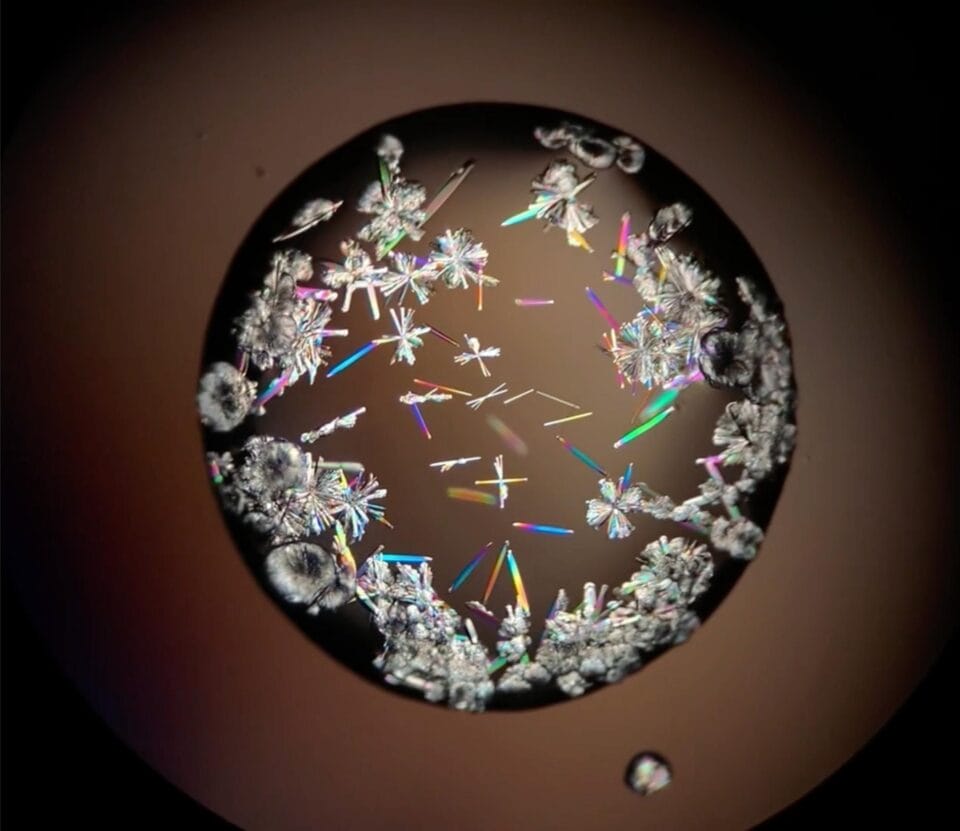
In addition to the top three winners, the panel of judges recognized several entries with honorable mentions for their exceptional visual and scientific merit. Among them is a striking submission by Cora A. Harris of the United States, which documents the fascinating crystallization process of Monosodium Glutamate (MSG) salt as it forms within shifting droplets of solution. The video captures the geometric precision and rapid growth of salt crystals from a liquid phase, offering a brilliant look at physical chemistry in action.
Another notable honorable mention was awarded to Gerd Günther of Germany for his dynamic footage of Volvox aureus alga colonies in motion. Günther’s video captures the mesmerizing, rolling locomotion of these spherical green algae colonies, which move collectively through the water via the coordinated beating of thousands of tiny flagella on their outer surfaces. The footage highlights both the geometric symmetry of colonial organisms and the fluid dynamics governing their propulsion.
The competition continues to serve as an invaluable platform for bridging the gap between specialized scientific inquiry and public appreciation. By highlighting the hidden wonders that exist at the cellular and molecular levels, Nikon’s Small World in Motion allows researchers to share their discoveries with a global audience in a way that transcends language barriers and academic disciplines.
Enthusiasts and science lovers who wish to explore the full breadth of this year’s creative and technical achievements can view the complete collection of winning videos and honorable mentions directly on the contest’s official website. Meanwhile, the excitement in the microscopic imaging community continues to build as participants and observers alike await the upcoming announcement of the winners for the companion Nikon Small World photo competition, which is scheduled to be revealed on October 21.