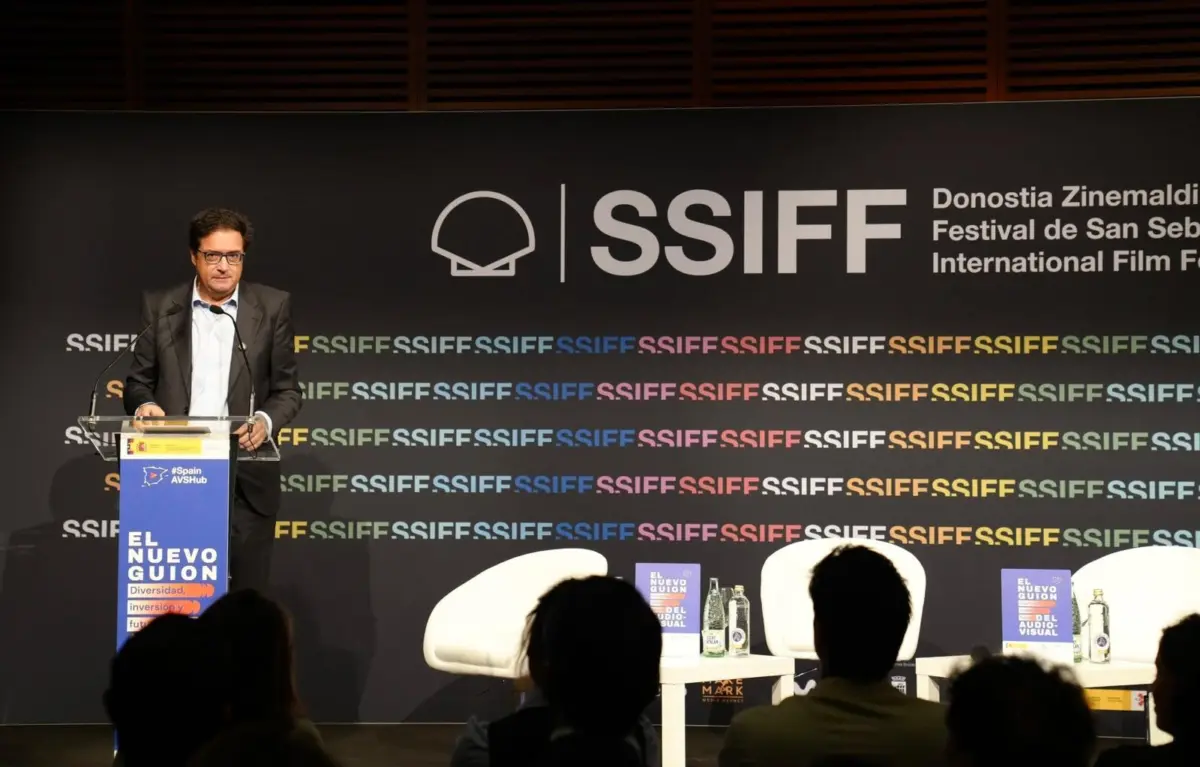
Spain is preparing to press forward with its unwavering commitment to the nation’s rapidly expanding audiovisual industry, anchored by long-term financial backing and institutional support. Speaking at the high-profile conference titled "The New Script of the Audiovisual Industry" during the San Sebastian Festival, Minister for Digital Transformation and Public Administration Óscar López announced that his ministry would continue championing the sector through the Spain Crece Fund.
The strategy is expected to feature further strategic investments channeled through SETT, the ministry’s sovereign venture capital fund, which has emerged as a critical financial instrument for the country’s creative economy.
"When a public policy works, it should be maintained without a deadline. It is the golden age for our audiovisual sector," López told attendees on Sunday, pointing to a series of unprecedented, record-breaking figures that underscore the industry’s remarkable ascent on the global stage.
López delivered his remarks just hours before "La Bola Negra," created by Spanish filmmakers Javier Calvo and Javier Ambrossi, claimed the coveted 2026 TIFF People’s Choice Award at the Toronto International Film Festival. The prestigious audience prize is widely regarded by industry insiders and critics alike as a reliable bellwether for films destined to make significant waves on the road to the Academy Awards.
The minister’s optimistic outlook is further validated by dominant international streaming metrics. Currently, four Spanish series seasons and three feature films occupy spots in Netflix’s all-time Top 10 lists for its biggest non-English hits ever—representing a larger share of top global titles than any other country in the world.
Reflecting on the structural shift that enabled this cultural export boom, López noted that Spain historically possessed the essential raw ingredients for success, yet lacked the necessary financial and political alignment.
"We had the talent, the ideas and the locations. What was missing was political will and a significant injection of capital," López said. He highlighted the Spain Audiovisual Hub Plan as a foundational driver of the sector’s current development, describing it as an unprecedented institutional commitment commensurate with the scale of the challenge that made it possible to design an economic transformation on an unprecedented scale.
"And here we are, €1.6 billion later, reaping the benefits and expanding our horizons," he added.
Statistics Reveal Spain’s Dramatic Growth
The transformation of the Spanish media landscape is readily apparent in official economic metrics. Spain now stands proudly as the European Union’s largest production market, with domestic audiovisual production having surged by an impressive 31% in 2025. Furthermore, Spanish productions account for nine of the 11 most-watched series across the European continent, according to the figures cited by the minister.
Employment figures have mirrored this exponential growth. Jobs within the audiovisual sector have effectively doubled since 2020, climbing from 30,900 workers to more than 64,000 by 2025.
López noted that the industry is poised to reap further rewards from €450 million in investments mobilized by SETT (the Spanish Society for Technological Transformation), which is injecting capital into prominent creative companies such as Lazona, Good Films, and Aurora Media.
High Praise for SETT, the Venture Capital Fund of Spain’s Ministry for Digital Transformation
The impact of these financial mechanisms was a central theme during the conference’s opening panels. Speaking at the first of three discussions, Good Film Studios founder Miriam Segal offered high praise for Spain’s robust studio infrastructure, local talent pool, and immense international potential. Having built a career producing across the United States, the United Kingdom, and various European territories, Segal admitted she was initially unaware of Spain’s incredible industry infrastructure or the government’s extraordinary passion and commitment to the sector.
For the first time in her career as an independent producer, Segal noted that this governmental support has directly enabled her to offer competitive pay-or-play deals to actors.
Similarly, José Carlos García of Anima Kitchen expressed deep gratitude to SETT for backing the company’s ambitious creative vision. He explained that the funding has catalyzed corporate growth, streamlined talent recruitment, and secured concrete plans for the production of three high-end animated films over the next five years—an initiative that will further solidify Anima’s leadership position in the animation sector.
Europe Panel: A Roadmap to the Future
The European panel convened industry leaders from Spain, Greece, and Denmark to debate how the continent can successfully preserve its rich cultural diversity while remaining fiercely competitive in an increasingly globalized media market. The panelists reached a clear consensus that there is no single European audiovisual model. Instead, Carla Redondo of Spain’s Ministry of Digital Transformation described this pluralism as one of the true strengths of Europe.
During the discussion, Spain emphasized its successful framework of tax incentives, targeted investments, talent cultivation, and infrastructure development. Greece highlighted its strategic use of international co-productions to simultaneously build local technical capacity and workforce training programs. Meanwhile, Esben Snoer Iversen of the Danish Culture Ministry emphasized the critical importance of regional cooperation and flexible funding mechanisms as the digital media landscape continues to evolve at a dizzying pace.
Speakers across the board also issued calls for greater administrative harmonization and robust support for emerging creative industries. As Leonidas Christopoulos of Ekkomed aptly summarized, "It’s all about the stories"—arguing that compelling, high-quality content remains the ultimate driver of international competitiveness.
Linear Television is Not Dead
Addressing the anxieties surrounding shifting consumer habits, the third panel of the conference explored how traditional broadcasters and modern streaming platforms are adapting to a rapidly fragmenting audiovisual environment.
"Television is not dead," declared Mediaset’s Fernando Hernaiz, arguing that the medium has successfully evolved into a much broader, interconnected ecosystem spanning traditional linear channels, streaming applications, bespoke production houses, and multi-platform distribution models.
"We have a capacity to adapt," Hernaiz said, emphasizing that contemporary television represents an intricate convergence of technology, artistic creation, scriptwriting, and rigorous business strategy.
While audience fragmentation and complex measurement methodologies continue to pose significant operational challenges, panelists—including Alfonso Morales of RTVE, Miguel Langle of Atresmedia, and Clara Ruipérez of Movistar Plus—urged lawmakers to implement forward-thinking regulations that can keep pace with agile streaming platforms and social media networks. Sustained investment, targeted promotion, and uncompromising storytelling were highlighted as the absolute prerequisites for ensuring that Spanish content continues to travel successfully across international borders.
Sneak Peek at the Olsberg-SPI Data
Adding analytical weight to the conference, Juan Manuel Guimerans of the Spain Film Commission and Leon Forde of Olsberg SPI provided attendees with an exclusive sneak peek of an upcoming comprehensive study on the country’s audiovisual sector. Based on rigorous official data, the preliminary findings estimate an astounding €20 billion in direct production expenditure between 2020 and 2025.
This massive capital injection has generated nearly €18 billion in gross value added while continuously supporting the aforementioned 64,000 jobs. According to the data, direct investment surged by 45%, while gross value added rose by 38%. Crucially, the study reveals that more than half of the employment generated by the audiovisual sector trickles down into related industries and supply chains, heavily benefiting sectors such as construction, hospitality, and transport.
Forde stressed that reliable data remains an absolute prerequisite for effective policymaking, even though information collection remains inherently fragmented across such a complex, multifaceted industry. Describing the audiovisual sector as an interconnected ecosystem where all component species are indispensable, the researchers emphasized that the industry requires continued investment and careful economic balance. A more detailed and definitive report is scheduled to be presented on September 22.
(Reporting contributed by John Hopewell.)