A striking trend has begun to define the landscape of contemporary Swiss cinema heading into 2026 and the years immediately preceding it. Many of the nation’s most talked-about breakout films share a common linguistic thread: they are either entirely in English or incorporate significant chunks of dialogue in the language. This evolving cinematic phenomenon was the centerpiece of a high-profile panel discussion at the Venice Production Bridge, where Switzerland served as the designated country of focus.
The panel, appropriately titled "Beyond Borders: English as the New Language in Swiss Cinema?", brought together some of the country’s most celebrated contemporary helmers. Among them were Tim Fehlbaum, director of the lauded historical thriller September 5; Ursula Meier, director of the upcoming feature Quiet Land; and Michael Koch, helmer of the drama Erosion. Moderated by Variety’s Italy and Middle East correspondent and Rome bureau chief, Nick Vivarelli, the conversation delved deeply into both the tactical advantages and the distinct creative challenges of shooting in English within the modern Swiss filmmaking ecosystem.
The shift toward English is visible across an array of recent festival favorites and critical darlings. It encompasses Petra Volpe’s Locarno-winning feature Frank & Louis, Damien Hauser’s festival hit Memory of Princess Mumbi, Denis Rabaglia’s buzzy project Butterfly Stroke, and Fehlbaum’s widely praised September 5. Yet, as the panel made clear, this linguistic pivot is far from a superficial attempt to chase international markets; rather, it is a deliberate artistic and logistical choice driven by the demands of specific stories.
The Financial Realities and Creative Impulses of English-Language Production
During the panel discussion, Fehlbaum offered insight into his upcoming cinematic endeavors, revealing that his next project will be set in historical Germany and shot in a blend of German and English. According to the director, incorporating an American perspective into a natively German story organically expands the linguistic scope of the film. By introducing a character who does not understand German, the narrative naturally shifts toward English, a decision that he noted significantly streamlines the international financing process.
However, Fehlbaum was quick to emphasize that language choices must always be dictated by the narrative core of the project rather than commercial calculation alone. Reflecting on his career, the director recalled the pressures he faced during his feature directorial debut, Hell, a post-apocalyptic sci-fi film. At a time prior to the streaming boom of platforms like Netflix, producers insisted that the film had to be shot in English to secure financing. Trusting his instincts, Fehlbaum refused to force the language choice where it did not naturally belong, and the resulting German-language film performed exceptionally well both domestically and internationally.
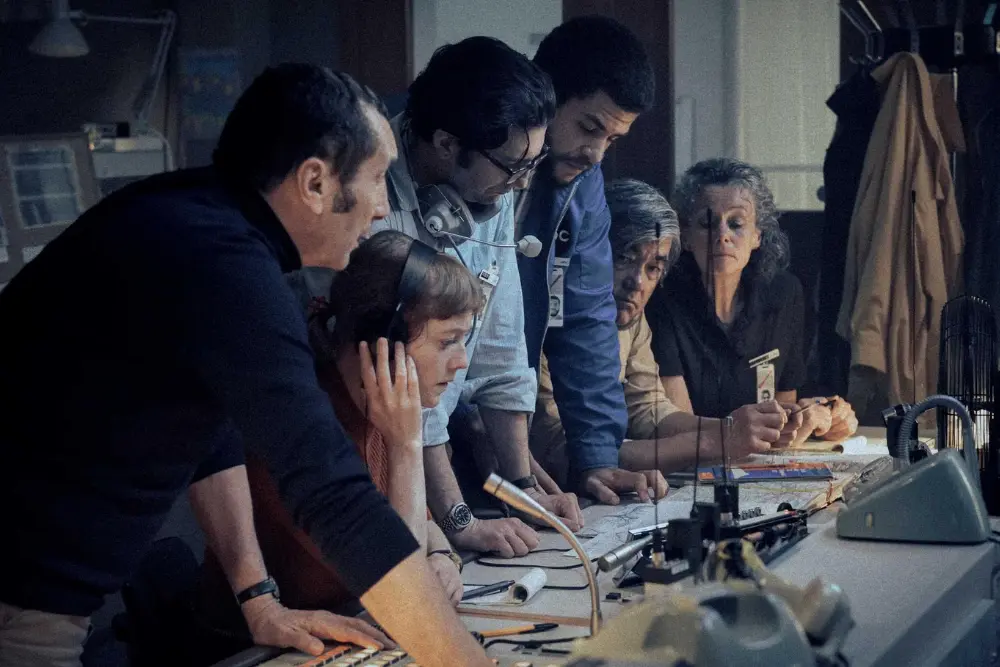
Conversely, for his subsequent project, The Colony, Fehlbaum chose to shoot in English even though the script did not strictly demand it. The lukewarm critical and commercial response to that film reinforced his conviction that utilizing English only works when it is diegetically justified. That principle guided his approach to September 5, a tense historical drama told entirely from the perspective of American television broadcasters working in Munich during the tragic hostage crisis at the 1972 Olympic Games.
Collaborating Across Cultures and Financing Like a Ferrari
For director Michael Koch, stepping into the realm of English-language filmmaking involved casting prominent American actor Peter Sarsgaard as the lead in his upcoming drama Erosion. The film reunites Koch with the non-professional actors who populated his previous critically acclaimed mountain village drama, A Piece of Sky. In Erosion, the narrative observes the tense and delicate dynamics unfolding between a foreign outsider and local Swiss farmers in an isolated mountain community. It was actually Fehlbaum who originally forged the connection between Koch and Sarsgaard following their successful collaboration on September 5.
For Koch, casting an English-speaking actor was rooted firmly in creative vision. Unlike his previous feature, which immersed audiences entirely in the internal world of a tight-knit mountain community through local non-professional actors, Erosion deliberately flips the perspective to look at that world through the eyes of a stranger. Pairing a globally recognized talent like Sarsgaard with non-professional Swiss actors presented a fascinating juxtaposition that Koch was eager to explore.

From a financing perspective, landing a major American star transformed the production mechanics of Erosion. Using Vivarelli’s Ferrari metaphor to describe the financial journey, Koch noted that while the film required a larger overall budget, securing those funds proved to be remarkably fast and efficient. He acknowledged, however, that this outcome was largely contingent upon Sarsgaard’s genuine personal passion for the material, noting that otherwise the production could never have afforded him.
Linguistic Nuance, Translation, and the Dangers of Automation
The panelists also explored the technical nuances of writing and communicating in a second language. Fehlbaum pointed out that the English language possesses roughly three times as many words as German, offering writers a vastly expanded vocabulary. In scriptwriting, where conciseness is often paramount, the ability to convey complex subtext with a single English word—where German might require an entire explanatory sentence—can be a distinct advantage.
Yet, working across languages also introduces hurdles, particularly when it comes to maintaining cultural and linguistic authenticity. Fehlbaum strongly cautioned against the growing industry temptation to rely on artificial intelligence for script translation and dialogue adaptation. Drawing on a recent meeting with a traditional translator who noted how AI is beginning to encroach upon translation jobs, Fehlbaum underscored the irreplaceable value of working with a seasoned human linguist. During the production of September 5, he collaborated closely with a translator who not only converted the script from German to English but also injected an authentic American perspective into the dialogue.
Similarly, Ursula Meier shared her extensive preparation process for her upcoming English-language feature Quiet Land, which was featured in the Venice Gap-Financing Market. The ambitious project stars legendary actors Bill Murray and Léa Seydoux. Set in the expansive landscape of Montana, the film is scheduled to shoot in Alberta, Canada, with pre-production well underway.
When asked about her motivation for crossing linguistic borders, Meier explained that the scale of the story demanded a broader canvas. For her, everything in the United States inherently feels larger. Writing the screenplay, however, presented a formidable personal hurdle. Admitting that her spoken English is limited, Meier spent a full year meticulously overseeing the writing process, which began with drafting the script in French before undergoing a rigorous translation and adaptation phase.
Meier also expressed her deep admiration for the physical approach of American actors, recalling her positive experience working with Gillian Anderson on her Oscar-shortlisted film Sisters. She praised how American performers embody their characters with a distinct physical presence that brings a unique energy to the set.
Navigating the Set and the Multilingual Reality of Switzerland
Despite the creative and financial benefits, the directors candidly addressed the trials of navigating a second language under the immense pressure of daily film production. Fehlbaum admitted that the language barrier on set often proved to be significantly wider than he had initially anticipated.
However, Koch offered a constructive counter-perspective on the communication gap. He observed that when verbal vocabulary is somewhat limited, actors are forced to listen more intently, decode intent more deeply, and actively participate in the collaborative process in non-verbal ways. This dynamic fostered a unique environment where people from entirely different cultural worlds could connect and share creative energy beyond mere words.
Ultimately, all three filmmakers agreed that while English-language projects are undoubtedly on the rise, English is best viewed as just another tool in the creative arsenal of Swiss cinema. Switzerland itself is a nation built fundamentally on the coexistence of multiple official languages—including German, French, Italian, and Romansh. Within that inherently multilingual society, the growing embrace of English represents not a departure from national identity, but rather another card for Swiss directors to play as they continue to expand their reach onto the global stage.