In software engineering and interface design, few challenges are as deceptively complex or persistent as naming things. The terminology selected by product teams does far more than label a file or reference a variable; it fundamentally shapes how multi-disciplinary teams conceptualize their products, construct system architecture, and communicate across departments. When vocabulary fractures, operational friction inevitably follows. Disconnects frequently arise over the designation of brand colors, icon libraries, user interface components, and feature sets, creating compounding confusion when translating designs into design tokens, HTML class structures, and code variables.
The core dilemma often rests on a difficult spectrum. On one side, names that are too generic fail to convey intent, leaving engineers and designers uncertain of a component’s specific purpose or context. On the other, names that are overly specific restrict flexibility, preventing component reuse and leading to bloated codebases. As digital ecosystems scale across multiple platforms and brands, establishing clear, structured, and extensible naming conventions has evolved from a matter of convenience into a critical operational discipline.
Across the software and design community, practitioners are building open-source repositories, taxonomy maps, and specialized naming frameworks to address these exact pain points. By analyzing shared vocabularies, token structures, and linguistic resources, digital organizations are finding ways to align internal team dialects and streamline the development lifecycle.

Overcoming Naming Friction and Creative Blocks
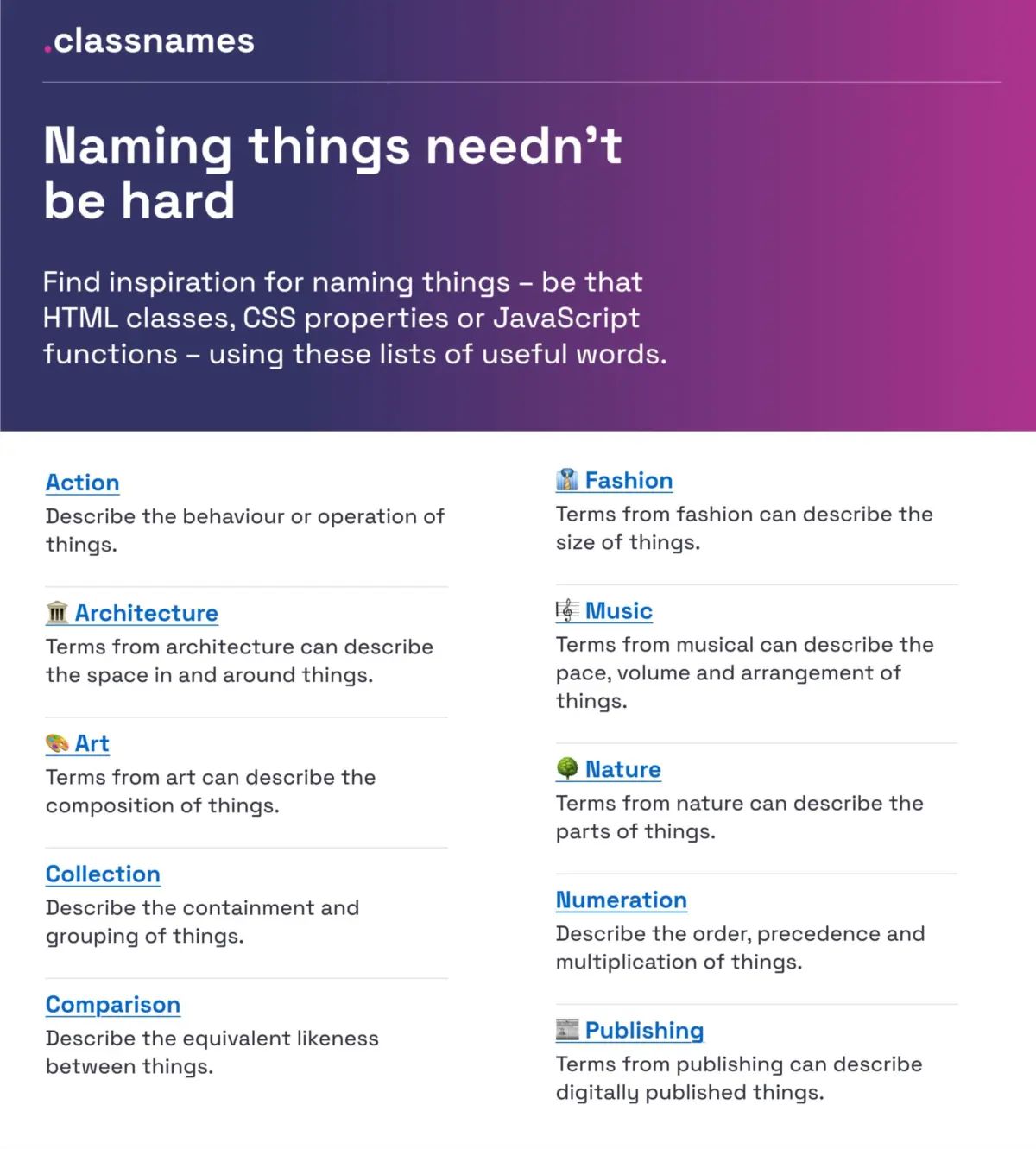
When developers and designers step outside traditional code constructs to label interface abstractions, finding the right words can quickly lead to creative fatigue. To help teams break out of conventional naming ruts, developer and designer Paul Robert Lloyd created Classnames, an open-source resource engineered to inspire clearer naming for HTML classes, CSS properties, and JavaScript functions.
Rather than offering a rigid dictionary, the platform organizes language into thematically grouped lists designed to prompt lateral thinking. The tool categorizes words by behavior, structural likeness, relative order, grouping, and conceptual association. Beyond standard technical jargon, the platform draws inspiration from external disciplines, curated into themed collections based on nature, art, theater, music, architecture, fashion, and publishing. By framing digital components through established analogies—such as architectural supports or publishing layouts—teams can define intuitive semantic structures that remain adaptable without relying on fragile visual descriptions.
Solving the Spectrum Challenge in Color Naming
Color systems present unique naming hurdles for design operations. As color palettes grow to support dark modes, accessibility contrasts, and multi-brand themes, assigning arbitrary or visually descriptive names like "light-blue-2" quickly breaks down when system themes invert or evolve.

To bring order to color classification, developer David Aerne maintains a massive open-source color name repository containing over 30,355 unique color names. This extensive dataset pools contributions from historical references, scientific classifications, and thousands of community submissions, establishing a standardized lookup for digital palettes.
To make this vast library functional for daily product workflows, the project includes specialized color pickers and search utilities, such as Color Parrot. By allowing contributors to input precise color values—via web interfaces or automated social tools—the project translates raw hexadecimal or RGB coordinates into distinct, recognizable semantic titles. This extensive reference library enables design system maintainers to anchor baseline color tokens to recognized terms, easing the transition into functional semantic abstractions.
Establishing Rigor in Layer and Component Architecture
Within design software like Figma or Sketch, loose layer management frequently leads to chaotic file handoffs. UX designer Javier Cuello synthesized a set of core naming guidelines to help product teams organize layers, groups, and master components in a way that remains predictable and scalable.

According to Cuello’s framework, an effective component or layer name must adhere to strict structural criteria: it should maintain a logical hierarchy, remain concise yet meaningful, be readily understood by both design and engineering disciplines, and avoid binding itself directly to volatile visual attributes.
Through explicit rules regarding design practices, Cuello outlines how teams can avoid common pitfalls—such as naming a container by its present background color or physical pixel width—in favor of functional, role-based designations. His guidelines break down the specific details required when establishing sizes, color tokens, element groupings, structural layers, and complex interface components. By enforcing structural consistency within design canvas layers, teams reduce cognitive load during handoffs and establish direct parity with code structures.
Managing Multi-Brand Systems Through Token Architecture
At an enterprise level, naming challenges expand exponentially when a single design system must support multiple distinct brands and product lines. This exact structural hurdle faced the design system team at Intuit, the financial software company behind platforms including Mailchimp, QuickBooks, TurboTax, and Mint. To unify these disparate user experiences under a cohesive technical framework, Intuit needed a design token taxonomy that extended far beyond a basic brand theme.

Nate Baldwin documented the process of architecting Intuit’s flexible design token taxonomy, detailing how the team systematically restructured their approach to overcome the limitations of their previous token system. The case study outlines the operational pain points caused by rigid naming patterns, defines the core evaluation criteria for a unified taxonomy, and illustrates how the new architecture accommodates complex brand expressions without breaking systemic logic. The resulting framework offers a blueprint for enterprise organizations seeking to build scalable token architectures that seamlessly serve varied product lines.
A complementary approach to complex token mapping comes from the Vodafone UK Design System team, who made public their Variables Taxonomy Map. Built to support a multi-brand, multi-theme ecosystem, the project deconstructs the anatomy and categorization of design tokens into an organized hierarchy of system collections.
Drawing upon foundational token research pioneered by design system consultant Nathan Curtis, Vodafone’s map organizes tokens across four distinct tiers: brand definitions, primitive values, semantic abstractions, and page-level variables. By mapping the clear lineage between raw values and context-specific implementation, the framework allows designers and developers to decipher a token’s exact location, intent, and platform application simply by reading its systematic name. This structured clarity bridges the gap between design software variables and production CSS custom properties, ensuring that cross-brand updates propagate predictably.

Shared Vocabularies Across Real-World UI Libraries and Features
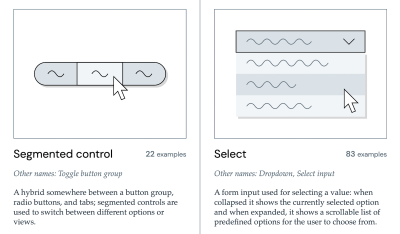
When teams struggle to select a canonical name for an interface element, analyzing broader industry usage often provides the necessary clarity. To prevent teams from spending countless hours auditing external libraries, web developer Iain Bean created The Component Gallery, an aggregated directory of interface components collected from real-world, production design systems.
The repository indexes real-world implementations across more than 50 common UI component types—ranging from basic accordions and modals to complex utility patterns like visually hidden wrappers. Crucially, The Component Gallery lists the alternative names that different design systems assign to similar UI patterns. This cross-reference allows teams to identify broad industry consensus versus brand-specific jargon, easing decisions on whether to adopt common conventions or specialized terms.
Complementing this programmatic index, resources like Name That UI act as visual dictionaries, allowing team members to visually match interface elements to their standard industry designations.
However, the naming challenge extends beyond internal system components to user-facing capabilities. As UX researcher Erin Gannon highlights in her practical guide on feature naming, new product features often suffer from low user adoption due to poor discoverability and misaligned terminology.
Gannon notes that feature adoption requires a clear progression: a feature must first be discovered, then understood, tried, learned, and ultimately integrated into a user’s daily workflow. To facilitate this journey, feature names must be directly anchored in user needs and problem spaces rather than internal engineering codenames. Effective naming clearly signals the core value proposition or "job-to-be-done." By gathering direct feedback and encouraging users to describe functional tasks in their own words, product teams can align feature labels directly with customer mental models, boosting discovery and long-term engagement.
Dedicated Frameworks for Tokens and Enterprise Naming
To further streamline token creation, designer Romina Kavcic built the Design Token Naming Guide, an interactive builder crafted to assist teams in structuring custom token schemes. The tool walks practitioners through the core concepts of token logic, allowing them to configure custom naming chains built from components, categories, interaction states, and functional roles.

To complement the builder, Kavcic created the Design Token Names Inventory, a standardized four-level spreadsheet designed to provide a comprehensive, bird’s-eye view of an organization’s token ecosystem. The spreadsheet structure allows teams to expand rows, insert custom thematic modes, and filter tokens seamlessly without breaking the underlying structural logic, providing an accessible entry point for teams auditing legacy variables.
When organizational naming requirements extend beyond individual interface elements to encompass top-level product offerings or entire services, broader brand naming methodologies become necessary. The open-source project Onym serves as a centralized directory for this higher-level branding process.
Onym curates tools, frameworks, and reference guides spanning early-stage brainstorming, etymological research, legal vetting, naming sprints, and case studies detailing naming cautionary tales. By aggregating exercises, literature, and specialized agency strategies, the repository equips product leaders with structured methodologies for crafting product titles that resonate in competitive markets.

Aligning Cross-Functional Dialects for Better Adoption
Ultimately, the technical and operational success of a naming convention depends on how well it is adopted across functional disciplines. A name only fulfills its purpose when it is clearly understood and consistently utilized by every member of a team.
In many software organizations, substantial efficiency is lost when different disciplines speak disparate dialects. Designers work within canvas layer terms, developers code against technical abstraction classes, product managers reference internal roadmap descriptors, and customers navigate an entirely separate product vocabulary. This divergence breeds friction, misunderstandings, and misaligned implementations during feature releases.
When a design system component or feature experiences low internal adoption or frequent implementation bugs, the root cause is frequently a confusing or rigid name rather than a flawed functional design. Identifying naming conflicts and placing them into a dedicated maintenance backlog allows teams to systematically address communication bottlenecks. Resolving these linguistic discrepancies strengthens cross-departmental collaboration, accelerates product delivery, and establishes a shared digital architecture capable of scaling smoothly alongside the organization.