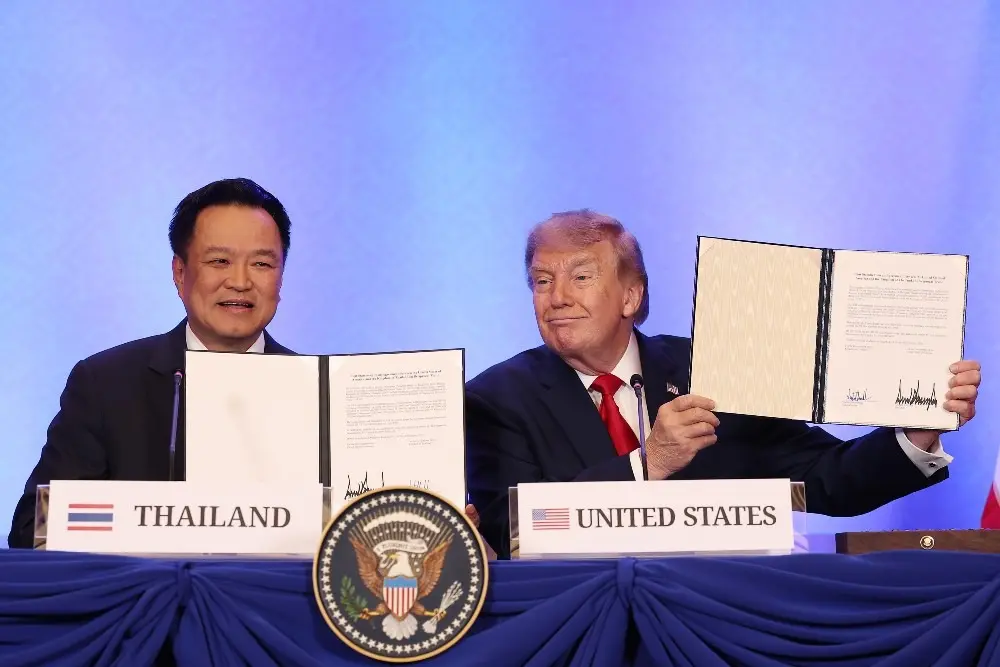
The agreement represents a major milestone in ongoing economic negotiations between Washington and Bangkok, coming on the heels of meetings between President Trump and Thailand’s Prime Minister Anutin Charnvirakul. The two leaders ceremoniously signed the reciprocal trade framework on Tuesday, setting the stage for what both administrations are hailing as a mutually beneficial economic partnership.
According to details provided by Thai Commerce Minister Suphajee Suthumpun on Wednesday, the arrangement involves strategic concessions from both sides. Bangkok’s primary gain from the pact is a reduction in its Section 301 forced labor tariff rate, which will be lowered from 12.5 percent to 10 percent. This adjustment brings Thailand’s tariff rate in line with the duties currently levied on neighboring regional competitors, including Cambodia, Malaysia, and Indonesia.
However, a notable discrepancy emerged regarding the implementation of the tariff reduction in official communications. While Thai officials prominently highlighted the lowering of the Section 301 duties as a core component of the bargain, the White House release did not explicitly announce a reduction in these specific tariffs. Instead, the American administration’s public statements emphasized that Thailand has made firm commitments to elevate its labor standards. Specifically, Bangkok has pledged to amend its domestic laws to bolster worker protections and aggressively address any labor violations in industry sectors deemed to carry a high risk for forced labor and child labor.
Under the terms of the broader economic framework, the United States will maintain a 19 percent reciprocal tariff on Thai goods—a baseline established during prior framework negotiations held in October 2025. Despite this baseline, the U.S. government has agreed to review last year’s comprehensive product list to identify specific items eligible for potential tariff reductions, which could eventually drop as low as zero percent for select goods.
The economic stakes of the agreement are substantial for both nations. The United States remains Thailand’s single largest export market. Last year alone, Thailand shipped $70.2 billion worth of goods to American shores. At the same time, the trade dynamic has long been a point of contention for U.S. policymakers seeking to balance the ledger. According to White House data, Thailand currently stands as America’s 11th largest goods trade deficit, generating a deficit valued at approximately $45 billion in 2024.
Through the newly forged agreement, Washington has successfully leveraged its market power to compel Bangkok to open selective portions of its domestic economy while carefully preserving appropriate import limits and safeguards for domestic industries. Beyond the sweeping reduction of duties on the vast majority of U.S. products, Thailand has committed to purchasing American-made vehicles alongside an additional $2.6 billion investment in U.S. agricultural products.
Furthermore, the diplomatic breakthrough addresses longstanding friction points regarding digital commerce and intellectual property. Both governments announced that they would finalize commitments to tear down barriers hindering digital trade, specifically targeting services taxes that have historically discriminated against U.S. technology and digital products. In tandem, Thailand agreed to tackle long-standing intellectual property concerns, promising more robust enforcement mechanisms against trademark counterfeiting and copyright piracy. The neighboring allies also committed to close bilateral cooperation on export controls, unfair trade policies, and joint efforts to curb duty evasion.
The White House indicated that technical delegations from both countries will continue intensive negotiations over the coming weeks to solidify the final mechanisms required to lock in these commercial benefits for U.S. businesses. Meanwhile, Thai representatives reported that their legal counsel is slated to spend approximately two months finalizing the complex legal text of the agreement before it is formally submitted to the Thai cabinet for final authorization.
Reflecting on the breakthrough during the signing ceremony, President Trump expressed optimism about the trajectory of bilateral commerce. This is an incredible victory for both countries, both the people of Thailand and the American people, and he stated that he looks forward to finalizing the details of the formal agreement in the coming weeks. Prime Minister Charnvirakul echoed these sentiments, emphasizing the deep historical ties uniting the two nations. Thailand attaches great importance to its long-standing relationship with the United States, Charnvirakul remarked, adding that their partnership extends far beyond traditional trade and investment metrics and remains firmly rooted in a shared commitment to regional cooperation across areas of mutual interest.
Following the conclusion of the ASEAN Summit events in Manila, President Trump traveled onward to Shenzhen, China, to participate in the Asia-Pacific Economic Cooperation (APEC) forum. His arrival in China set the stage for a highly anticipated diplomatic encounter on Thursday involving Chinese President Xi Jinping and Russian President Vladimir Putin, drawing intense global scrutiny regarding the future of international trade relations and geopolitical stability.
Substantial speculation had preceded the gathering, with international observers anticipating that the high-level talks might offer a prime window for President Trump and President Xi to advance discussions regarding the future trajectory of U.S.-China trade relations. These commercial negotiations had previously been extended for three months in September following an agreement to prolong the previous year’s Busan trade truce. However, tangible headway on core trade disputes appeared limited during the Shenzhen meetings. Official readouts characterized the conversation primarily as an in-depth exchange of views concerning the broader international situation, with both leaders reaffirming a shared commitment to maintaining strategic stability and international security.
Looking ahead to future diplomatic engagements, President Trump and President Xi are scheduled to meet face-to-face once more in December. That upcoming encounter will take place during the G20 Leaders’ Summit, slated for December 14–15 at the Trump National Doral golf club in Miami, where trade policy is once again expected to feature prominently on the agenda.
Beyond the immediate bilateral trade dialogues and discussions on great-power relations, the participating leaders in Shenzhen used the multilateral forum to address several broader global governance issues. In addition to committing to comprehensive efforts to reform the United Nations so that international institutions can respond more effectively to complex modern challenges, the leaders pledged to maintain an open and continuous dialogue focused on reducing nuclear risks and preventing the further proliferation of nuclear weapons. In a notable joint initiative aimed at reassuring global markets, they also announced coordinated plans to increase the production of refined petroleum products, a measure designed to foster stable energy flows for the benefit of all nations.