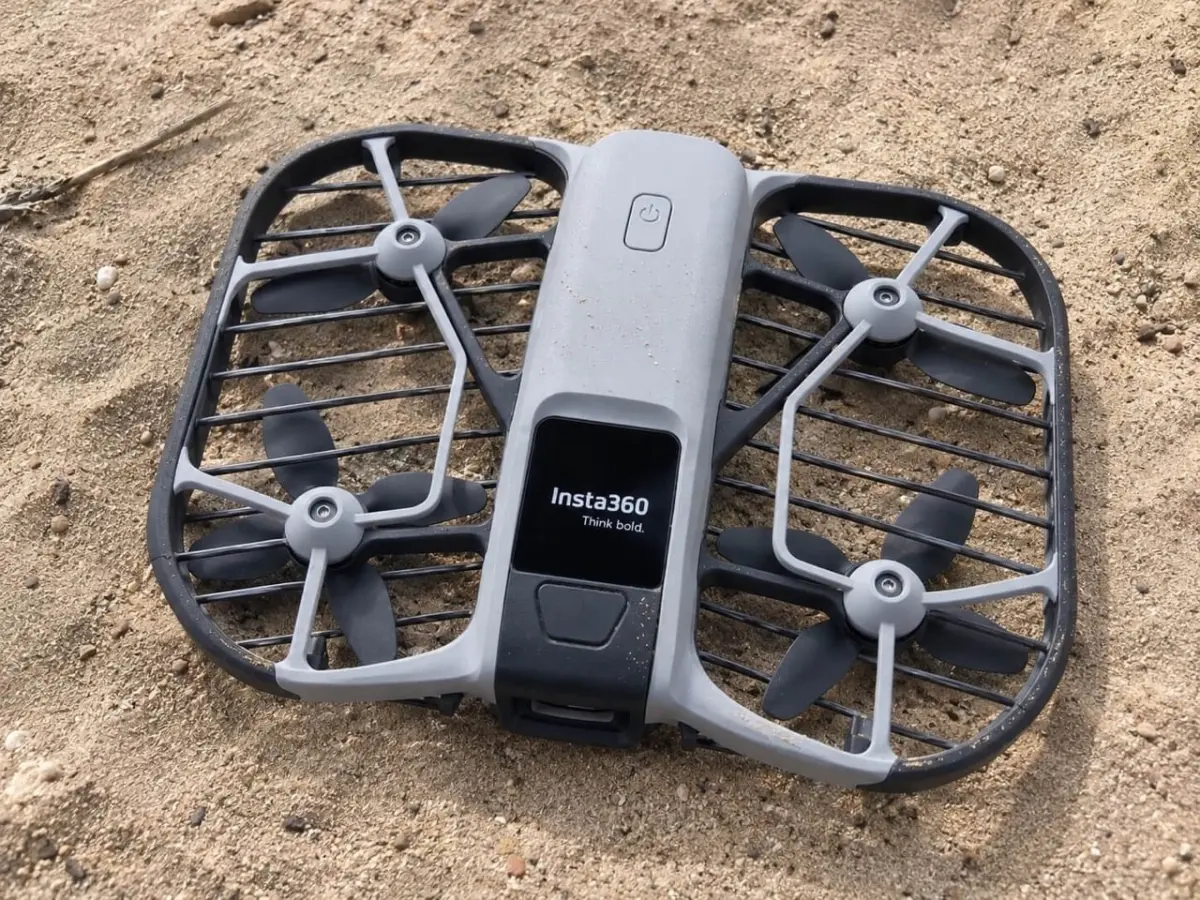
Back in 2022, Insta360’s primary entry into the aerial imaging market was a remarkably unconventional workaround: a camera you strapped onto somebody else’s drone. The Sphere model was designed to clamp around DJI’s Mavic Air 2, cleverly erasing the host aircraft entirely from the resulting 360-degree footage. It was an innovative engineering feat, though it essentially amounted to borrowing a fierce rival’s vehicle to win a race. Three years later, Insta360’s dedicated drone brand matured to the point of building its own aircraft with the launch of the 8K 360 Antigravity A1. Now, a newly surfaced leaked photograph suggests the company has its sights set directly on DJI’s most popular ultra-lightweight category. Shared widely by tech leak analyst Igor Bogdanov, the image reveals a compact Insta360 drone featuring fully guarded propellers and an integrated tiny screen, signaling an imminent challenge to the DJI Neo series.
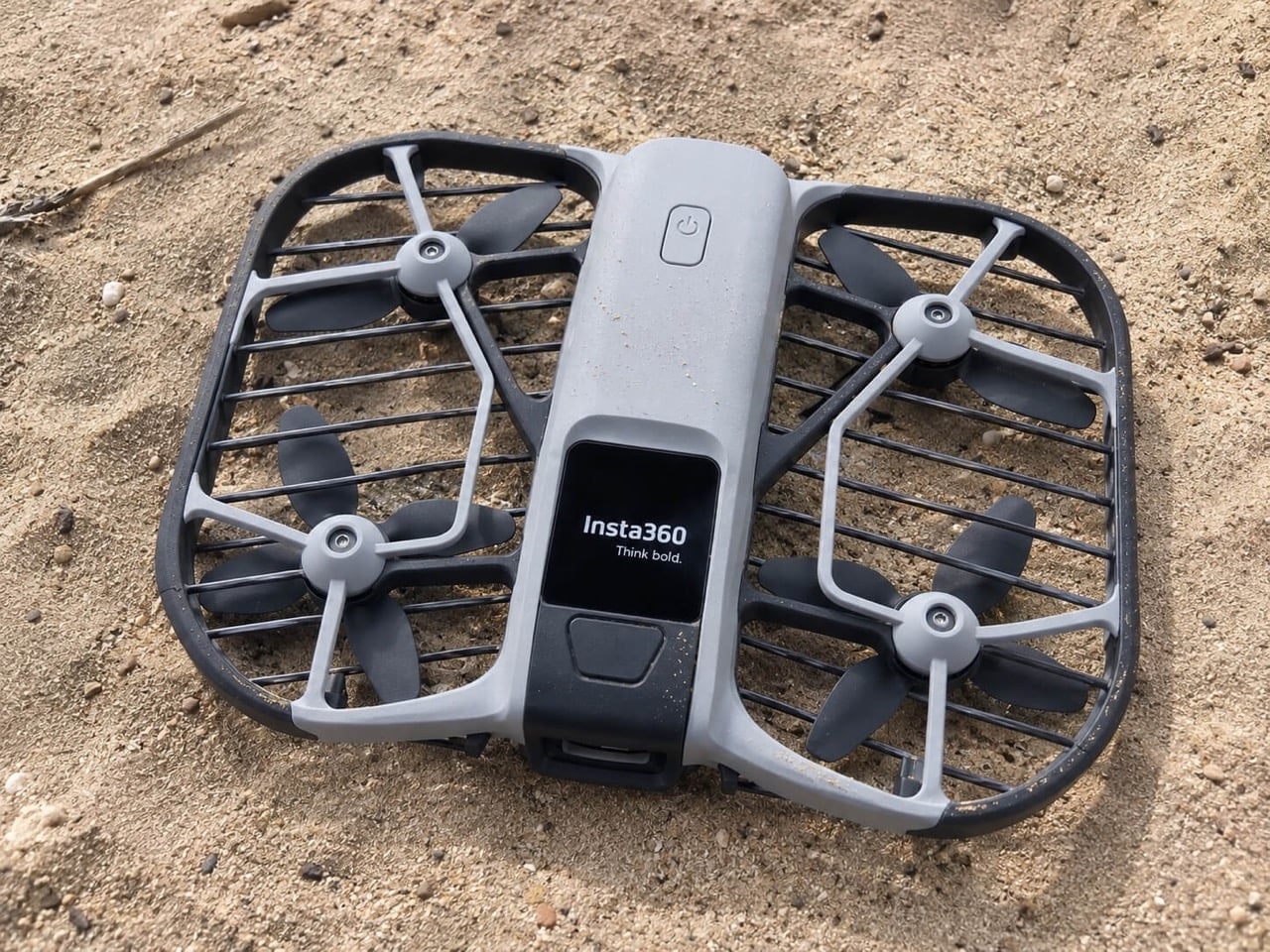
While the flagship A1 is a hefty $1,599 flying 360-degree camera system that relies on specialized aviation goggles, it represents far too much complexity for casual users who simply want a quick clip of themselves walking down a hiking trail. This newly leaked prototype appears to be a much simpler, highly streamlined proposition. It boasts a remarkably compact body, fully enclosed propeller guards, a tactile power button, and a small glowing panel that prominently displays the Insta360 branding. Subsequent leaks have pointed to the inclusion of a conventional forward-facing camera module, while a patent published by the company as early as February details ingenious folding arms that lock securely into the main chassis. Although Insta360 has yet to confirm the existence of this device officially, and with foreign-made drone models facing rigorous new regulatory hurdles in the United States, American consumers may ultimately find themselves facing a lengthy wait.
Guarded Props, Folding Arms, and a Tiny Screen On Board
The leaked prototype photograph showcases a compact chassis wrapped entirely in protective guards, finished in a sleek black on the exterior with lighter internal support structures designed to ensure fingers and propellers never collide. A Chinese patent published on February 3 by Insta360’s parent company, Arashi Vision, describes structural arms that nest neatly inside the main body and lock into place when deployed. If the production prototype ultimately utilizes this patented design, the aircraft could easily fold down to a genuine pocket-sized footprint. Additional photos shared by industry publication TheNewCamera highlight a central lens housed within a black rectangular module, flanked seamlessly by small, round optical sensors likely intended to manage subject tracking or obstacle avoidance.
It remains entirely unconfirmed whether a mechanical gimbal sits directly behind that primary lens, though industry observers suggest Insta360 may rely heavily on its proprietary FlowState electronic stabilization technology instead, leveraging a domain where the company has historically excelled. Every major manufacturer in the burgeoning pocket drone market has tackled the challenge of propeller protection differently. DJI’s Flip utilizes folding protective ducts, though it has faced criticism for feeling bulky when folded and producing more operational noise than models like the Mini 4 Pro. Meanwhile, HoverAir—which helped pioneer this specific genre—folds its X1 shut in a clamshell configuration, whereas the Neo 2 wraps full protective cages around a fixed body framework.
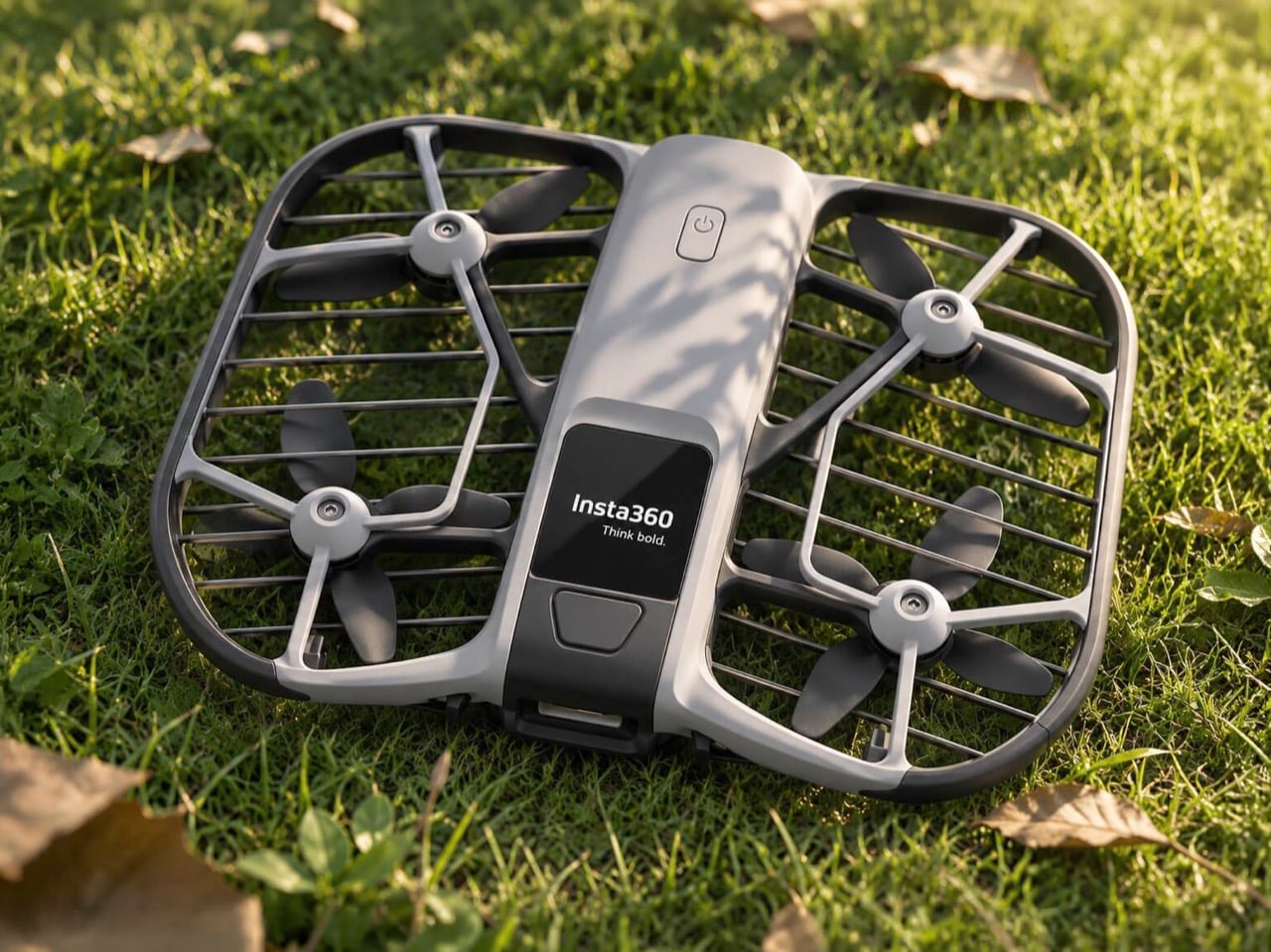
Insta360’s patented nested-folding approach could land somewhere squarely in the middle of these design philosophies, offering a device that remains small inside a backpack while remaining fully caged during flight. That intriguing little glowing panel represents another noteworthy design choice, particularly since the Neo 2 recently introduced an onboard screen and leaked details regarding the upcoming Neo 3 point toward a screen-equipped remote control. A broader industry trend is clearly shifting manual controls away from tethered smartphones, and Insta360 appears to be thinking along remarkably similar lines.
Insta360’s Next Drone Controller Might Live on Your Wrist
Advanced subject tracking, automated reframing, and convenient one-tap video editing suites are already deeply integrated into Insta360’s existing ecosystem of standalone action cameras, providing the exact foundational skill set required for a dedicated "follow-me" aerial drone. The Antigravity brand has already been actively experimenting with wearable control peripherals. In October, the division launched a specialized Watch Remote featuring a 1.72-inch display capable of showing a live video feed while combining the watch’s internal GPS data with the A1’s visual tracking algorithms, ensuring the aircraft maintains its lock even if the user temporarily ducks behind an obstacle like a tree.
Furthermore, a remarkably lightweight 0.3-ounce Ring Remote introduces intuitive gesture control capabilities. Pairing both wearable accessories together unlocks what the company refers to as a wireless selfie stick mode, where a simple rotation of the wrist commands the drone to pull closer or push further away. While Insta360 has not yet explicitly stated whether these specific wearables will achieve cross-compatibility with the newly leaked drone, the concept effectively serves as a literal continuation of the invisible selfie stick phenomenon.
The reigning DJI Neo 2 establishes a competitive baseline at just 5.3 ounces, or 151 grams, offering 4K video recording at up to 100 frames per second through a two-axis gimbal alongside an omnidirectional obstacle-detection array driven by vision sensors and forward-facing LiDAR. Its manufacturer-rated 19-minute flight time, however, can diminish noticeably in windy outdoor conditions or during aggressive tracking maneuvers, highlighting a vulnerable performance gap that a resourceful challenger could easily target. Meanwhile, the unannounced DJI Neo 3 rumors suggest an expanded 6.8-ounce body, a square 1/1.1-inch image sensor, and a high-capacity 1,800mAh battery delivering roughly 64 percent more energy than its predecessor. If Insta360 genuinely intends to enter this arena, delivering dependable real-world flight durations and rock-solid tracking performance will ultimately matter far more than theoretical figures on a spec sheet. A charming display panel will do little to salvage a pocket drone that is forced to land after barely twelve minutes in the air.
The US Door Is Open for Insta360 Cameras, and Trickier for Its Drones
DJI never officially distributed the Neo 2 within the United States market, leaving American enthusiasts of this ultra-portable drone category largely limited to the original Neo or competing offerings from HoverAir. Compounding these regional challenges, the Federal Communications Commission added several new foreign-manufactured drone categories to its Covered List on December 22, 2025, effectively blocking fresh equipment authorizations unless a specific hardware model successfully navigates a complex exemption or waiver process.
Insta360 as an overarching corporate entity is not currently named on that restrictive list, allowing its standalone 360-degree action cameras to continue arriving unobstructed on American retail shelves. Indeed, the high-end Antigravity A1 successfully secured its FCC approval just before the updated regulations took effect, allowing it to retail domestically for $1,599. However, a brand-new, Chinese-manufactured pocket drone will inevitably face the exact same regulatory hurdle as its industry peers, rendering American market availability the single largest unknown variable currently attached to the unannounced aircraft.
Industry analysts at TheNewCamera project an official commercial launch sometime during the first half of 2027, and no formal FCC filing for the mysterious drone has surfaced publicly thus far. This unfolding timeline could afford Insta360 the strategic advantage of observing how DJI positions its upcoming Neo 3 before making a definitive move. Competitors like HoverAir also remain firmly in the race with products such as the $699 X1 ProMax and the aquatic, floating Aqua model. For Insta360, the most viable path forward may involve sidestepping the traditional flight-control engineering race that DJI has spent two decades mastering, focusing instead on pure operational simplicity—crafting a pocket drone designed to be casually tossed into the air, left to autonomously follow its subject, and retrieved with cinematic footage that is ready to share. Four years after the company resorted to physically strapping its camera onto a rival’s aircraft, pulling off such a feat would represent a striking turning point for the brand.