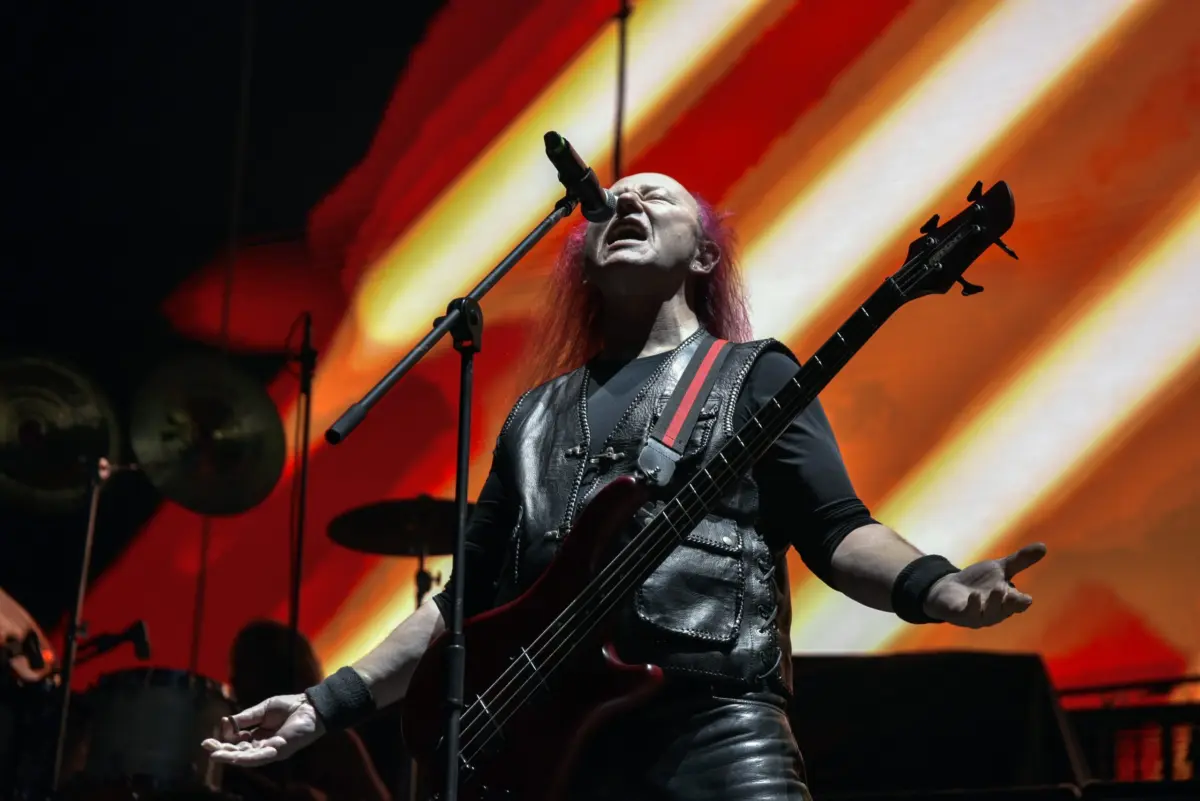
Conrad “Cronos” Lant, the commanding frontman, bassist, and creative force behind the legendary Northern British heavy metal band Venom, has died at the age of 63, according to statements released by the band on their official social media channels and corroborated by the Guardian. No specific cause of death was cited in the announcements, leaving fans and the global heavy metal community to mourn the sudden loss of a true pioneer who helped shape the trajectory of extreme music.
“For more than four decades, Conrad’s voice, bass and vision were at the heart of Venom,” read a solemn statement issued by the remaining members of the band. “He created something that changed heavy music for ever. Venom never followed the rules. They forged their own path. And Conrad was there at the centre of it all — uncompromising, fearless and unmistakable.”
When Venom unleashed its debut full-length album upon the world in 1981, the group’s outrageous imagery and theatrical presentation were so extreme that many mainstream critics and casual listeners initially struggled to take them seriously. Adorning themselves with skulls, bondage gear, swords, and an eclectic mix of pseudo-witchcraft and overt Satanism, the band pushed the boundaries of visual and lyrical shock value far beyond anything that had come before. Yet, beneath the sensationalist exterior lay a raw, aggressive musical blueprint that would exert a vast and far-reaching influence on the development of heavy metal, particularly the explosive thrash metal movement of the 1980s.
Venom’s sonic footprint can be heard directly in the formative sounds of genre giants such as Metallica, Slayer, and Anthrax. Their dark aesthetic and unrelenting speed even resonated far beyond the traditional metal underground, capturing the attention of figures like Nirvana drummer and Foo Fighters frontman Dave Grohl, who later collaborated directly with Lant on the critically acclaimed Probot heavy metal side-project album in 2004. Furthermore, Venom’s seminal 1982 sophomore album, “Black Metal,” proved so foundational that it single-handedly provided the namesake for an entire extreme subgenre. This subgenre would subsequently be taken to even greater, darker extremes by subsequent generations of Scandinavian black metal bands, cementing Venom’s status as architects of modern extreme music.
Born in London into a musically inclined family, Lant moved north with his relatives to settle in Newcastle during his childhood. Immersed in the burgeoning rock and metal sounds of his youth, Lant gravitated toward the guitar and performance. At the tender age of 16, he joined a local underground group called Guillotine, an ensemble that would eventually undergo several lineup shifts and artistic evolutions before morphing into the legendary lineup of Venom.
In the early days of the band, Lant initially contributed as a guitarist. However, as various members departed and the group sought a more cohesive musical identity, he transitioned to the bass guitar—an instrument he would master and play for the remainder of his professional career—while also taking on the daunting role of lead singer. With their definitive moniker and signature dark image firmly established, the core trio comprising Lant, guitarist Jeff Dunn (who performed under the moniker Mantas), and drummer Tony Bray (known as Abaddon) entered the studio to record their historic debut.
Released in 1981, that first album, titled “Welcome to Hell,” introduced listeners to a chaotic and thunderous new brand of metal. Among its standout tracks was the single “In League With Satan,” a song infamous for featuring a spoken-word intro delivered backward, setting a sinister tone that would become a hallmark of the band’s early output.
The group maintained this relentless momentum across a series of five distinct studio albums throughout the course of the 1980s, continuously pushing sonic boundaries and shocking conservative sensibilities. However, the release that unexpectedly propelled them into the wider mainstream consciousness was their fourth studio effort, titled “Possessed.” Released in April of 1985, the album arrived at a culturally explosive moment in popular music history, coinciding precisely with the sudden, high-profile rise of the Parents Music Resource Center.
The PMRC, a lobbying organization spearheaded by prominent Washington figures including Tipper Gore and Susan Baker, had launched a fierce moral campaign against what they deemed objectionable content in popular music. The group famously testified before the United States Congress regarding overtly sexual, violent, and Satanic lyrics and imagery across various musical genres. Amid this intense national debate, Venom’s “Possessed” found itself unexpectedly thrust into the spotlight, landing at No. 14 on the organization’s notorious “Filthy 15” list of socially concerning songs.
Sharing space on the controversial chart alongside mainstream pop and rock staples by artists such as Prince, Madonna, Sheena Easton, Cyndi Lauper, and heavy metal peers Judas Priest, the inclusion of Venom thrust the underground band into the living rooms of countless thousands of people who had otherwise never heard of the Newcastle trio. While the PMRC hearings ultimately achieved their primary goal of introducing mandatory parental advisory warning stickers to certain compact discs and vinyl releases, the massive wave of controversy generated priceless publicity for extreme metal acts like Venom, further solidifying their rebellious mythology.
Following a tumultuous decade of defining the outer limits of heavy music, Venom went on hiatus in 1988 as internal pressures and shifting musical landscapes took their toll. During the 1990s, Lant embarked on a dedicated solo career, continuing to record and perform under his well-known moniker Cronos and exploring various creative avenues outside the immediate confines of his former band.
Despite the long break and numerous lineup iterations over the decades, the pull of Venom proved too strong to resist permanently. Lant eventually reformed the band, spearheading a successful return that resulted in another seven full-length LPs added to their extensive catalog. The most recent of these studio offerings, “Storm the Gates,” was released in 2018 to praise from dedicated fans who had followed the band’s tumultuous journey from the underground clubs of Northern England to international stages. Refusing to slow down with age, Lant and the latest incarnation of Venom continued to maintain an active touring schedule, performing live concerts for devoted metalheads right up until this past summer.