“Have a scrumdiddlyumptious day!” is how Rusty Goffe, who famously played an Oompa-Loompa in the 1971 cinematic adaptation of “Willy Wonka & the Chocolate Factory” opposite the legendary Gene Wilder, cheerfully signs off a recent Zoom interview. With such classic Wonka-isms rolling off his tongue with effortless nostalgia, it comes as little surprise that Netflix sought him out for their latest franchise expansion. Five years after acquiring the expansive literary estate of author Roald Dahl, the streaming giant turned its attention to creating a game show inspired by the beloved universe, immediately placing Goffe at the top of their casting wish list.
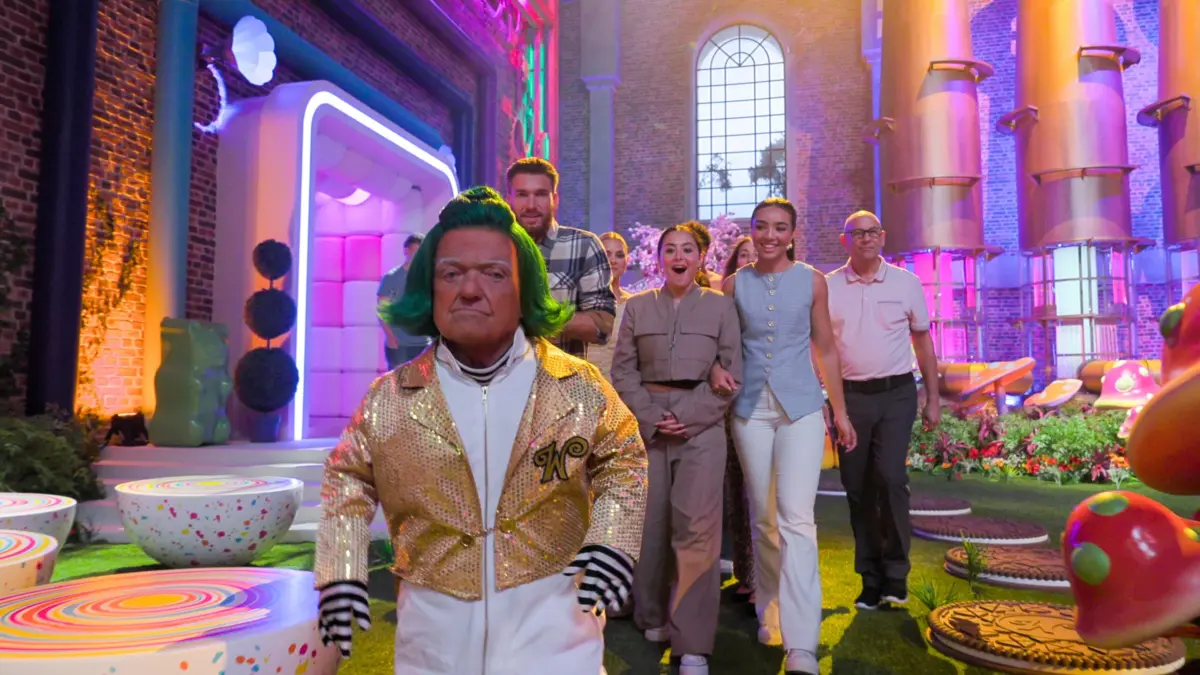
In “Wonka’s Golden Ticket,” which officially launched on September 23, Goffe steps back into the chocolate-coated world alongside his son, Ben Goffe. The younger Goffe is also an established professional actor whose credits include roles in Disney’s “Artemis Fowl,” among other titles. They are joined on screen by an entirely new generation of Oompa-Loompas. Unlike the uniform appearance of the iconic workers in the 1971 film, these new Oompa-Loompas “come in all shapes and sizes now,” as the competing contestants are explicitly informed during the program. Also returning to the fold is Gene Wilder, albeit strictly in vocal form. In a move that has sparked widespread public discussion and debate, Wilder’s voice has been digitally recreated using artificial intelligence with the full blessing and permission of his widow, following the beloved actor’s passing in 2016.
Over the course of a rigorous nine-episode arc, viewers watch a diverse group of 12 contestants endure a series of increasingly wacky and unpredictable challenges. Their ultimate motivation is the chance to secure a grand prize described as a “lifetime’s supply of money,” calculated as an impressive $3 million payout distributed as a six-figure annual salary over a 30-year period. The action plays out entirely on elaborate, nostalgia-inducing Wonka-themed set pieces. These meticulously crafted environments include the famous Great Glass Elevator and, of course, the vibrant edible candy room, complete with its signature flowing chocolate waterfall.
Ahead of the premiere of “Wonka’s Golden Ticket,” the 77-year-old Goffe spoke with Variety about how he was approached for the project, what it felt like to step back onto a studio-built confectionery wonderland decades later, and his deeply emotional reaction to hearing Gene Wilder’s voice brought back to life through the modern application of artificial intelligence.
How the Return Came About
Reflecting on how the unexpected opportunity materialized, Goffe explained that the journey began with a standard professional inquiry from his representation.
“Well, I just had a phone call from my agent in New York saying they want you in Netflix, talking about ‘Wonka,’” Goffe recalled. His initial reaction was one of gentle disbelief, given the vast expanse of time that had passed since his days working alongside Gene Wilder. “Being in ‘Wonka’? That was a long time ago. And they said, ‘Yeah, they still want you.’ So that’s how I got into it, and I really loved the new one.”
Once he officially signed on and realized the production was taking the shape of a high-concept game show, Goffe admitted he initially wondered how the unconventional format would function in practice. However, adjusting to the unique rhythm of the production did not take long. He noted that the contestants were kept isolated in their own competitive bubble during filming, requiring the actors portraying the Oompa-Loompas to maintain strict professional boundaries.
“When they came on, you just nodded to them, because they were trying to get answers from your face, how they’re doing. So we’re not giving anything away,” Goffe explained.
Amid the excitement of the production, the veteran actor expressed a particular sense of personal pride and joy regarding his scene partner for the series. Having his 33-year-old son, Ben, cast alongside him as a fellow Oompa-Loompa added an entirely new dimension to the experience.
“I was really pleased — thrilled — this time to have my son with me, Ben. [He’s] 33 years of age, an Oompa-Loompa!” Goffe said.
Discussing what it meant for his son to inherit the mantle, Goffe noted that Ben grew up immersed in the legacy of the original film through his father. When Netflix presented the opportunity, the younger actor did not hesitate. “He jumped at the chance. ‘Yeah, yeah, I’m going to be an Oompa-Loompa,’ you know, because he’s an actor. He’s done Shakespeare, many, many movies.”
When asked if he offered any veteran wisdom or professional tips to his son before filming commenced, Goffe’s response was characteristically straightforward. “No. None whatsoever. I was an Oompa-Loompa. You’re the new one. Learn — on the job!”
Stepping Back Into the Chocolate Room
Revisiting the physical environment of the franchise proved to be a surreal, highly nostalgic experience for the veteran performer, even as modern television production techniques transformed the soundstages.
“It was bizarre, going into the studio, into the chocolate room, in fact. And it was all modern,” Goffe said. Despite the technological updates, certain signature elements remained sacred. “They still had a river. They still had a waterfall. It was absolutely fantastic, it was.”
The return to the confectionery river also prompted memories of the notoriously difficult and famously maligned conditions on the set of the 1971 original. Goffe compared the modern soundstage conditions to the famously foul-smelling reality of the original production, where real dairy products were used under intense studio lighting.
“The river — last time, it was just dirty water, it smelled because we were pouring real cream and real sugar into it, and with the hot lights, it was melting. It was melting, and poor Michael Bollner, who played Augustus Gloop [in the 1971 film], he had to fall in it when he was a kid.”
Goffe humorously referenced how his former co-star still recounts the experience in interviews, adopting a playful German accent to mimic Bollner’s recollection: “What was it like, Michael? What was the river like? ‘It vas stinky vater!’ But it was lovely. But unfortunately, he wasn’t there, it was just myself and my young son, who wasn’t there in the original.”
When asked if he managed to retain any physical artifacts or souvenirs from the original 1971 production that might serve as a family heirloom, Goffe kept his cards close to his chest with a knowing smile. “Mmmmmm, yes. I might have a golden ticket, a real one or two. My children’s inheritance.”
Despite the high-stakes financial rewards dangled in front of the participants on the new Netflix series, Goffe firmly stated that he had no personal desire to swap sides and experience the competition as a participant. “No. It was great being the Oompa-Loompa just watching them, because I knew what they were going to win, lose, what’s going to happen if they lost [a challenge]. Which is not good on some occasions.”
A Lasting Legacy and the AI Debate
Reflecting on the extraordinary longevity of the 1971 film, Goffe admitted that he never could have anticipated the cultural footprint the project would leave behind across multiple generations. Decades after the film’s initial release, the project continues to define a significant portion of his public life through fan conventions and public appearances.
“I am still absolutely amazed how big it still is,” Goffe shared. He frequently encounters dedicated fans, primarily across the United States, who eagerly share their personal connections to the musical classic. “They say, ‘Yeah, we loved it. We came out the theater, when we saw the new ones. We came out the theater, but we were still singing “Oompa-Loompa doompa dee do” — your movie.’ They loved it. But I was surprised how big it still is and still is! And I thank the people for keeping it alive. If it wasn’t for the fans, it’d be gone.”
A notable evolution in the Netflix series is the deliberate push toward a more diverse ensemble of performers embodying the famous factory workers, breaking away from the strict casting parameters of the original motion picture.
“Oompa-Loompas, they weren’t just short,” Goffe observed. “We had one bodybuilder, big guy, a tall guy, three ladies, a small man, and Ben. It was wonderful to have this diverse [cast of] people.”
One of the most heavily discussed elements of Netflix’s “Wonka’s Golden Ticket” is the controversial decision to recreate Gene Wilder’s iconic voice using artificial intelligence. For Goffe, who shared a profound professional and personal bond with the late actor, hearing Wilder’s cadence integrated into the new production evoked deeply personal emotions.
“Well, ‘weird’ is not the word. It was lovely hearing his voice again, because I loved that man,” Goffe said. He remembered Wilder as a gentle, exceptionally kind, and deeply humorous presence on set. Hearing his voice incorporated into the show left Goffe profoundly grateful to the platform. “I was so pleased that Netflix had done it. He is Mr. Wonka. He is Willy Wonka. Gene Wilder is Willy Wonka.”
When asked if hearing the synthetic vocal recreation felt uncanny or if it evoked the immediate sensation of Wilder standing physically in the room, Goffe confirmed the strong emotional impact it carried.
“It’s just him standing there. I did shed a tear when I first heard it, because I loved the man so much. But then I thought he wouldn’t want me to do that. He’d want me to be an Oompa-Loompa, get out there, do the job. Yeah, that that was Gene. He was a lovely, lovely man.”
Asked to pinpoint his absolute favorite moment from the production of the new streaming series, Goffe offered a lighthearted response that underscored his decades-long career in the entertainment industry.
“Yes, the breaks!” he laughed. Summing up his journey from the soundstages of the 1970s to the modern streaming era, Goffe noted the poetic symmetry of his professional trajectory. “It was one of the best moments of my life to do ‘Wonka’ again. I started my career on ‘Willy Wonka & the Chocolate Factory’ and now I am pleased to announce to Variety that I’ve ended my career on ‘Willy Wonka’s The Golden Ticket.’”