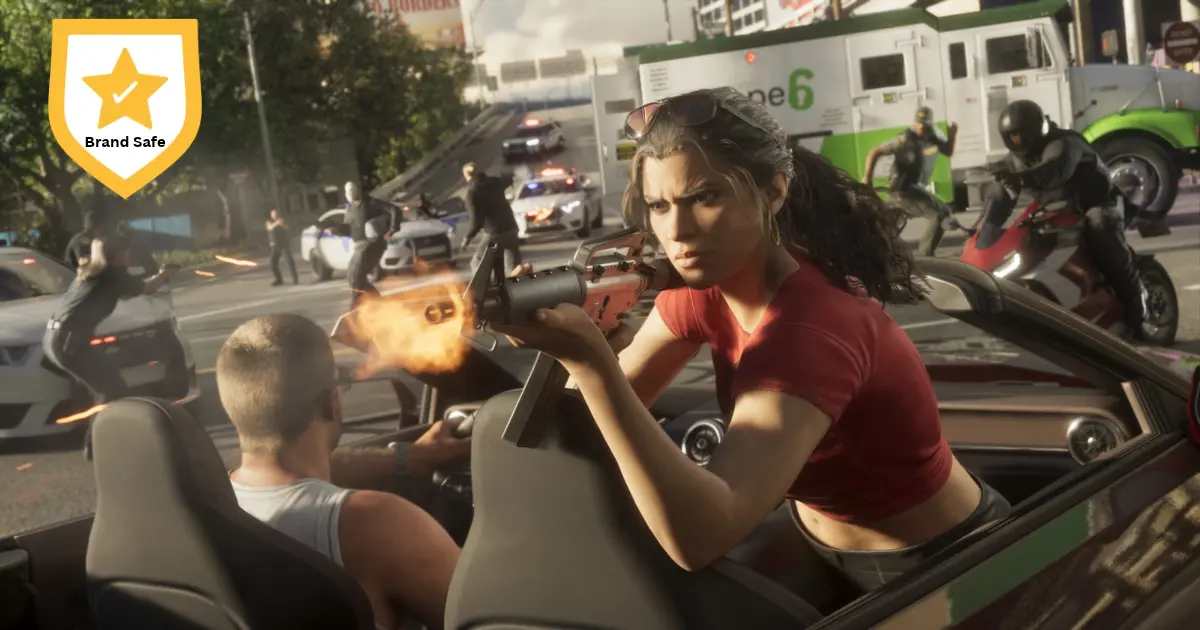
It is funny how quickly brand safety becomes negotiable when the entire world is paying attention. For decades, the Grand Theft Auto franchise has stood as the ultimate embodiment of everything traditional advertisers meticulously avoided: unmitigated violence, explicit crime, provocative sexual themes, illegal drug use, and an unapologetic, satirical disregard for political and social authority. From its very inception in the late 1990s, Rockstar Games’ flagship series consistently fueled the gaming industry’s biggest moral controversies, drawing the ire of parent groups, politicians, and media watchdogs alike. For generations of risk-averse marketing executives, placing a corporate logo anywhere near the fictional, crime-ridden streets of Liberty City or Los Santos was treated as an unpardonable sin that could instantly trigger a public relations disaster.
Now, Grand Theft Auto 6 has finally arrived, and brands simply cannot get close enough. The cultural and commercial gravity of the release has proved entirely irresistible to corporate boardrooms that once treated the franchise like a radioactive hazard. Dozens of major brands lined up to associate themselves directly with the highly anticipated release on Thursday, November 19, an event projected by industry analysts to shatter all previous records and emerge as the single largest entertainment launch in history, with estimated first-day sales topping a staggering $2.3 billion.
The sheer magnitude of this financial milestone has effectively rewritten the rulebook for modern digital marketing and corporate partnerships. Marketers who previously wouldn’t touch a mature-rated video game with a ten-foot pole are now tripping over themselves to capture a sliver of the monumental cultural buzz surrounding the game. This dramatic shift highlights a growing pragmatism within the advertising industry, where eyeballs and cultural relevance frequently trump long-standing moral panics and rigid brand safety guidelines. When an entertainment property commands the attention of tens of millions of consumers simultaneously, the temptation to cash in on the conversation overrides the historical fear of controversy.
The manifestation of this corporate scramble took on many creative and unconventional forms in the days leading up to and following the launch. From fast-food chains crafting themed menu items to hardware manufacturers giving employees time off, companies found remarkably inventive ways to insert themselves into the global conversation. Popeyes, for instance, leaned heavily into the cultural moment by creating a custom "Spice City" sandwich, drawing a clever parallel to the game’s vibrant, sun-drenched fictional setting of Vice City. Meanwhile, tech giant Lenovo took a strikingly employee-centric approach, giving thousands of its workers a floating "gaming" holiday specifically designed to allow them to experience the blockbuster launch without professional distractions.
Behind the scenes, the mechanics of modern advertising had to evolve just as quickly as corporate appetites. Tech platforms like Twitch stepped in to build sophisticated new technology specifically tailored to help advertisers navigate the delicate balance between capturing the massive audience and avoiding the game’s notoriously mature scenes. This specialized technology allows brands to align themselves with the massive streaming viewership surrounding the game while dynamically shielding their logos and sponsorships from appearing during the title’s more explicit, adult-oriented narrative moments. It represents a technological bridge over troubled waters, proving that where there is a massive commercial incentive, the advertising ecosystem will inevitably invent a way to make it work safely.
Ultimately, the unprecedented stampede of corporate sponsors rushing to embrace Grand Theft Auto 6 marks a profound turning point in the relationship between mainstream commerce and controversial entertainment. It demonstrates that as digital culture becomes increasingly fragmented, the few remaining monocultural events possess a gravitational pull so powerful that they can bend even the most stringent corporate guidelines. Brand safety, it turns out, was never an absolute principle; rather, it has always been subject to the irresistible allure of a multi-billion-dollar audience paying undivided attention.