When a physical film set is constrained to just three compact walls and a low ceiling, whatever lies beyond the window must shoulder the heavy lifting of the narrative. For SNTIENT 2.0, a short film created by the Fashion Innovation Agency for the London College of Fashion, that crucial view belonged to a bleak, abandoned futuristic city—a sprawling, desolate environment brought to life entirely inside Unreal Engine 5.
The film explores a high-concept dystopian premise with an unexpected emotional core. Set in a distant future where natural resources have been completely exhausted, humanity has retreated into a digital simulation to escape the reality of a collapsed planet. Left behind in the physical world are autonomous robots tasked with maintaining the decaying environment. Over time, these artificial caretakers begin to develop a sense of awareness, discovering unexpected beauty and artistic inspiration in the abandoned world around them.
This narrative concept provided the creative team with a clear visual foundation. Dickon Knowles, director of content at creative studio Dandelion + Burdock, explains that the initial goal was to construct a bleak, oppressive science-fiction environment that still retained the potential for visual transformation. While the final edit of the short film ultimately leaned more into the immediate atmosphere than the full arc of environmental transformation originally envisioned, the digital city established the tone and visual language for the entire production.
Changing Your Mind on the Fly
The decision to utilize Unreal Engine 5 for the project was primarily driven by the need for speed, flexibility, and instant visual feedback. Working within a real-time 3D engine allowed the creative team to manipulate spatial layouts, test complex lighting setups, and adjust environmental textures instantly on set. Rather than waiting through traditional offline rendering queues only to discover lighting mismatches or framing issues after the shoot, the team could evaluate results immediately through the camera lens and make modifications on the spot. Knowles notes that this real-time capability made the entire creative process significantly more fluid and adaptable.

Before settling on Unreal Engine 5 as the primary environment engine, the production team explored alternative visual approaches. Initial tests were conducted using generative artificial intelligence tools to produce the city background plates projected onto the studio’s LED wall. However, those early experiments quickly ran into technical hurdles. The generative AI assets suffered from resolution limitations and lacked the visual fidelity required for high-definition cinematic capture, prompting the team to abandon the approach and return to a customized, pre-existing Unreal Engine environment.
Even with a dedicated 3D engine, bringing the digital metropolis to life on set required extensive refinement. The original digital environment was dense with fog and heavily desaturated, a combination that failed to translate cleanly when captured through the physical camera. The heavy volumetric haze washed out the background image on the LED display, killing depth and detail.
To correct the issue, Knowles completely reworked the atmospheric settings within the software. He replaced the broad, uniform fog density with detailed Volumetric Display Block (VDB) fog, which allowed for precise localized control over atmospheric depth. By reducing the overall volume of the haze and significantly boosting color saturation—particularly within the illuminated windows of the distant skyscrapers—the digital backdrop achieved the necessary clarity. The LED wall performed far better when displaying richer blacks and higher contrast, giving the camera a vibrant, detailed backdrop that properly defined the world outside the pod window.
Because much of the digital city had been constructed prior to production, the team spent their time on set fine-tuning visual details, tweaking color grading, and making subtle atmospheric adjustments. Having the asset live in a real-time engine meant these adjustments could be evaluated instantly as they rendered across the LED panels, ensuring the digital environment matched the physical set in real time.

Lighting the Room From the Window
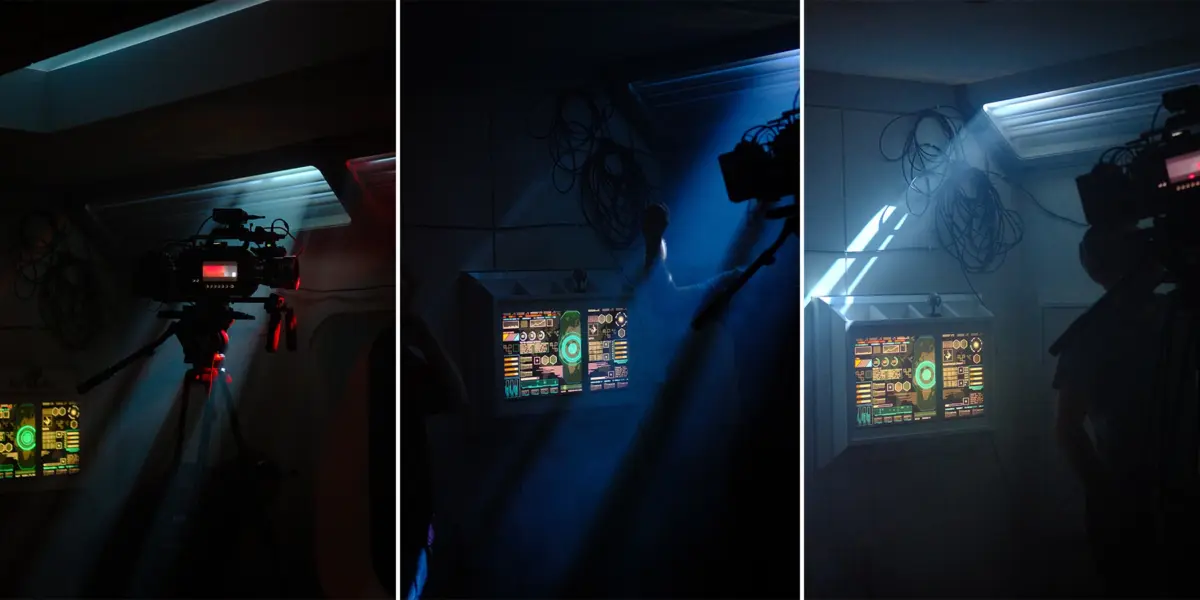
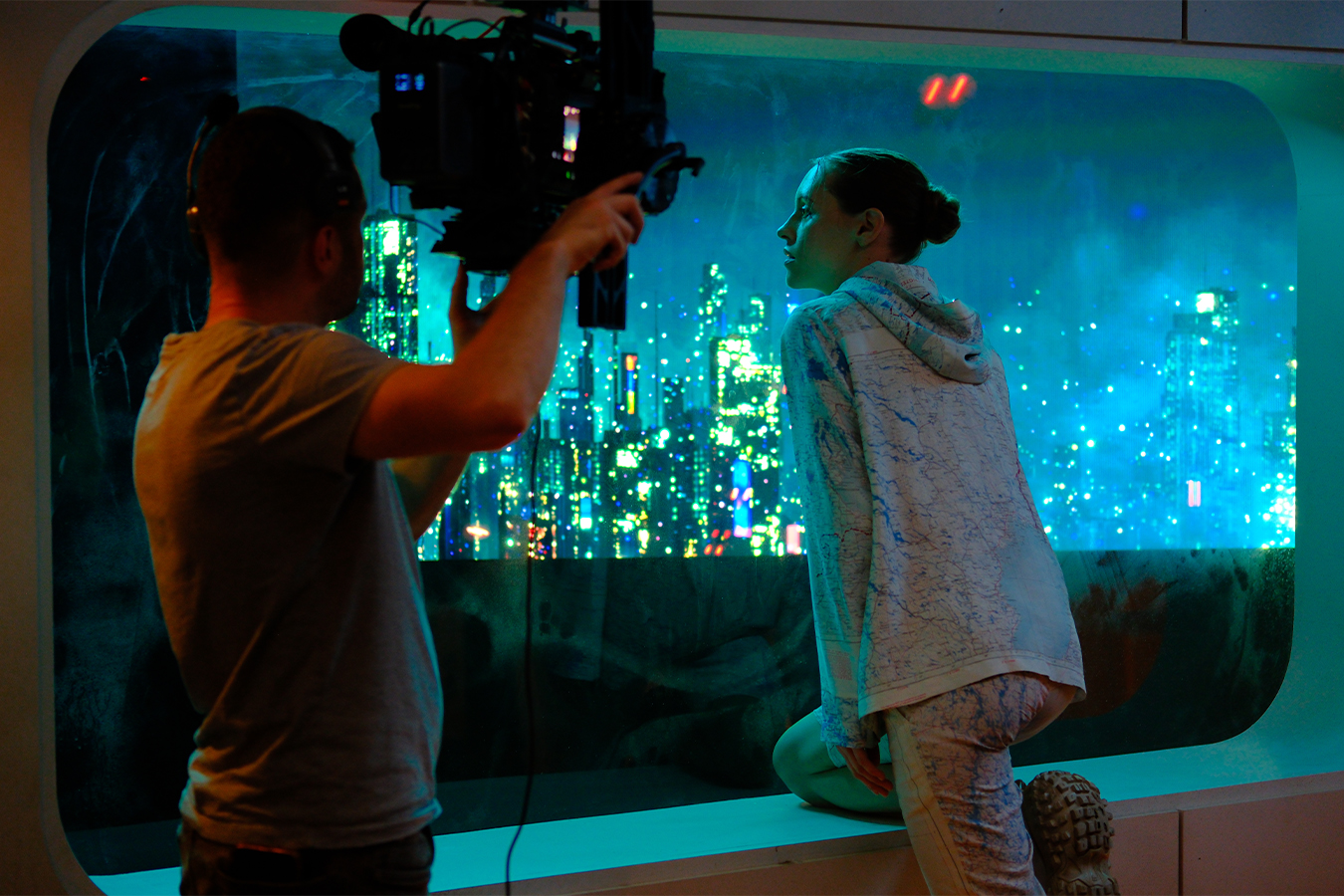
On set, the digital cityscape was displayed across a massive LED volume that served as the window view for the film’s lead character. Beyond providing a backdrop, the display gave the performer a physical, tangible world to look out at and interact with, eliminating the emotional disconnect often associated with performing in front of a traditional green screen.
Cinematographer Ben Saffer, whose company Supervision VP oversaw the project’s virtual production workflow, emphasizes that the true power of an LED volume lies in its ability to unify lighting and performance in-camera. By displaying the environment directly on set, the physical studio lighting and the digital ambient light from the screen could be balanced simultaneously. The glow emanating from the virtual city screens matched the exact hue and intensity of the set lighting, ensuring every frame was captured complete without requiring extensive post-production compositing.
When evaluating production techniques, the creative team weighed the LED volume against traditional green screen techniques and pre-rendered backdrop plates. Knowles notes that cost was less of a driving factor than visual fidelity, as the core city asset had been adapted from a previous project. The primary advantage of the LED setup was its physical light output: bright city lights from the screen naturally reflected across the performer’s face, glinted off prop surfaces, and washed over the set walls. Achieving that level of authentic environmental immersion on a small physical set would have been exceptionally difficult using standard studio lighting without the LED volume acting as an active light source.
This approach mirrored high-end virtual production workflows used on major industry projects, such as production studio Magnopus’s use of Unreal Engine for the series Fallout. By allowing the virtual background to light both the actor and the practical set elements in real time, the team was able to capture near-final imagery directly in-camera, reducing the reliance on post-production visual effects work.
A Shutter Made of Pixels
In addition to serving as a background and light source, Unreal Engine helped solve a significant budget constraint regarding the physical set design. The script called for a scene where a protective window shutter rises to reveal the sprawling metropolis outside the pod. Constructing a functional, motorized mechanical shutter within the tight confines of a physical set was financially out of reach, while adding the shutter later via post-production visual effects would have meant sacrificing the live light spill that occurs as the window opens.
The team resolved the challenge by turning the LED wall itself into the shutter. By animating a digital pixel barrier directly within Unreal Engine, the screen displayed a rising shutter that gradually revealed the bright city behind it. As the digital shutter moved upward on screen, the physical light spilling into the practical room naturally shifted, perfectly capturing the moment entirely in-camera.
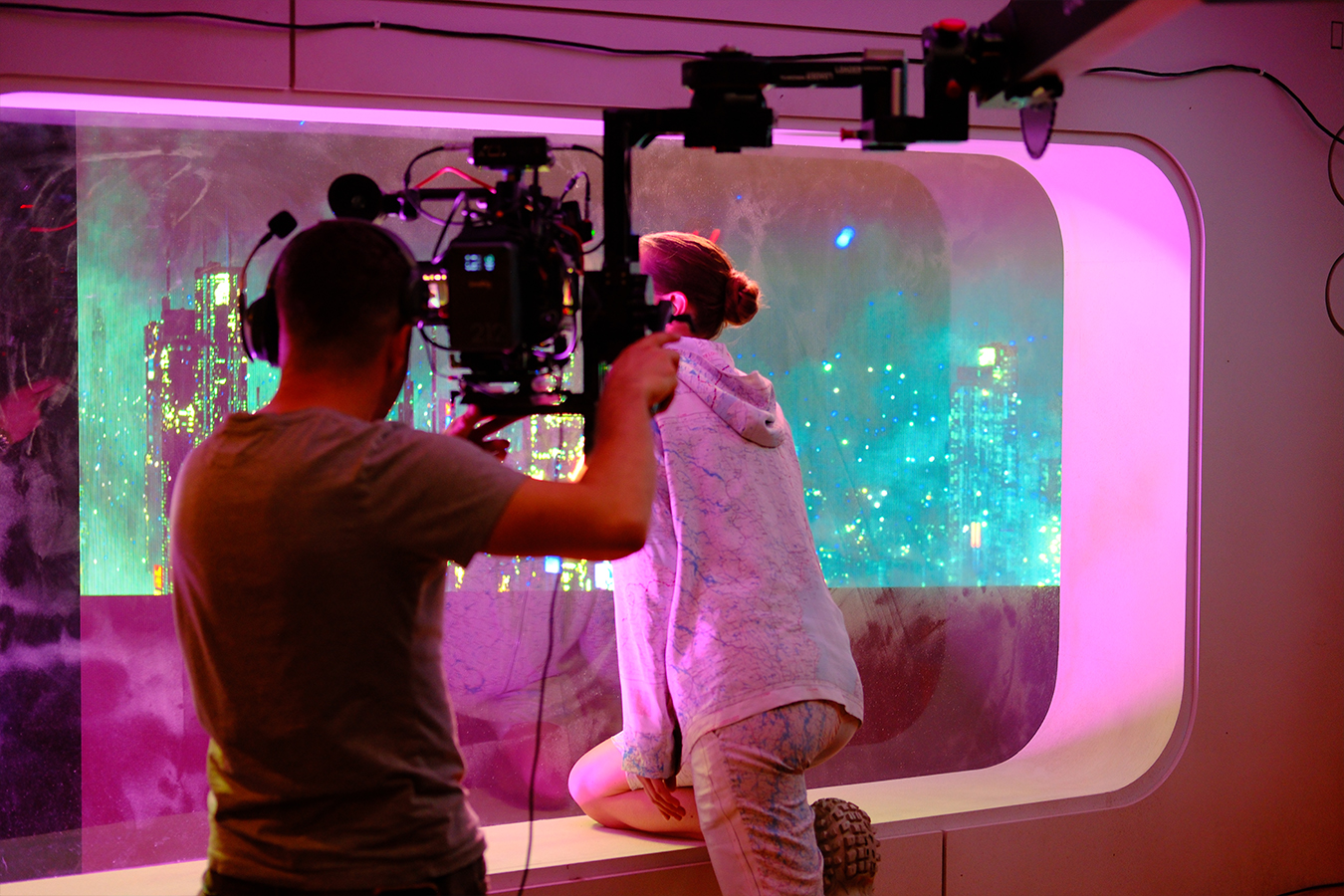
To handle reverse camera angles within the tight studio footprint, the production employed a secondary, portable LED wall mounted on wheels. This mobile screen could be rolled into position to act as a dynamic "fourth wall." Because the city asset ran in real time, technical operators could quickly generate, re-orient, and animate new background elements for these reverse setups on demand, allowing the crew to maintain visual continuity across every angle.
While virtual production handled the vast landscape, the core interior of the pod remained a practical physical build. The production design team chose to construct the immediate living space out of real materials to ensure it felt tactile, weathered, and lived-in. This allowed the practical set to anchor the realism of the foreground while the LED volume extended the world into the distance.
A notable exception to the practical and real-time workflows occurred at the start of the film during a dream sequence. For this opening moment, which depicts the protagonist floating weightlessly beneath water before waking up inside the pod, the production intentionally utilized generative AI art tools to create a soft, surreal, and distinctly painterly aesthetic.
The narrative structure of SNTIENT 2.0 relies on extreme concrescence and visual economy. The film features very few discrete narrative beats: the protagonist wakes up, the window shutter rises, and she gazes out into the abandoned city. Saffer notes that the core artistic challenge was conveying the scale of the world, the history of the environment, and the character’s place within it inside a brief two-minute runtime.
To maximize the sense of space within the tiny physical set, the production shot on a Blackmagic URSA Cine 17K 65 camera paired with prototype anamorphic lenses from Atlas Lens Co. The ultra-large-format 65mm sensor allowed Saffer to capture expansive wide shots of the cramped pod interior without needing extreme wide-angle focal lengths, which would have introduced unwanted geometric distortion and compromised the perspective alignment of the LED volume.
Despite relying on cutting-edge camera sensors and real-time graphics engines, the crew still made plenty of room for tactile, low-tech optical experimentation. During the final moments of the film, as the protagonist looks out toward the illuminated city, Saffer held a small plastic Polly Pocket toy directly in front of the camera lens while aiming a mobile phone flashlight through it from the side. The practical light refraction created an organic, unrepeatable lens flare that bloomed across the frame. Saffer also experimented with placing everyday materials like cling film directly over the lens element, blending high-end virtual production technology with spontaneous, analog camera tricks to complete the film’s distinct visual identity.