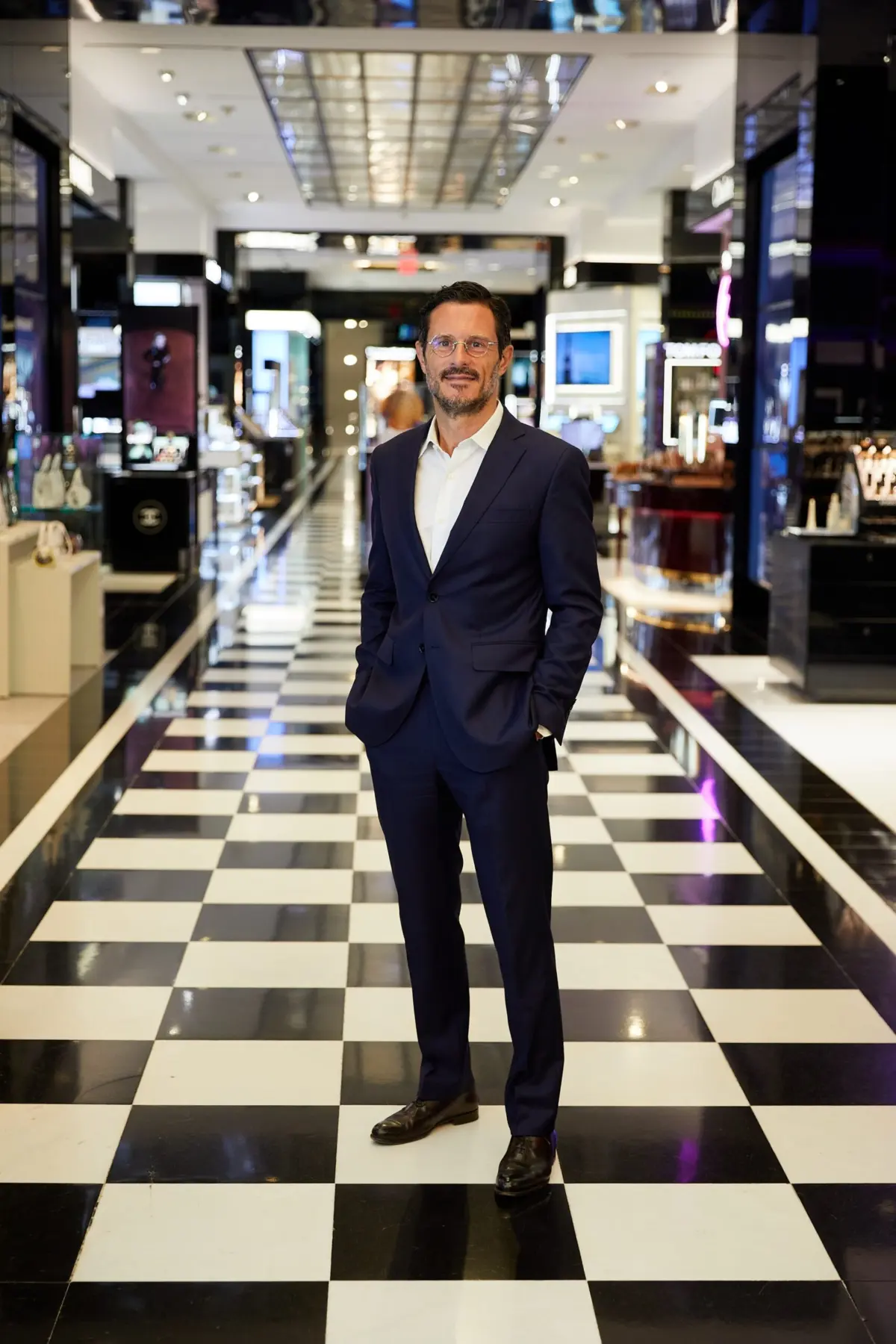
For Olivier Bron, chief executive officer of Bloomingdale’s, the modern retail equation comes down to a single guiding principle: balance.
That philosophy translates into maintaining a carefully curated merchandise presentation, striking a delicate equilibrium between short-term financial returns and long-term brand equity, and running a business model shaped by an equal measure of art and science. Speaking candidly on Thursday at the Wharton Baker Retailing Center CEO Summit in Manhattan, Bron shared his insights during a conversation with Christine Barton, CEO Advisory and North American Lead at the Boston Consulting Group.
During the panel discussion, the Bloomingdale’s chief executive delivered a pointed critique of the contemporary retail landscape in the United States, arguing that the industry has lost touch with the emotional connection that underpins great shopping experiences.
“It can’t only be about data, data, data. At some point, it’s about relationship building. It’s about experience. It’s about emotions, which are very important. We probably lost a bit of that in the U.S.,” Bron remarked.
Bron came down notably hard on the prevailing corporate mindset within American commerce, asserting that the ecosystem is far too heavily weighed toward immediate gratification.
“It’s very skewed toward short-term returns,” he said. “You can’t build a brand that way.”
This philosophy is particularly vital for an institution like Bloomingdale’s, which relies on a carefully calibrated merchandise mix. The department store bridges the gap between premium contemporary lines and high-end luxury brands, while simultaneously maintaining a strong duality between fashion apparel and home furnishings.
That strategic balance has paid off handsomely in financial terms. Bloomingdale’s recently posted a standout performance during the second quarter, registering a robust comparable sales gain of 11.3 percent. That surge brought the brand’s volume to $922 million, marking the highest second-quarter sales total in its storied history. Industry sources have further estimated that the brand is on track to generate around $4 billion in total sales by the end of 2025.
Operating a robust footprint that includes 31 department stores, 25 outlets, and four smaller-format Bloomie’s locations, the brand is currently benefiting from macroeconomic tailwinds. Specifically, Bloomingdale’s is being propelled by the so-called "K-shaped" economy, a financial phenomenon that has helped the U.S. luxury retail market rebound strongly this year, contrasting with more sluggish recoveries observed across Europe and Asia.
“The economy is not bad for us,” Bron observed, noting that the positive momentum is clearly reflected in consumer sentiment.
According to the CEO, Bloomingdale’s net promoter scores, or NPS, currently sit at the highest levels in the brand’s history. Beyond the hard numbers, however, Bron pointed to an intangible quality that has captured consumer interest.
“But also the vibe and the energy right now at Bloomingdale’s is amazing,” he said.

The CEO also addressed the shifting competitive landscape. In an apparent reference to the Exemplar Luxury Group—the parent entity operating Saks Fifth Avenue, Neiman Marcus, and Bergdorf Goodman, which successfully emerged from Chapter 11 bankruptcy proceedings in June—Bron suggested that rival disruption has created a strategic window of opportunity.
“We know some competitors have been unfocused recently, which gives us some room and some opportunities,” Bron noted. “It probably helped the great performance of Bloomingdale’s over the past 24 months. 2025 has been the new high water mark for Bloomingdale’s. In 2026, I hope we will be well above that, so it definitely helped. About probably 25 percent of this performance is due to the challenges that others faced at some point over the past 12 to 24 months. But I really believe it’s our strategy that’s [providing] the biggest impact and driving the biggest results for us.”
Historically, Bron acknowledged, Bloomingdale’s has maintained a relatively risk-averse posture. However, he emphasized that modern leadership requires a shift in appetite, particularly when dealing with long-term investments that do not offer immediate payoffs.
“Retail and particularly fashion retail is about taking risks. Over the last three years, we took some risks in buying or investing in some not so short-term ROIs,” he explained.
As part of this calculated risk model, Bron noted that roughly 80 percent of the merchandise sold at Bloomingdale’s is acquired through wholesale channels. While the wholesale model carries inherent financial risk compared to a standard consignment or concession arrangement, it also offers significantly higher potential profitability depending on the strength of the brand partner.
Central to Bron’s vision is a comprehensive mission to transform the physical in-store experience. He wants Bloomingdale’s to emulate the intimate, high-touch environment found inside dedicated brand or designer boutiques. In those spaces, fashion is typically displayed with dramatic flair, customer service is elevated, the ambient environment feels exclusive, and visual storytelling successfully captures the true essence and image of the brand.
In contrast, Bron offered a critical assessment of the traditional American retail layout.
“When you go in a U.S. department store, it’s pretty obvious there is a big difference versus what you experience in Europe or in Asia,” he said. “The experience of department stores here is like this forest of racks with a lot of brands, packed with products. Some department stores have great products. But it’s boring.”
Purchasing high-end goods, such as a luxury handbag, involves far more than simply exchanging capital for a physical item, Bron argued.
“You’re buying a brand. You’re buying a social marker. You’re buying an experience that makes it worth what you bought, and this is really what I think the department store world lost a bit of over the past 30 years. It’s this branding, this storytelling, that has become increasingly important for the customer and for our brand partners.”
Despite the structural challenges facing traditional retail formats, Bron dismissed persistent rumors regarding the death of the department store model, noting that hundreds of millions of consumers continue to walk through their doors every year.
“It’s still a very relevant model, maybe slightly eroding in traffic and in number of customers here and there, but it’s not a fatality,” Bron stated. “If we do it right, I’m absolutely convinced—and this is what we’re experiencing at Bloomingdale’s—the number of customers are increasing and the sales are increasing. I think we’re more relevant than what we used to be.”

For Bron, the most effective way to invest capital into the Bloomingdale’s brand is to pour resources directly back into its brick-and-mortar stores. Physical locations serve as the emotional heart of the enterprise, acting as anchors that drive both foot traffic and digital engagement.
“If you close your eyes and think about your best experience at Bloomingdale’s, you will never refer to that big, nice brown box delivered to your front door. Never. You are going to refer to an experience in the store where you met someone you loved or found products you were not expecting to discover,” he said.
This synergy between physical retail and digital commerce is borne out by company data. Bron revealed that an impressive 80 percent of Bloomingdale’s digital sales originate from geographic areas that house a physical Bloomingdale’s store.
“Investing in our stores is really reinforcing our digital business,” he added.
While contemporary retailers can easily become consumed by an obsession with technological innovation, digital transformation, data analytics, and artificial intelligence, Bron maintains that Bloomingdale’s takes a more grounded approach. The key is to invest in technological advancements without ever losing sight of the company’s core purpose, its unique brand DNA, or the experiential qualities that make department stores truly special.
For inspiration, Bron looks across the Atlantic to Paris.
“For me, the best department store in the world is probably Le Bon Marché in Paris,” he said. “They don’t have digital. They are all in on the in-store experience.”
He noted that Le Bon Marché will occasionally remove entire sections of merchandise entirely to clear space for high-profile special events and elaborate fashion shows.
“I’m not saying [Bon Marché’s approach] is the right model for us. I’m just saying they’re an interesting source of inspiration. Data and digital technology can not be the only answer to the challenges we’re facing. They support the strategy. They’re helping us getting better at serving the customers the right way,” he said, adding that technology must be utilized “without losing the purpose and without losing the vision of who we are.”
Ultimately, Bron returned to the fundamental emotional core of luxury retail—a business built around desire rather than absolute necessity.
“We’re selling products that actually you don’t need. So why would you buy another handbag? Why would you buy another you know shirt or skirt? Because it feels good. Because it’s rewarding. It’s good for your self-esteem,” he concluded.
“When you close the door of Bloomingdale’s behind you, you have to feel something different. It has to feel good. It’s a lot about emotions.”