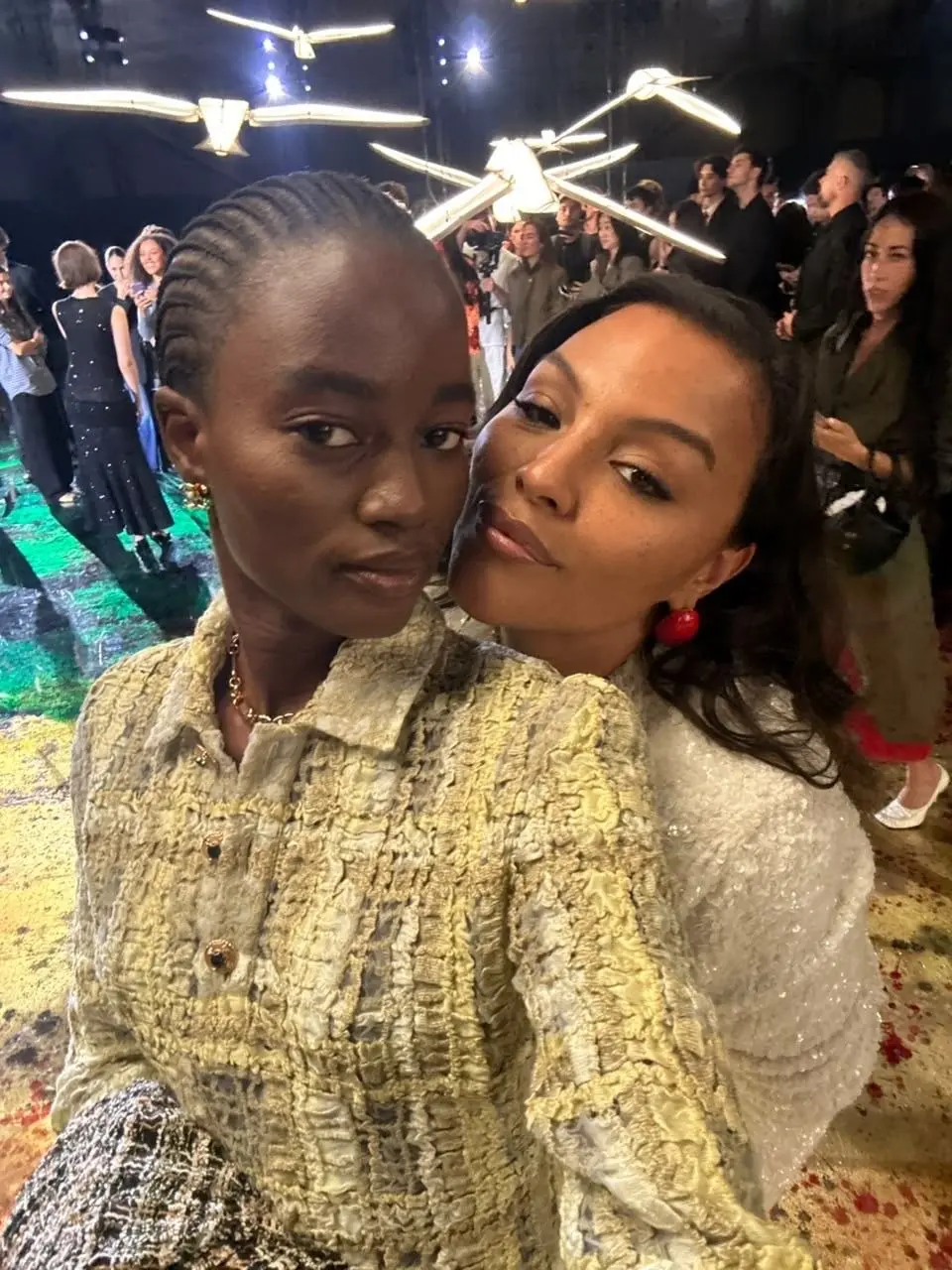
Rachel Ojuromi had been in Paris for just a week when one of her oldest manifestations finally materialized in the physical world. “I’ve always wanted to come to Paris,” the 22-year-old says, reflecting on a journey that began years prior. Back in 2020, she would regularly post videos imagining herself one day living in the French capital, complete with the quintessential Parisian atmosphere, cats and all. “And now, I’m like, ‘Hello? I’m actually in Paris?!’”

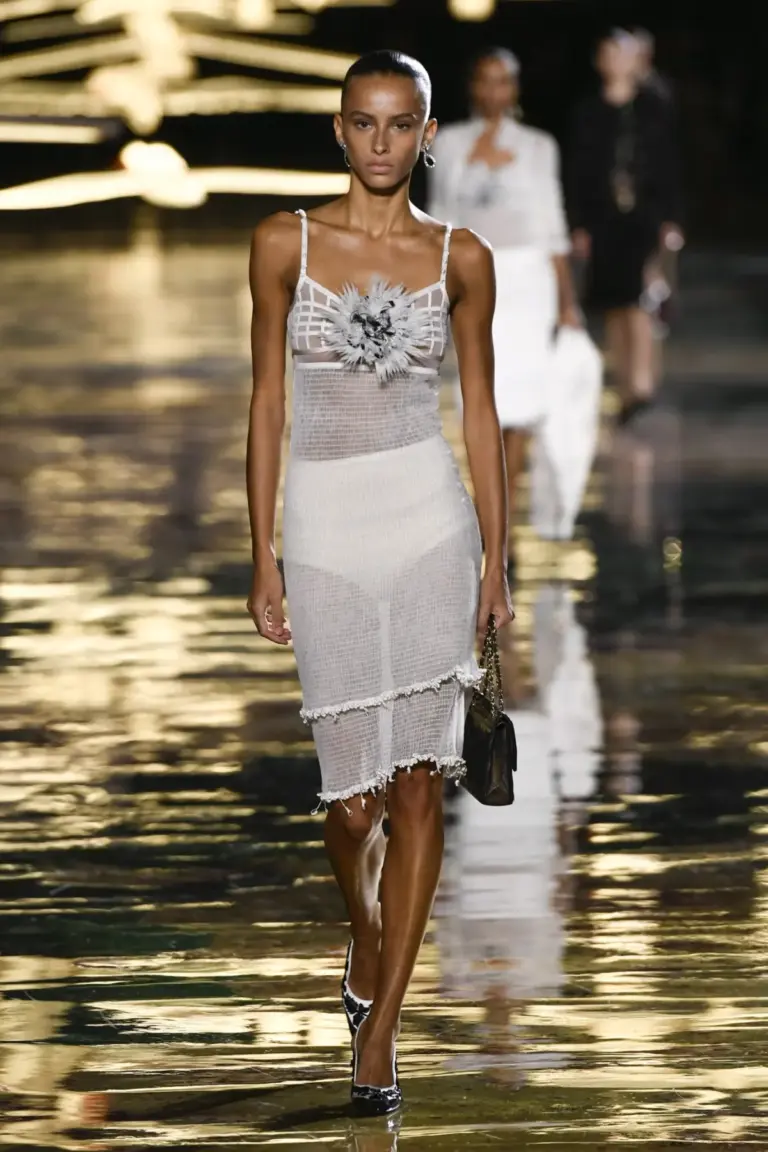
She has rightly been making the absolute most of her time there. By her second night in the city, Ojuromi had already gathered her friends for an impromptu 3 a.m. pilgrimage to the Eiffel Tower, calling others back home in Nigeria to share the moment in real-time. And she has been back to the landmark since. “I really, really love looking at the Eiffel Tower,” she says with a laugh. Her days have been filled with simple pleasures: chicken and fries (“the French fries are actually really good”), long, winding conversations with friends, and routine matcha runs. But nothing in her packed schedule could quite compare to what came next. Last night, Rachel Ojuromi officially made her runway debut at Chanel.
Long before Ojuromi was walking beneath the soaring glass roof of the Grand Palais, she was already treating Lagos as her own personal runway. Working closely with her best friend, stylist, and designer Debby Fasingha, Ojuromi began attracting widespread attention online with exuberant fit-check videos. These clips placed her commanding model walk and vibrant, reference-heavy looks against the rich legacy of maximalist Nollywood and the everyday, bustling backdrop of her hometown. Viral videos showcase her striding and strutting through the streets of Lagos in fuchsia fringed skirts, animal-print co-ords, louche tailored suits, luxurious layering, and corseted gowns—all while performing mundane daily errands like buying vegetables from a local market, picking up the morning newspaper, or balancing a basket of bananas gracefully on her head.

The content is defined by joyous color combinations, textural delights, and plenty of aesthetic-hopping. It is a creative conceit that hits its mark precisely because it is simple yet magnetic: if the traditional global fashion world was not immediately accessible to her doorstep, she would simply build one around herself. That foundational ethos is something Ojuromi has continued to champion through her own cultural platform, The Process Africa.
Lagos remains fundamentally tied to the way Ojuromi sees herself and her work. Born and raised in Nigeria, she has frequently spoken about the city as something deeply embedded in everything she creates. Even as those street-side walk videos began traveling far beyond the borders of her home country, they remained unmistakably and proudly rooted there. In Paris, that exact instinct and swagger suddenly found themselves transported onto fashion’s most rarefied and prestigious international stage.

Ojuromi’s relationship with Chanel had already taken on a strangely prophetic quality well before the casting confirmation arrived. While she had been referencing historic Chanel collections for some time, it was her viral recreation of the Métiers d’Art show that truly propelled her into this orbit. “That video was a vehicle that led us to where we are now,” she notes. Still, she is deliberately wary of framing any aspect of her journey as an overnight success story. “It’s a series of compounding events. It’s never overnight. It’s all your life you work towards something.”
Ojuromi describes herself as someone who has always been characteristically stubborn about seeing an idea through to its absolute end. Once she makes a firm decision about something, she feels an inner compulsion to turn it into reality—even, she jokes with a smile, when that decision is as simple as spontaneously cutting her hair. “Every time I ever had an idea, I always made sure to see it through,” she says. “Having an idea and executing, believing in your dreams, and believing in yourself” is, from her perspective, the exact formula that led her to where she is today.

The confirmation itself arrived amid an otherwise ordinary day. Ojuromi was sitting at home relaxing in a robe—“I love robes. I’m always wearing robes”—when her team called with the life-changing news. Her initial reaction was almost comically calm: “Oh, of course.” The true enormity of the achievement only fully landed later, during the first official lineup. “I started crying because I was like, ‘Wait, wait, wait, wait… what’s going on?’”
Making her runway debut under the current creative tenure of Matthieu Blazy adds a deeply poignant layer to the milestone. Ojuromi remembers listening to a podcast about Gabrielle Chanel while walking down the street just last year, becoming utterly fascinated by a pioneering woman who lived life fully and relentlessly pursued her ambitions despite being told otherwise. Furthermore, Blazy’s design work had deeply resonated with her long before Chanel ever entered the picture. She recalls seeing his leather ready-to-wear collections at Bottega Veneta and being profoundly struck by his keen understanding of “the impact of simplicity.” When she first heard the news that he was moving to Chanel, she remembers thinking to herself, “Wow, my two worlds are colliding.”

For the show, Ojuromi wore a striking gray and yellow tweed shirt paired with a matching midi skirt—a detail that carried extra significance because the sunny shade happens to be Debby’s absolute favorite color. “When I saw my look, I was like, ‘It’s a sign. This is a sign,’” she says. The textured tweed felt instinctively right to Ojuromi, who viewed the ensemble as a youthful, fresh interpretation of one of the fashion house’s most recognizable heritage codes. Her beauty look for the presentation, featuring gleaming skin and braids pulled back neatly, was similarly unfussy and authentic. “They wanted me to look exactly like me and I really appreciate that,” she says. “I look so pretty. I feel really pretty.”
The night before the monumental show was spent at a final fitting, getting her hair styled, and then decompressing with friends over drinks before, almost inevitably, taking another late-night run to see the Eiffel Tower. The following morning began with matcha and, crucially, a proper, uninterrupted night’s sleep. “No way, I have to sleep,” she remembers thinking ahead of the biggest day of her career. “I have to be well rested, ready to go.”

She practiced her walk, too. Even for someone whose energetic, confident stomp through the streets of Lagos helped introduce her to millions across the internet, natural nerves still crept in when the reality of the Chanel runway beckoned. “I wanted to make sure that nothing goes wrong. I don’t stumble on my feet.” Fortunately, more experienced runway models—including Bhavitha Mandava and Anok Yai—helped settle her pre-show jitters, reminding Ojuromi to stay calm, let loose, and, most importantly, remember that she fully deserved to be standing right there. By the time she finally stepped out onto the runway, the advice had completely sunk in. “I was having fun,” she says. “I was like, ‘Yeah, I deserve to be here, of course!’”
Backstage after the show, the overwhelming emotions caught up with her all over again. When Ojuromi started crying, the people around her closed ranks, offering immediate reassurance and helping her pull herself together before any cameras could catch her off guard. “You got this girl, don’t stress,” she remembers being told. She took a quick moment for a glam check. “Of course it didn’t look like I was crying because, diva,” she jokes.

Inevitably, her thoughts return to Lagos. Ojuromi remembers sitting on her couch there, watching a runway livestream, and wondering whether she and her friends could somehow build a fashion world of their own. And so they did—and now, she has successfully walked the real thing on a global stage.
Her message back home is clear and resonant: “You can dream, you can believe in something, and it can just work out,” she says. “You can dream yourself into a life that is possible even if nobody else gets it.” From the bustling streets of Lagos to the grand architecture of the Palais, Ojuromi stands as compelling proof of that very concept.