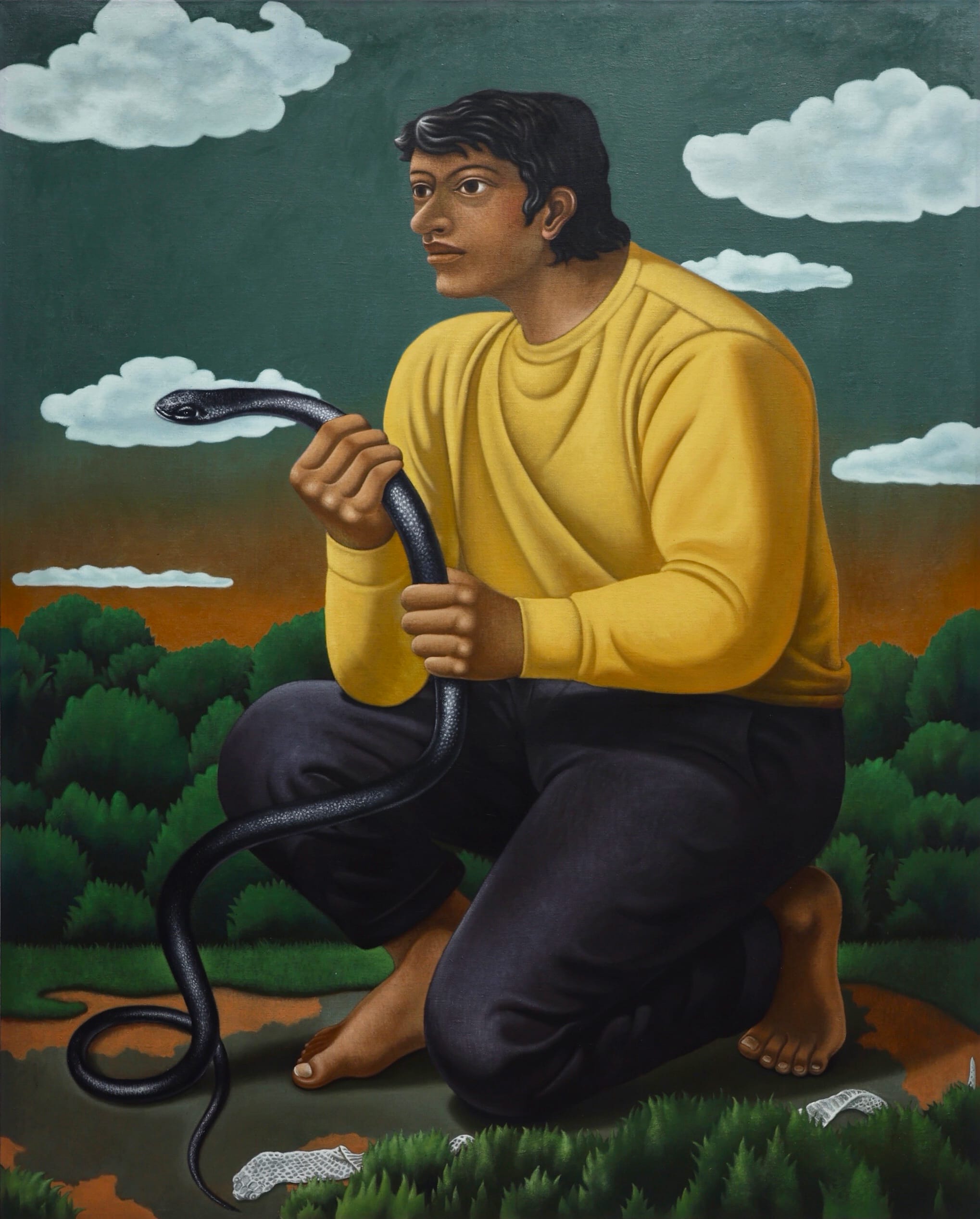
As a young boy growing up in Dashishan Village, nestled deep in the landscape of southern China, Tang Shuo harbored a distinct childhood fear of snakes. For generations, the Tang family shared a tight-knit rural existence within this small community, farming the rugged land, tending to crops and sheep, and occasionally crossing paths with the local reptiles. Today, that deeply personal childhood memory forms the emotional bedrock of a striking new painting on linen, in which the contemporary artist confronts his adolescent phobia head-on. In the artwork, Tang envisions himself confidently grasping a sleek, black serpent, while its recently shed skin rests quietly on the ground beneath them.
This profound engagement with personal history and psychological reckoning serves as the driving force behind Borrowed History, Tang’s highly anticipated first solo exhibition in New York. Long fascinated by his ancestral roots and his family’s enduring connection to the natural world, Tang once again turns his artistic gaze toward his home territory. This new body of work expands upon the artist’s ongoing inquiry into how familial heritage, collective memory, and geographical lineage inform our understanding of identity—specifically, how past generations shape who we are and how we arrived at our present circumstances.
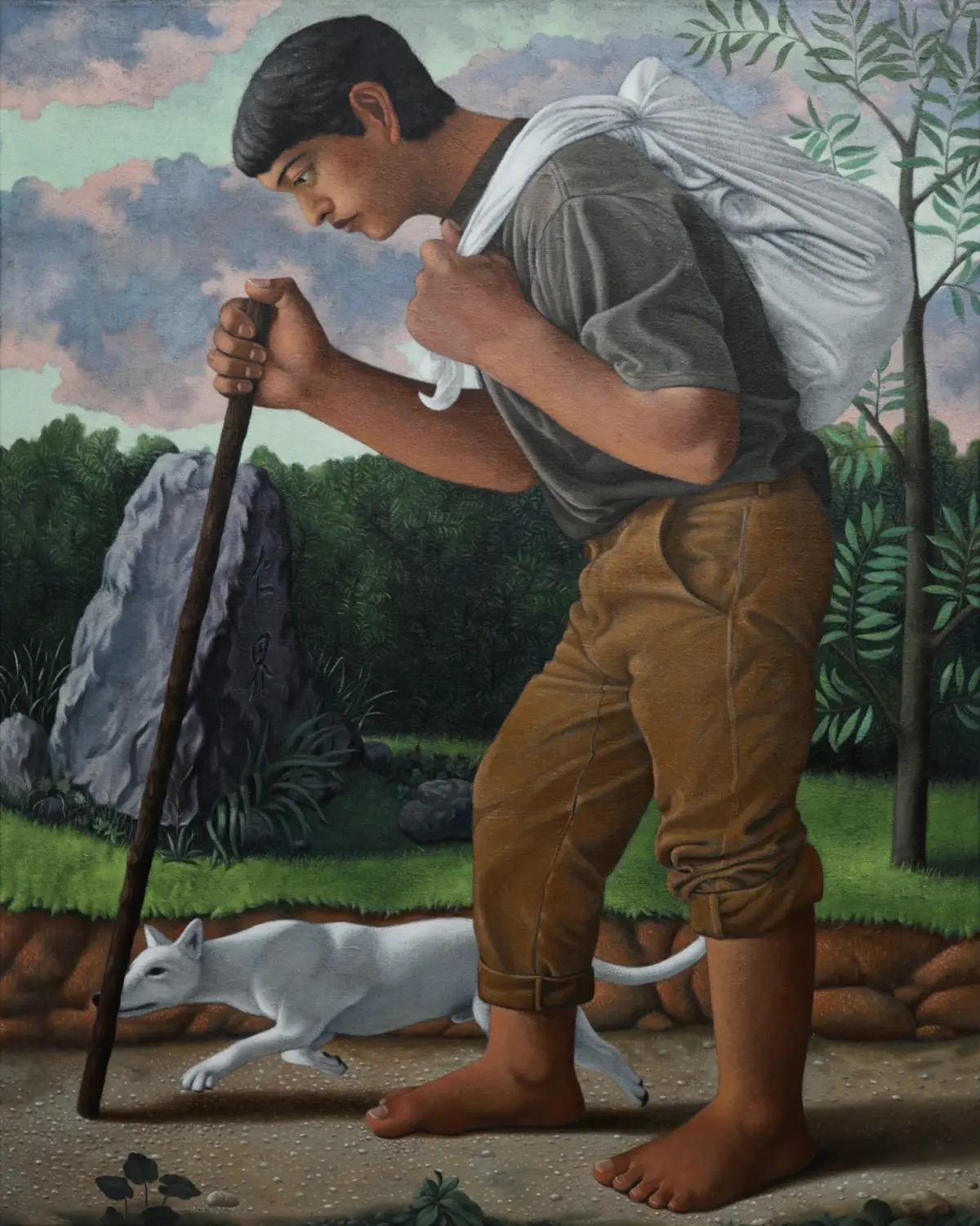
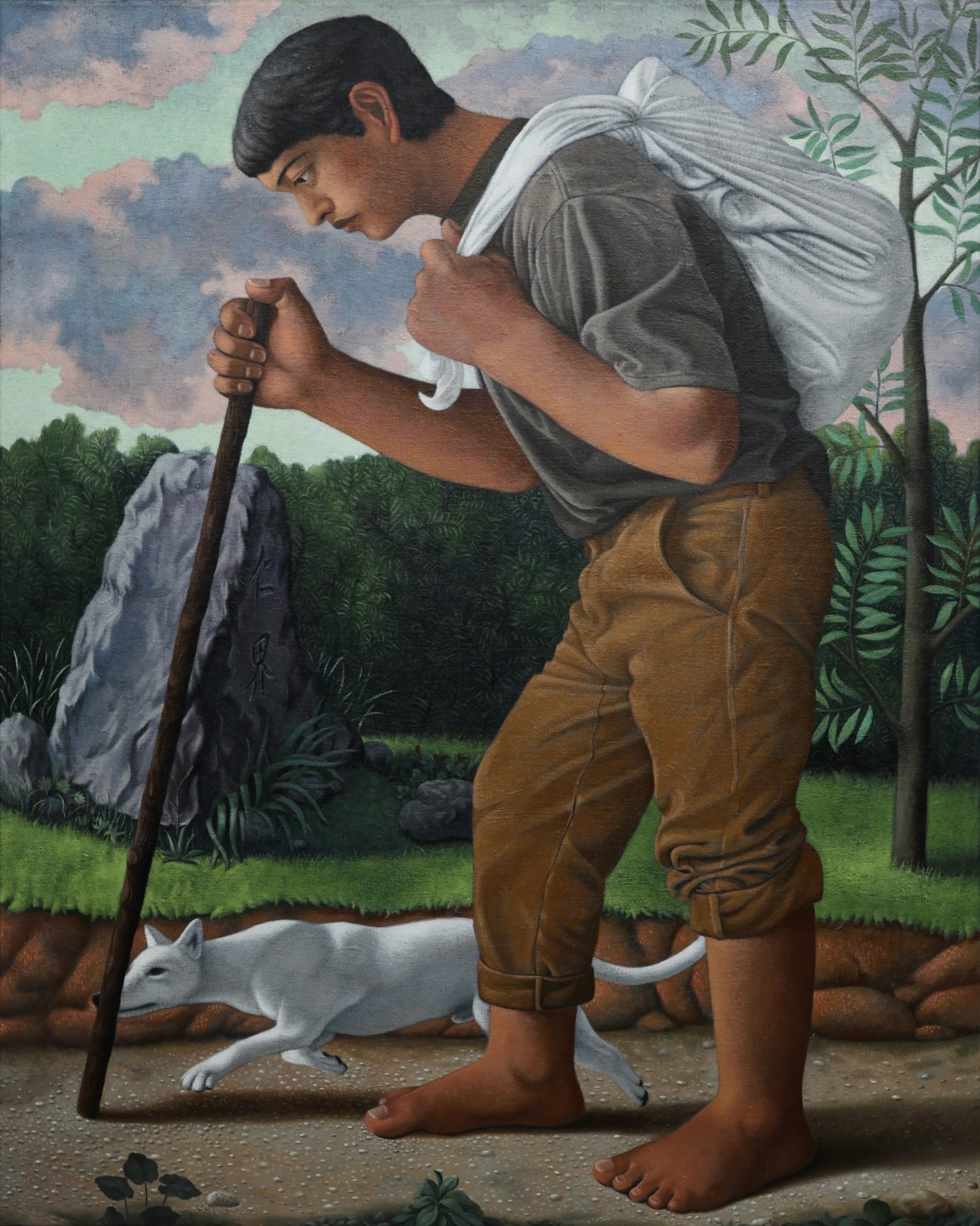
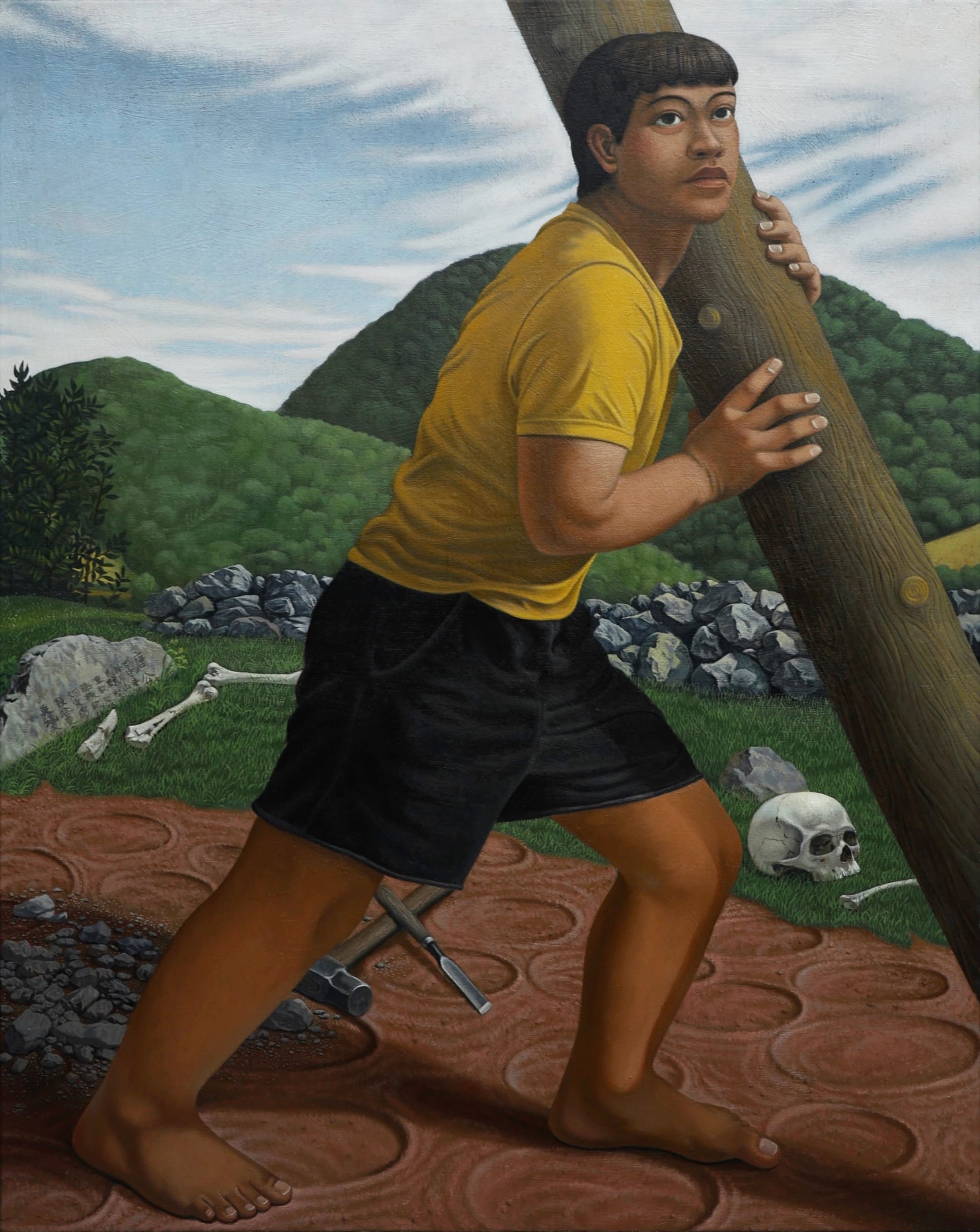
To bring these ancestral narratives to life, Tang employs a deeply introspective and imaginative process. Working directly from photographs of himself, the artist meticulously renders his own likeness in a diverse array of physical postures and labor-intensive scenarios that he vividly imagines his forebears once occupied. Among these evocative pieces are works such as The Migrant, which portrays a solitary figure carrying a small sack slung securely over his back, and The Settler, depicting a figure laboriously hoisting a heavy tree trunk against a backdrop scattered with tools and bones.
Infused with the atmospheric aesthetic of magical realism—an influence Tang openly attributes to the literary masterworks of Gabriel García Márquez, particularly One Hundred Years of Solitude—the paintings reach backward across time to reconstruct the imagined daily lives and quiet struggles of the artist’s ancestors. Lush, untamed forests and vivid, candy-colored clouds envelop the painted scenes, acting as visual bridges that connect disparate eras and bridging the gaps between generations. Through these surreal yet grounded elements, Tang suggests that the natural environment and the very terrain occupied by his family form the unbroken throughline that tethers him directly to those who came before.
While the specific narratives depicted within the canvases are fictionalized products of the artist’s imagination, Tang views his overarching creative practice as a vital act of archiving. According to exhibition statements, his work serves as a crucial documentation of "a world that is disappearing." The artist has frequently noted the stark demographic shift in his hometown: when Tang was a child, Dashishan Village was home to a vibrant community of more than 200 people. Today, that number has dwindled drastically, with only a dozen or so residents remaining.
In response to this steady erasure of local history, Tang continues his dedicated efforts to document the remaining inhabitants, oral histories, and fading traditions of the village. He plans to eventually compile these records into a comprehensive book chronicling the history of Dashishan, a project he affectionately describes as his "own bible." Through both his meticulous oil paintings and his archival documentation, Tang preserves the spirit of a place on the verge of vanishing from the map.
Borrowed History is currently on view to the public from October 8 through November 7 at Plato Gallery. Art enthusiasts and those interested in Tang’s ongoing projects can explore more of his extensive portfolio through his official Instagram account.