“Made in Afghanistan!” Gabriela Hearst declared proudly after her lovely spring show, leading editors through a lineup of models to point out the hand-painted miniatures, floral embroideries and ikat patchworks that added additional layers of meaning, empathy, beauty and rarity to the designer’s luxurious, eco-conscious fashion universe.
The declaration was more than just a nod to geography; it was the emotional and ethical anchor of an entire collection that seamlessly bridged high-end sustainable luxury with deep-rooted human solidarity. Hearst, known across the global fashion landscape for her unwavering commitment to environmental stewardship and uncompromising craftsmanship, used her latest platform to elevate some of the most vulnerable and skilled craftspeople in the world.
For this presentation, staged in the picturesque courtyard garden of the Petit Palais, Hearst was wearing a handsome, lustrous olive-colored shirt and jacket made of raw silk woven in Afghanistan. She clutched a thick notebook containing her dreamy watercolor sketches and various clippings, serving as a physical manifestation of the creative journey that brought the collection to life. In an incredible case of serendipity, one folded salmon-colored page dated Sept. 4, 2026, featured a Gabriela Hearst ad on one side, and on the other a “Lunch With the FT” article featuring former Afghan president Hamid Karzai. This uncanny alignment of materials and media seemed to underscore the profound personal resonance the project held for the designer.
The designer said she’s had Afghanistan on her mind ever since the Taliban seized control of Kabul in 2021, sending women and girls hurtling back to another dark age. That geopolitical catastrophe abruptly dismantled hard-won freedoms, education access, and professional opportunities for millions of women across the country, particularly threatening ancient cultural arts traditionally preserved by female makers. While eager to shed light on the women keeping textile, embroidery and jewelry traditions alive there, Hearst’s teams were only able to film women’s hands for fear of reprisals. The chilling reality of operating under such an oppressive regime meant that the human faces behind the exquisite needlework had to remain hidden, yet their artistry spoke volumes on the runway.
At the show, Hearst introduced journalists to professor Thomas Wide, who connected her to Turquoise Mountain, a nonprofit that supports artisan communities in Afghanistan, and connected her to marginalized makers. Turquoise Mountain has long worked in historical neighborhoods to revive traditional crafts, supporting artisans by providing international market access, design training, and fair wages. Through this vital conduit, Hearst was able to establish a direct, ethical supply chain that honored the integrity of the makers while adhering to rigorous commercial standards.
“I told them, ‘I want to work with you guys, but I need to make sure that whatever we make are things we can produce,’” she related during a preview earlier in the week at her showroom where, in lieu of a mood board of inspiration images, she charted 100 years of Afghan history, which boasts only rare periods of reform and enlightenment. It was reproduced as a booklet placed on each seat at the show, staged in the courtyard garden of the Petit Palais. This historical timeline offered invited editors, buyers, and industry insiders a sobering yet educational context, reminding the fashion elite that the beautiful textiles gracing the Parisian runway were born out of a landscape of profound resilience and historic struggle.
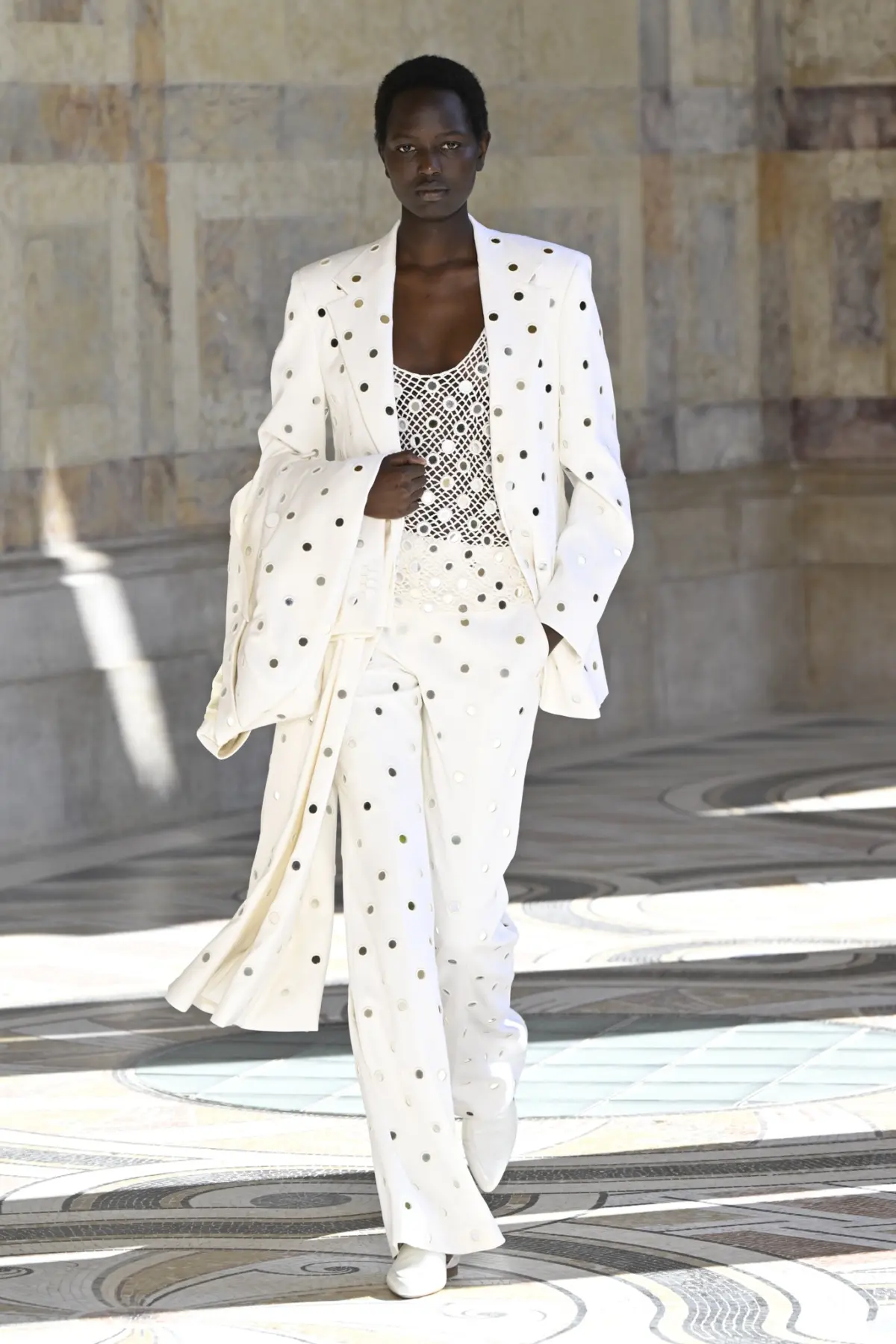
It was incredible to see how seamlessly the Afghanistan narrative was woven through the collection. Rather than feeling like a superficial add-on or a transient trend, the traditional techniques were deeply integrated into the signature Gabriela Hearst aesthetic. Hearst’s flawless pantsuits and knitted lace dresses came embedded with mirrors in the tradition of shisha, used to deflect negative energy, creating a subtle interplay of light and texture as the models walked. Meanwhile, floral Suzani embroideries on quilted leather blousons and knitted little black dresses added a nice bohemian touch, grounding the sophisticated tailoring in rich, tactile history.
The integration of these artisan-made elements did not dilute Hearst’s ongoing quest for material innovation; rather, it elevated it. Hearst still keeps upping her luxury credentials, this season introducing water-resistant trench coats made of 100 percent silk waxed with resin, proving that high performance and high fashion can coexist without relying on synthetic pollutants or environmentally damaging plastics. By combining cutting-edge sustainable fabrications with centuries-old heritage handcrafts, Hearst successfully folded in a poignant tribute to her 22 million muses this season: the women of Afghanistan.