When capturing images under the cover of darkness, standard photographic instinct usually drives the shooter to reduce shadows, pierce the gloom, and illuminate the subject as thoroughly as possible. Yet, in compelling photojournalism, visual drama frequently triumphs over technical perfection and shadow-free clarity. A striking testament to this philosophy has earned international recognition, showcasing the uncompromising realities of wildlife conservation deep within the Costa Rican rainforest.
The powerful image forms part of Michiel van Noppen’s celebrated series Tales of the Forest Keepers, a poignant body of work that has been honored with the prestigious Fritz Pölking Prize. Van Noppen’s portfolio documents the tireless efforts of conservationists operating in challenging tropical environments. Rather than relying on sterile, well-lit studio aesthetics, the photographer leans into the enveloping shadows of the jungle night to convey the visceral, high-stakes nature of modern field biology.
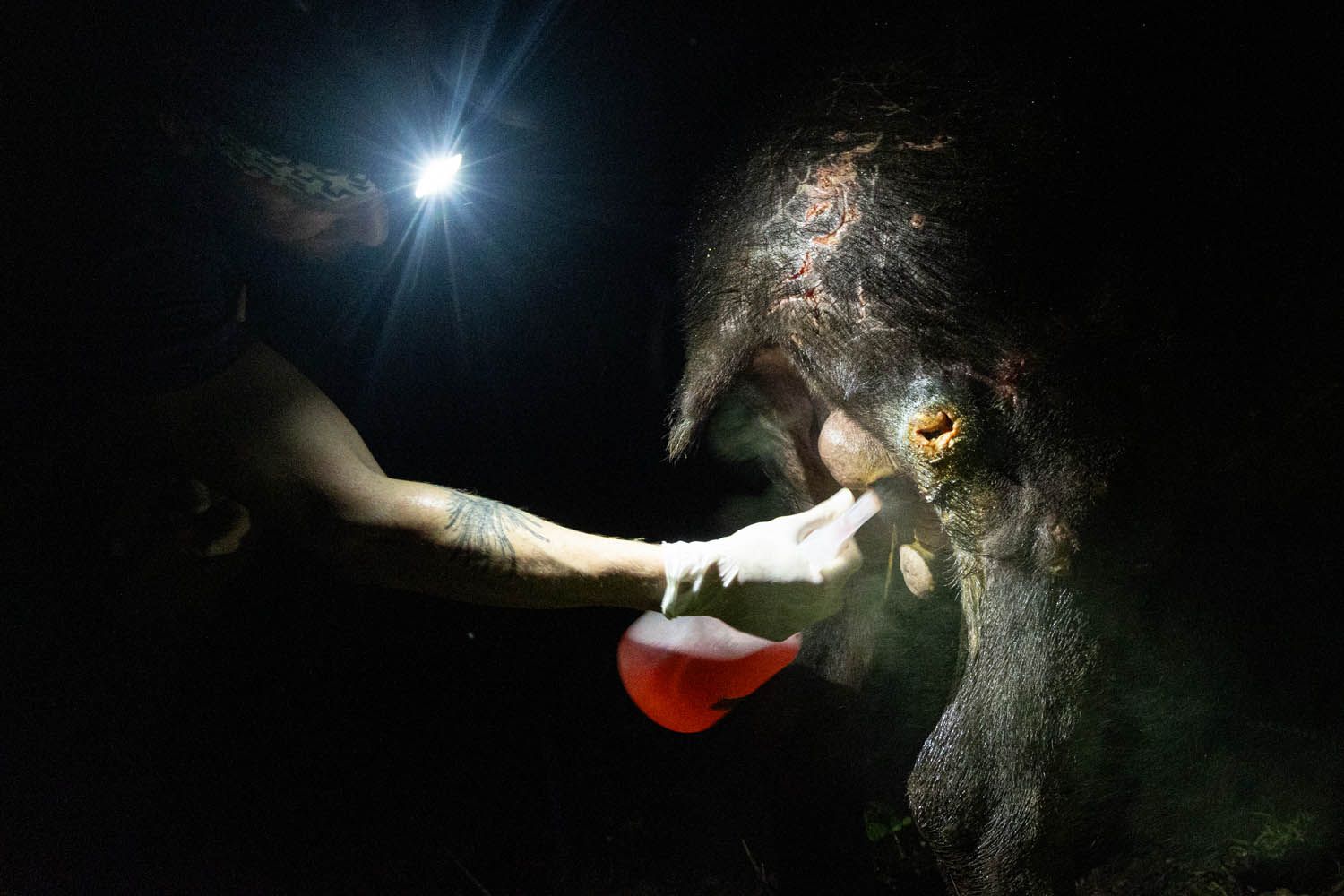
The scene unfolds in pitch blackness at precisely seventeen minutes past midnight. In the dimmest hours of the morning, a Baird’s tapir—a magnificent and endangered native herbivore—is undergoing urgent medical treatment. The animal is suffering from a severe infestation of screwworms, a destructive species of parasitic blowfly whose larvae actively feed on the living flesh of warm-blooded animals, posing a lethal threat if left untreated.
The visual composition is stark and uncompromising. The tapir’s head bears the quiet, weathered evidence of a harsh life, crossed with old scars alongside a large, open, and bleeding wound. Breaking into the frame from the left, a gloved and tattooed human arm reaches forward to administer medical care. Meanwhile, a blinding headtorch pierces the darkness directly toward the camera lens. It is an arresting and confronting sight, far removed from polished nature documentaries, yet it avoids any sense of gratuitous shock value. Every element serves a vital narrative purpose, communicating the urgent stakes of wildlife management on the ground.
Baird’s tapirs are exceptionally vulnerable to screwworm infestations, a hazard exacerbated by human encroachment. As their natural rainforest habitat continues to shrink and fragment, these elusive animals are increasingly forced to cross human-altered landscapes, navigating yards, agricultural lands, and cattle pastures where they routinely encounter barbed wire, domestic livestock, and new vectors of disease. Typically, the animals bear fresh bite wounds that serve as open invitations for opportunistic parasites.
The conservation challenge is made all the more frustrating by historical context. Screwworms had previously been entirely eradicated from Costa Rica for more than four decades, representing a major public health and veterinary victory for Central America. However, recent illicit livestock trafficking across the region has triggered an alarming resurgence, plunging local conservationists back into a defensive battle to protect vulnerable native fauna from imported parasites.
How the Shot Was Captured
Capturing such a fleeting, chaotic moment in absolute darkness required a delicate balance of technical precision and artistic vision. The dramatic scene was photographed using a Canon EOS R6 paired with an RF 24-105mm f/4L IS USM lens, locked at a 37mm focal length. Van Noppen shot in manual mode with a dedicated flash, utilizing exposure settings of 1/25 of a second at an aperture of f/5.6, pushed to an aggressive ISO 8000. According to the camera metadata, the recorded focus distance was precisely 1.31 meters, placing the viewer inches away from the medical intervention.
The resulting image relies on a sophisticated interplay of technical choices. The high ISO setting, slow shutter speed, and flash combination work in tandem to freeze the immediate foreground action while allowing ambient light sources to register. The flash performs the heavy lifting on the primary subject, freezing the dynamic movement, while the extended exposure duration and elevated ISO enable the intense glow of the headtorch to cut through the night.
Without this careful calibration, the photograph would likely dissolve into a clinical, flash-lit tapir floating against a void of uniform blackness, completely stripping away the gritty atmosphere of a dedicated team working by makeshift torchlight. Instead, the surrounding darkness acts not as an obstacle, but as a compositional frame that heightens the emotional resonance and urgency of the scene.
The visual energy of the frame flows naturally along a sharp diagonal axis. The glowing headtorch anchors the top left, the medical professional’s arm cuts horizontally across the center, and the open wound requiring treatment draws the eye toward the right. Splashes of vibrant red liquid from the medical intervention provide a stark chromatic contrast, pulling the viewer’s gaze back toward the heart of the frame where the critical action is unfolding.
Notably, no human faces are visible in the composition—a deliberate artistic choice that enhances rather than detracts from the storytelling. The photograph consciously shifts the narrative focus away from individual identities, placing the spotlight squarely on the selfless act of animal care and the broader ecological threats facing Central America’s fragile ecosystems.
Van Noppen’s striking contribution will be formally recognized during the official award ceremony for the European Wildlife Photographer of the Year 2026 competition. The event is scheduled to take place at the International Nature Photography Festival in Lünen, Germany, on October 23, where his work will be celebrated alongside other leading figures in contemporary nature and conservation photography.