Earlier this year, many onlookers in the tech and design communities believed that Grokipedia, Elon Musk’s ambitious AI-driven alternative to Wikipedia, had quietly met its demise. After a sudden halt in its operations, the platform seemed to join the long list of experimental digital projects left to gather dust in the corners of the internet. However, in a move that has caught the web-design and artificial-intelligence worlds by surprise, the AI-powered encyclopedia has risen from the ashes, boasting a refined visual facelift and a brand-new iteration designated as version 0.3. This latest update aims to address some of the structural and aesthetic criticisms leveled at the platform during its initial run, presenting a slicker, more polished gateway to its AI-generated knowledge base. Yet, as with any major redesign in the fast-paced world of artificial intelligence, the glossy exterior raises a familiar question: can a polished user interface truly mask the deeper, systemic challenges of automated information retrieval?
At its core, Grokipedia represents a direct challenge to the traditional, community-led model of knowledge curation that has defined the modern internet. While Wikipedia relies on a vast, global network of human volunteers who debate, source, and edit articles through a rigorous process of consensus, Grokipedia attempts to streamline this process by placing artificial intelligence at the center of the editorial desk. This fundamental difference has made the platform a lightning rod for controversy. Critics have frequently pointed to its reliance on thin sourcing, its susceptibility to hallucination, and persistent allegations of bias as proof that an AI model cannot easily replicate the collective intelligence of humanity. While the newly introduced design marks a visually impressive new era for the platform, the underlying mechanics of how it gathers, verifies, and presents information remain under intense scrutiny. After all, in the realm of educational and reference resources, looks are far from everything, and a beautiful layout cannot compensate for factual instability.
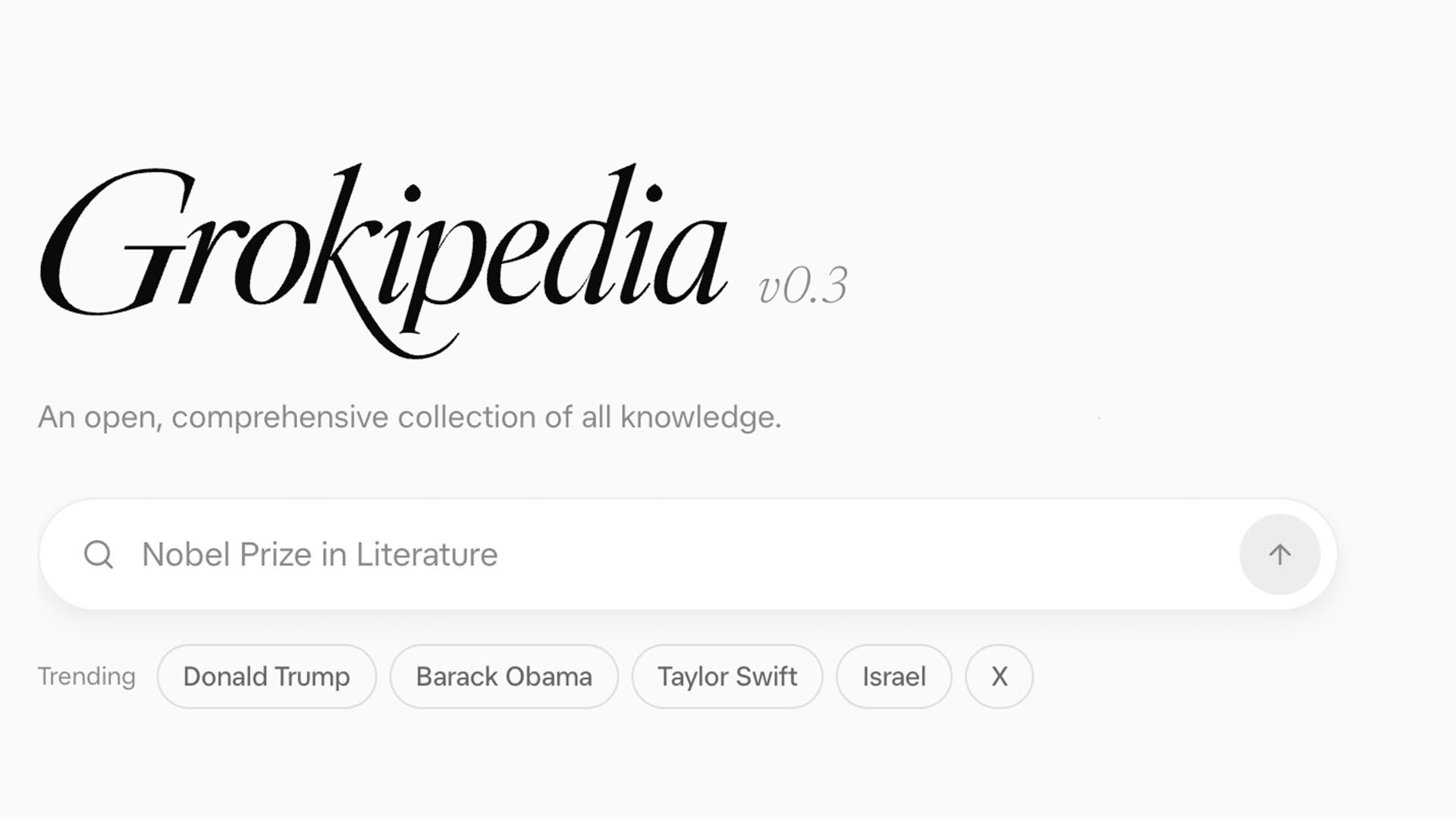
The centerpiece of the v0.3 update is undoubtedly its visual transformation, which starts with a brand-new logo. Moving away from its previous branding, the platform now sports a swanky, elegant script font logo that suggests a more classical, literary sensibility. This design choice appears to be a deliberate attempt to position Grokipedia as an authoritative, sophisticated repository of knowledge rather than just another sterile tech product. Along with the new typography, the update introduces significant evolutions to both the homepage and the live edits page, transforming the overall user experience into something far more interactive and dynamic.
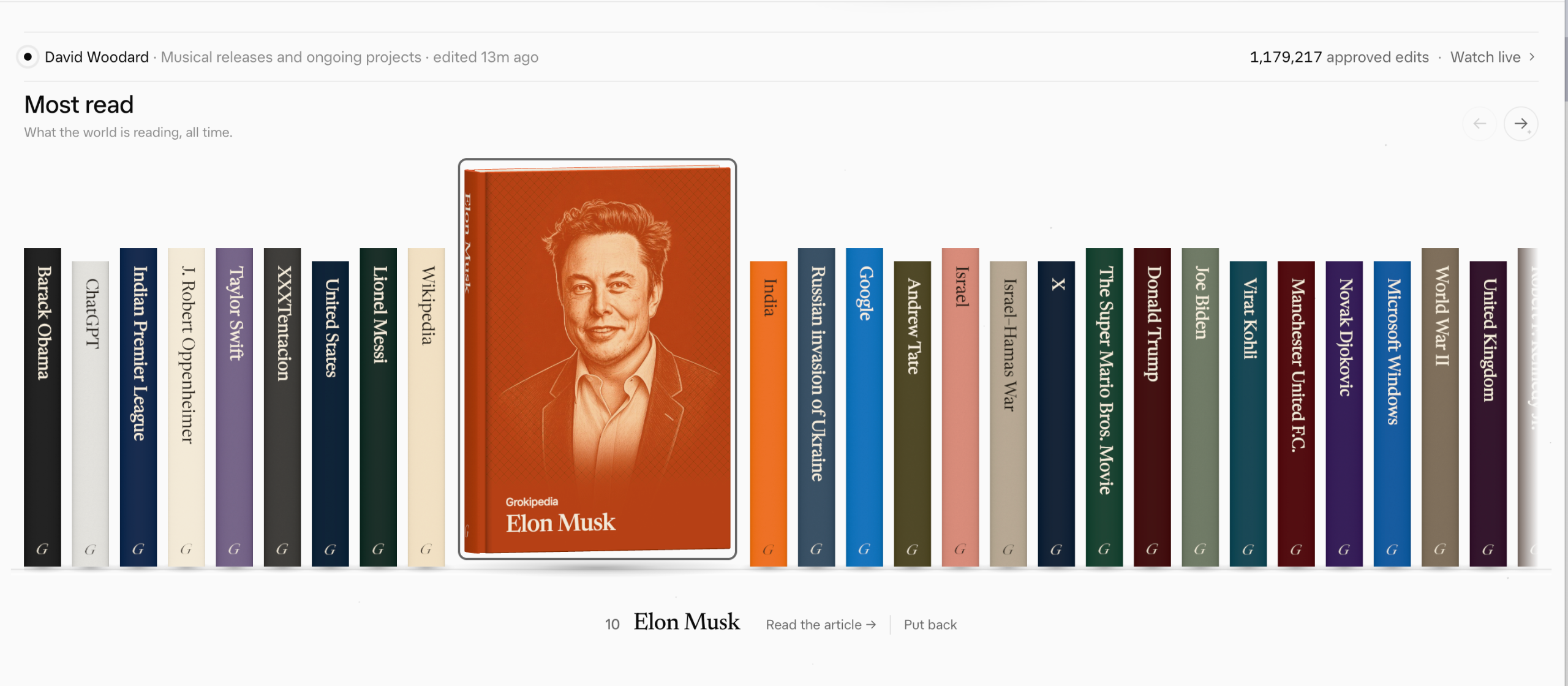
Designed to evoke the warm, intellectual atmosphere of a physical library, the new homepage features interactive 3D book covers that users can engage with as they browse. This tactile, skeuomorphic touch is accompanied by a dedicated "Most read" section, styled as a virtual bookshelf displaying trending topics. Below this, a "Latest edits" panel showcases real-time updates made by human contributors, which are then vetted by the Grok AI. This blend of physical library aesthetics with cutting-edge digital interactions represents a major step forward for the platform’s visual identity, transforming what was once a relatively plain interface into an engaging, gamified browsing experience that encourages deeper exploration.
The decision to implement interactive 3D book covers and a virtual bookshelf is a fascinating pivot in modern web design. For the past decade, the tech industry has been dominated by flat, minimalist design systems that prioritize clean lines, solid colors, and abstract iconography. By reintroducing elements of skeuomorphism—the design practice of making digital objects resemble their real-world, physical counterparts—Grokipedia v0.3 attempts to tap into a sense of nostalgia and comfort. A physical library carries an inherent association with quiet study, rigorous research, and curated authority. By wrapping an AI-driven system in the visual metaphor of a wooden bookshelf and leather-bound volumes, the designers are attempting to subconsciously transfer that sense of trust and permanence to an algorithmic system that is, by its very nature, fluid and occasionally unpredictable. This contrast between the ancient medium of the printed book and the bleeding-edge technology of large language models is one of the most striking aspects of the new update.
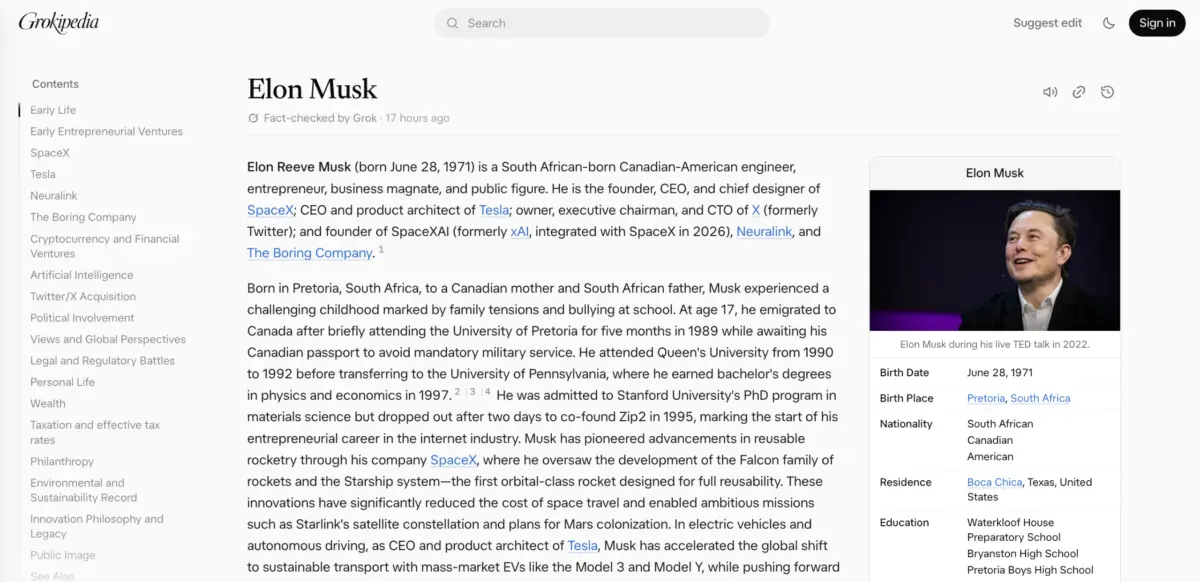
Moving beyond the homepage, the individual article pages have also received a series of subtle yet noticeable design tweaks. The most prominent of these changes is the introduction of more minimalist side tables, which are designed to display key biographical or historical information in a clean, easily digestible format. While these changes contribute to a much more fluid and modern user experience, they also reveal a deeper creative limitation. Upon closer inspection, the layout of these article pages is essentially a direct copy of Wikipedia’s iconic structural format. From the placement of the table of contents to the arrangement of the introductory summary and infoboxes, the design path is deeply derivative. For a platform positioned as a disruptive challenger to the established order, this lack of structural originality is a notable disappointment, suggesting that even the most advanced AI platforms still rely heavily on the design language established by the very giants they seek to replace.
To put Grokipedia’s design choices into perspective, it is worth comparing them to Wikipedia’s own gradual pace of design evolution. When Wikipedia rolled out its "Vector 2022" redesign—its first major desktop interface update in over a decade—it was the result of years of research, community consultations, and careful testing designed to ensure accessibility and usability for a global audience of billions. Wikipedia’s design philosophy is rooted in universal accessibility, ensuring that the site loads quickly on low-bandwidth connections and remains highly readable on any device. In contrast, Grokipedia’s rapid transitions, with its heavy 3D graphics and complex interactive elements, prioritize visual spectacle over universal accessibility. While this makes for a highly engaging experience on high-end desktop computers and modern smartphones, it may alienate users in regions with slower internet speeds or older hardware, further widening the gap between a democratic, globally accessible public utility and a premium, tech-focused alternative.
To understand the significance of this relaunch, it is necessary to examine the brief and turbulent history of Grokipedia. The platform was first introduced to the public in late October 2025, launching with a database built primarily from AI-cloned Wikipedia pages. This initial phase was largely a proof-of-concept, demonstrating how a large language model could ingest existing structured data and reframe it. By November 2025, the development team pushed out the v0.2 update, which sought to refine the platform’s capabilities. However, the momentum was short-lived. Earlier this year, the platform ground to a sudden halt. This operational freeze occurred after the developers suspended both autonomous AI-driven edits and the review of user-submitted suggestions, leaving the site in a state of suspended animation and prompting widespread speculation that the project had been permanently abandoned due to technical or editorial hurdles.
The foundation of Grokipedia on AI-cloned Wikipedia pages also raises critical questions about intellectual property, open-source licensing, and the ethics of data scraping. When the platform first emerged, it did so by importing vast quantities of Wikipedia’s publicly available data and processing it through AI translation and summarization layers. While Wikipedia’s content is published under Creative Commons licenses that allow for reuse and modification, these licenses generally require proper attribution and that any derivative works be shared under similar open terms. The act of cloning an entire collaborative encyclopedia to feed a proprietary AI system—especially one linked to a commercial enterprise—tests the boundaries of these open-source principles. It highlights a growing tension in the AI era, where public, community-generated knowledge is increasingly harvested by private entities to train commercial models, often without returning any tangible value to the community of creators who spent decades building that knowledge base.
The decision to halt operations earlier this year highlights the immense difficulty of managing an AI-driven encyclopedia. When Grokipedia first launched, the concept of allowing autonomous AI agents to edit and update articles in real time was promoted as a revolutionary advancement that would keep information more current than any human-edited site could manage. In practice, however, this approach quickly ran into the harsh realities of content moderation. Without strict guardrails, autonomous AI edits risked propagating misinformation, generating circular references, and compounding existing biases. By pausing these automated edits and halting the user suggestion review process, the creators of Grokipedia were forced to confront a fundamental truth: without a reliable system of verification, an encyclopedia quickly loses its utility.
The v0.3 update attempts to resolve this editorial dilemma by introducing a hybrid moderation model. Under this new system, human contributors are invited to make edits, but these contributions are ultimately vetted and approved by Grok, the proprietary artificial intelligence. While this approach seeks to combine human creativity with AI efficiency, it introduces a new set of concerns regarding centralization and bias. In a traditional wiki, disagreements over factual accuracy are resolved through open discussion among multiple human editors who cite primary sources. In the Grokipedia model, the final arbiter of truth is a single, closed-source AI model. This setup risks creating an information bottleneck where the biases, limitations, and political leanings of the underlying AI dictate what is accepted as historical or scientific fact, a prospect that many educators and information scientists find deeply troubling.
This intersection of design, technology, and corporate identity is a hallmark of Elon Musk’s various business ventures. From the stark, minimalist branding of X to the recently unveiled SpaceXAI logo—which many design commentators noted looks surprisingly familiar to other established tech emblems—Musk has consistently used visual identity as a primary tool for positioning his companies as disruptive forces. This branding strategy often draws sharp reactions from both supporters and critics. In some cases, it has even inspired external counter-campaigns, such as the hard-hitting advertisements that have recently thrown shade at Musk, Jeff Bezos, and Mark Zuckerberg to promote online democracy and protect the open web. These campaigns serve as a reminder that the battle for the future of the internet is not just being fought in server rooms and code repositories, but also in the public square through logos, branding, and visual storytelling.
Ultimately, the success of Grokipedia v0.3 will not be decided by its swanky script logo, its interactive 3D bookshelves, or its fluid page transitions. While these design choices make for an undeniably engaging visual experience, they do little to solve the fundamental challenges of AI-generated content. If the platform continues to rely on thin sources and struggle with issues of bias and accuracy, it will likely remain a niche novelty rather than a genuine threat to Wikipedia’s dominance. For now, Grokipedia stands as an intriguing design experiment—a testament to how modern UI trends can revitalize a stagnant concept, even as the core product continues to search for its footing in a highly skeptical digital world.