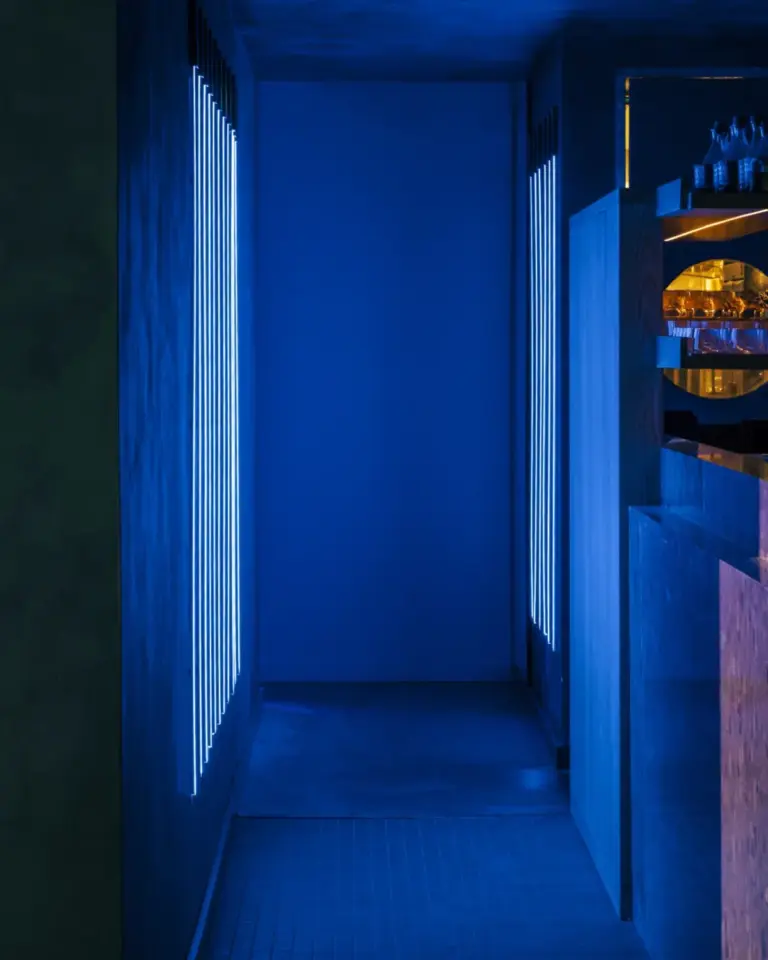
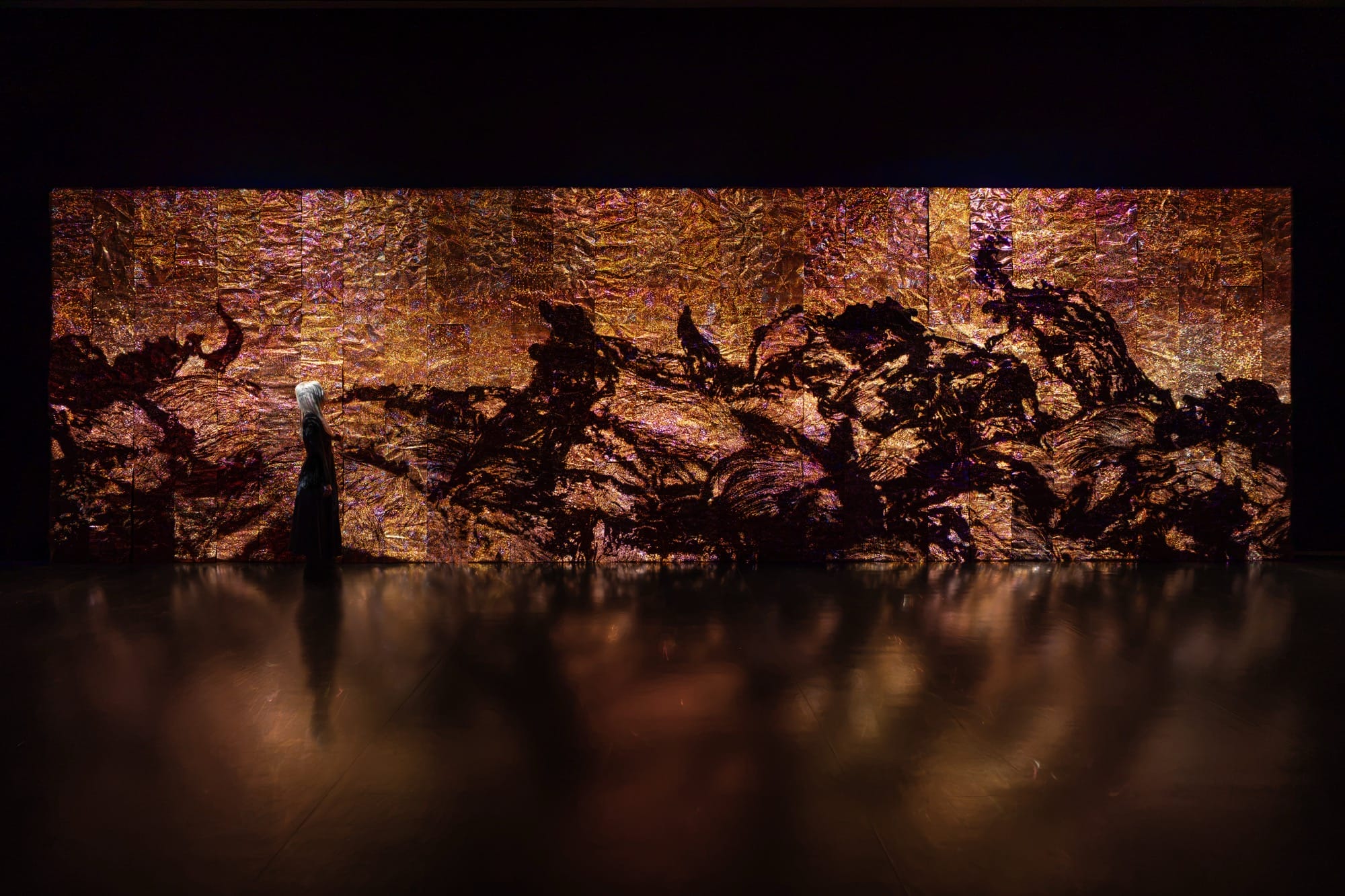
Against a patchwork wall of hammered copper, a black veil appears to billow in mesmerizing motion. The fabric-like layer writhes and twists against the glimmering backdrop, revealing its diaphanous texture as it unfolds to translucence. Like a curtain flapping in an open window, the digital projection floats effortlessly across the metallic surface of one of teamLab’s latest visionary works, establishing an immediate dialogue between the cold rigidity of industrial materials and the fluid, organic behavior of digital light.
This captivating installation forms a central part of teamLab: Everything Exists in Infinite Continuity, a major new exhibition currently hosted at the Smart Museum of Art. Titled “Sea of Darkness, Memory Shining from the Depths,” the piece stands out as one of several new commissions developed specifically for this presentation by the renowned international art collective. Founded in 2001 by Toshiyuki Inoko, teamLab operates as a multidisciplinary powerhouse comprising hundreds of artists, animators, musicians, mathematicians, software developers, and engineers. Together, this diverse team consistently probes the provocative and fertile intersection of art, science, and technology, challenging how modern audiences interact with gallery spaces.
The collective has long maintained a profound fascination with the limits of human perception and imagination. Through a series of interactive and immersive installations over the past two decades, they have continually invited viewers into carefully crafted worlds where traditional boundaries are suspended and continuity in both space and time serves as the fundamental organizing principle. Notably, teamLab was among the earliest adopters of incorporating digital technologies into experiential art works. Yet, rather than relying on hyper-complex or proprietary infrastructures, they frequently utilize basic software and accessible programs that are readily available to the general public.
In today’s contemporary landscape, encountering such elegant yet technologically approachable digital works has become increasingly rare. As society witnesses the exponential rise of artificial intelligence alongside a collective, widespread outsourcing of daily human experiences to automated systems, teamLab offers a distinct alternative. In sharp contrast to both uncritical tech evangelists and reactionary technophobes, the collective’s creative approach remains decidedly human without ever turning its back on the digital medium.
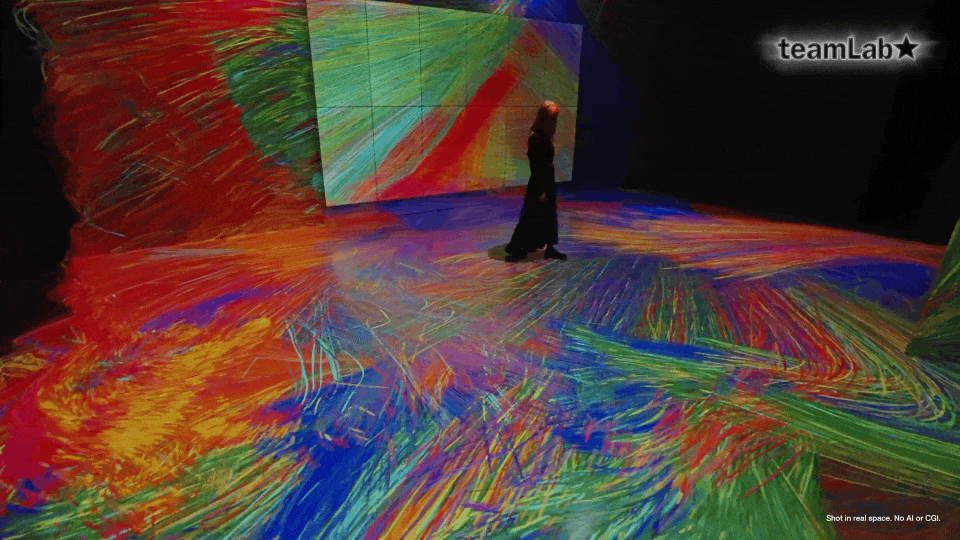
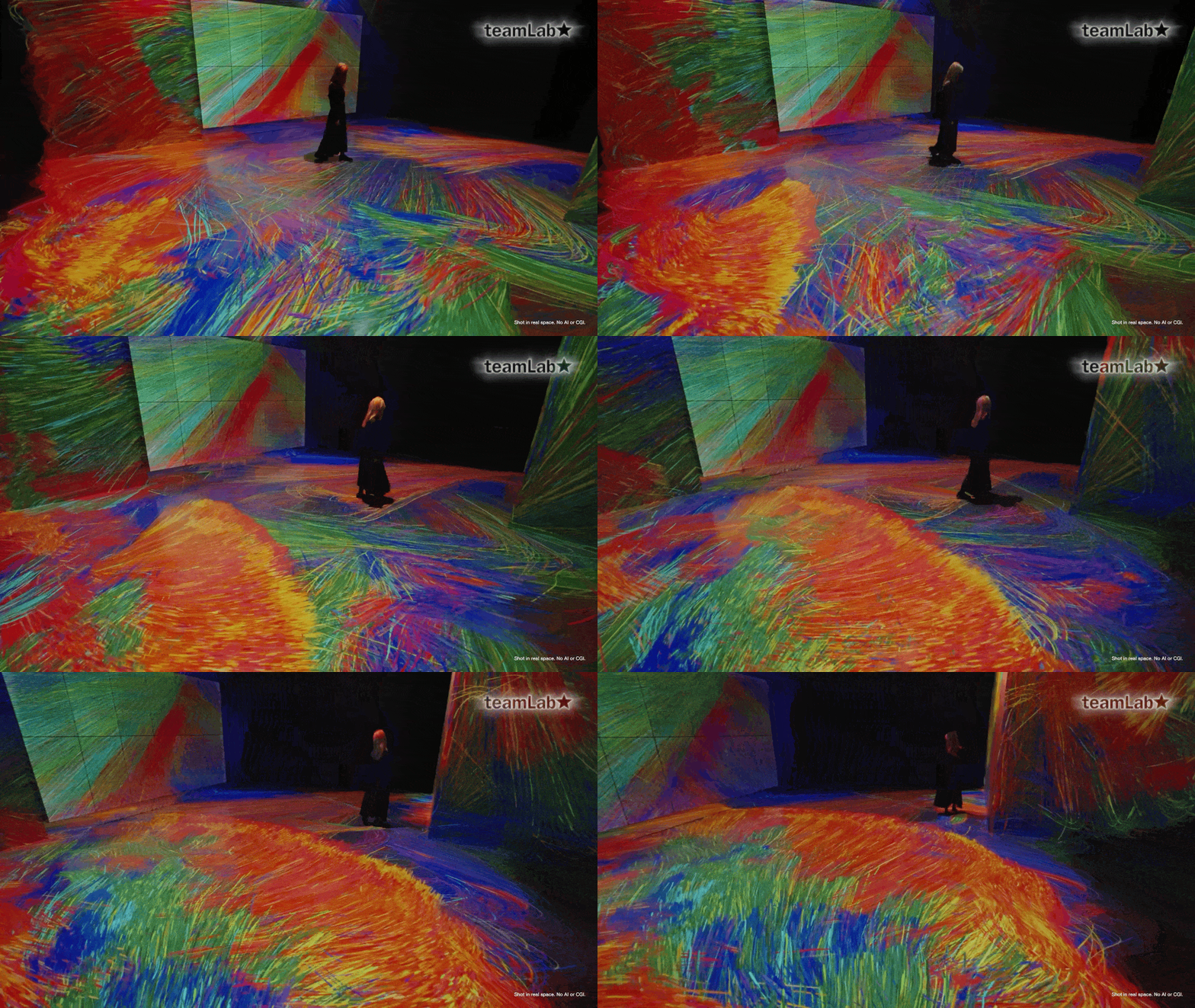
This philosophy is vividly demonstrated in works like “Order in Chaos,” which actively responds to physical human touch. When visitors interact with the piece, it shoots a cacophony of vibrant, energetic lines across the gallery floor, up the walls, and through a complex grid of screens. Riotous in its sheer energy and visual dynamism, the piece represents a deliberate theoretical undertaking. According to the collective, the work is "an attempt to expand painting from a completed image, or a perspective illusion of space, into a spatiotemporal pictorial space that is continuous with the real space." By breaking free from the traditional confines of a static canvas, the artwork bleeds directly into the physical architecture of the museum room.
The ambitious effort to bridge divides between distinct times and geographic locations also emerges powerfully in “Continuous Life and Death at the Now of Eternity II.” This sophisticated floral piece dynamically corresponds to the real-time environmental conditions of its current exhibition venue. While on view in Chicago, for instance, the digital ecosystem visibly brightens as the sun rises over the city and darkens correspondingly when dusk falls. In a similar display of temporal synchronization, as the autumn season transitions into the biting cold of winter in the Midwest, the digital ecosystem on the screen undergoes a parallel transformation, binding the gallery viewer to the exterior climate in real time.
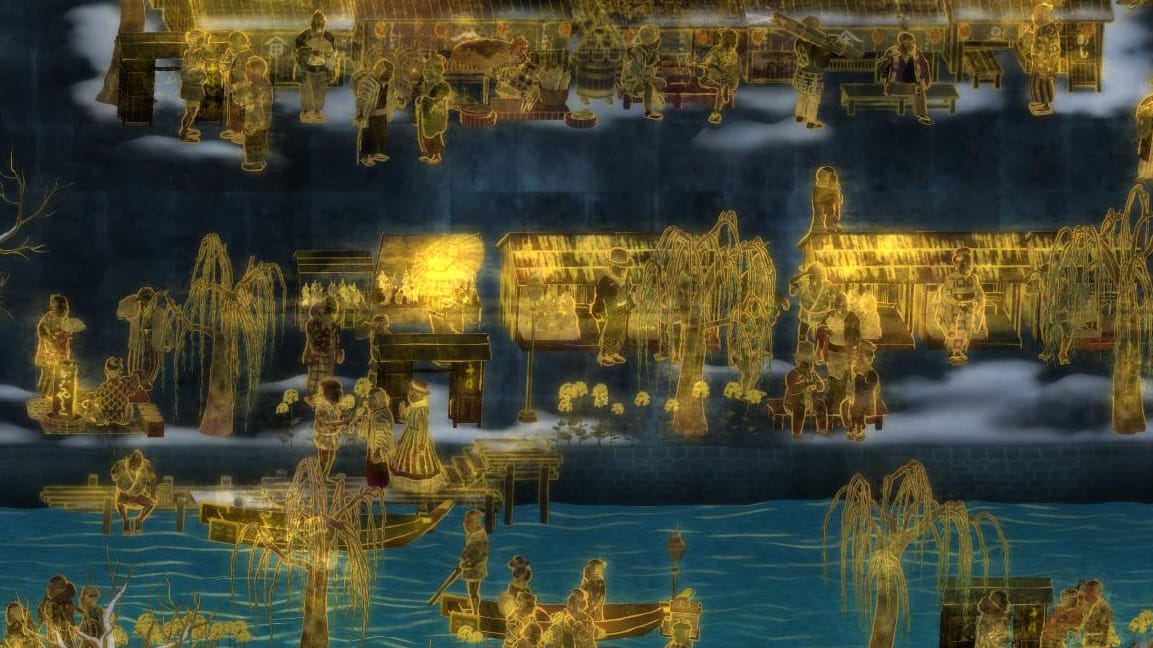
Among the most conceptually ingenious and intellectually challenging pieces in the exhibition is the closing installation, “The World of Irreversible Change.” Depicting a serene, beautifully animated community going about its daily routine, the paneled digital work is intricately programmed to respond directly to human touch. However, this interaction carries a heavy metaphorical burden: if a visitor taps the screen too many times, the system triggers a year-long, entirely irreversible state of war and bloodshed among the digital inhabitants. While several editions of “The World of Irreversible Change” were created by the collective, the specific iteration currently on view at the Smart Museum holds the distinction of being the only one to exist in its original, pristine condition, prompting museum staff to cordone it off carefully for long-term preservation.
During a guided walkthrough of the exhibition, Inoko elaborated on the bleak narrative arc embedded within the programming. When the digital conflict inevitably breaks out, the community loses its capacity to return to its previous era of quiet peace. Eventually, all the virtual people perish, and the once bustling, thriving metropolis dissolves into complete desolation. Only after several years pass do digital shrubs begin to sprout from the ruins, followed eventually by the distant, haunting sound of bird song ringing through the empty skies. Yet, humanity never returns to the landscape, serving as a poetic and undeniably cautionary tale tailored specifically for the anxieties of our modern era.
teamLab: Everything Exists in Infinite Continuity remains on view through February 21 at the Smart Museum of Art.