ANTALYA, Turkey — At the COP31 Health Pavilion, human geography expert Laurie Parsons offered a blunt provocation to the global fashion industry: Despite growing conversations around rising temperatures and human labor, the sector is still getting the fundamental equation entirely wrong.
Taking the stage on Saturday at a panel organized by the Fair Labor Association—whose members include major brands like Adidas, Gildan, Uniqlo owner Fast Retailing, and Patagonia—Parsons argued that while organizations have long grappled with heat as a spatial issue, excessive temperatures are fundamentally a problem of labor that traditional metrics fail to adequately capture.
“Hot space does not get sick,” said Parsons, a reader in human geography at Royal Holloway, University of London, and principal investigator of the Oppressive Heat project. “Hot people get sick, and people exist not just within spaces but within economies.”
This marked Parsons’ second appearance at an annual United Nations climate summit. At his first, COP26 in Glasgow in 2021, the United Kingdom’s Met Office warned that 1 billion people would face extreme heat stress if global temperatures rose by 2 degrees Celsius above pre-industrial levels. Five years later, a 2-degree warming limit—let alone the 1.5-degree hard stop pursued by the Paris Agreement—sounds almost quaint.
The United Nations Environment Programme warned last month that the “lowest possible” overshoot scenario for peak warming by roughly mid-century now sits at 1.7 degrees. However, that optimistic projection requires the world to slash emissions by 18 percent by the end of the decade, 45 percent by 2035, and 69 percent five years later, compared with 2025 levels. Under current global policies, warming could surpass 2.8 degrees Celsius within the century.
For the 2.4 billion workers the International Labour Organization estimates are exposed to excessive heat each year—including the one-third who experience physiological heat strain or heat-related illness as a result—these projections offer little comfort.
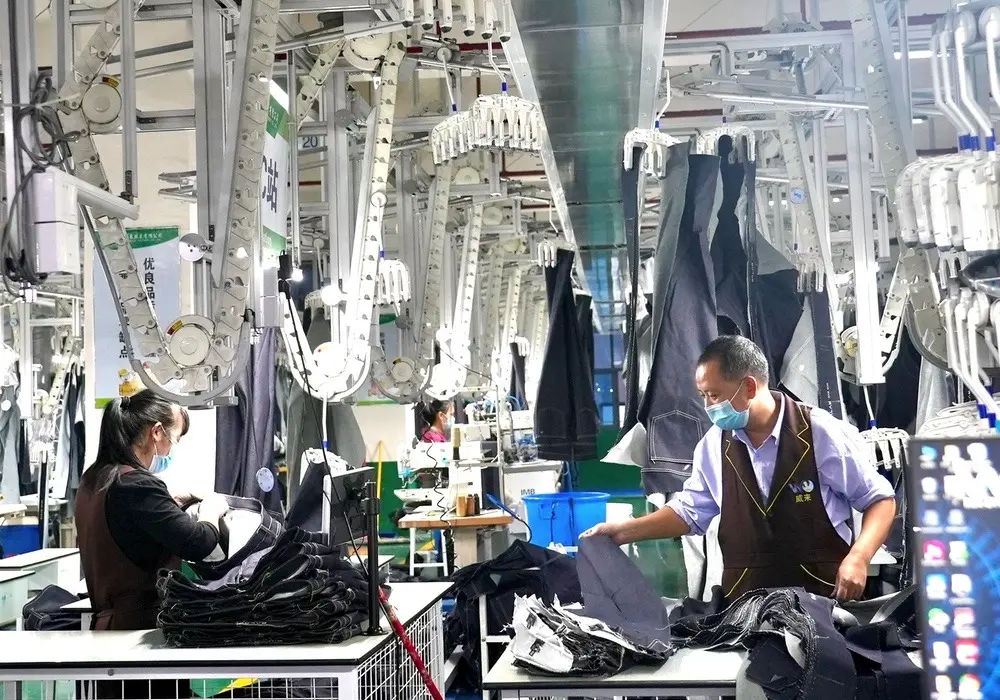
Statistics aside, Parsons contends that fashion industry stakeholders continue to rely on metrics that miss the reality on the factory floor. While the issue of heat stress in garment manufacturing has steadily gained traction over the past few years, the sector is still widely categorized as low-risk compared with more traditionally intensive fields like construction. Ambient room thermometers, however, regularly miss what is actually happening inside workers’ bodies. Individual employees, even when working side by side under identical conditions, experience acute heat stress differently. His research has focused on understanding why these patterns vary wildly across a workforce.
“The core temperature of our body usually oscillates within a very narrow range between 36.5 and 37.5 degrees when we’re healthy and we’re not doing something which makes us excessively hot, so if we go above 38 degrees, then that means that we’re entering a state of clinical heat stress,” Parsons explained. Looking at the proportion of workers crossing that threshold reveals a completely different picture than merely tracking room thermometers, offering a far more granular understanding of how heat stress plays out across a factory floor.
For garment workers, that critical proportion sits at 3 percent. At any given moment, Parsons noted, roughly 2 million out of the 70 million people who make our clothes are actively experiencing elevated core temperatures that veer into clinical heat stress. Over the course of a year, 67 percent of garment workers experience heat stress at least once, meaning different individuals breach the safety threshold at different times depending on their specific tasks.
Workers in pressing or washing departments, for example, experience more than 10 times the amount of elevated core temperatures compared to someone working in cutting. Consequently, the heat-stress risk for workers in pressing, washing, or operating certain poorly ventilated or non-air-conditioned knitting machines is far more equivalent to high-risk roles within the heavy construction sector than the rest of the garment industry.
As manufacturing hubs like Bangladesh, Cambodia, and India endure record-breaking heatwaves with temperatures frequently pushing past 46 degrees Celsius (115 degrees Fahrenheit), workers describe a devastating physical toll. Prolonged heat exposure brings excessive sweating, headaches, fever, nausea, heart palpitations, dehydration, and temporary vision loss. Inside manufacturing plants, temperatures can sometimes soar 10 degrees Celsius higher than the outdoors. Public health research has increasingly linked these high ambient temperatures to mental health challenges, including irritability, anxiety, depression, and even suicide.
The financial and social implications for workers are equally severe, according to Sophia Yang, founder and executive director of youth-led nonprofit Threading Change, which advocates for a fossil-fuel-free, equitable, and circular fashion system. Yang cited an August study by the International Institute for Environment and Development and the Ovibashi Karmi Unnayan Program, which found that garment workers in Dhaka lose an average of 4.5 percent of their annual income—roughly 12,000 Bangladeshi taka, or $96—by missing an average of 14 workdays per year due to extreme heat.
For workers in Bangladesh, who frequently take to the streets to demand higher minimum wages to cope with the skyrocketing costs of food, electricity, transportation, and healthcare, lost income compounds an already heavy financial burden. A recent survey by the Clean Clothes Campaign revealed that monthly wages for Bangladesh’s lowest-paid garment workers cover only 26 to 55 percent of a true living wage. As a result, Yang noted, workers face an impossible choice between protecting their health and safeguarding their future.
“Heat is a pay cut that nobody agreed to,” Yang said. When temperatures spike and it becomes too difficult to work at full speed, factory production targets do not budge. Brands continue demanding higher output, driven by the unrelenting demands of the fast-fashion model.
Predictive modeling from Cornell University’s ILR Global Labor Institute and investment firm Schroders indicates that productivity losses caused by rising temperatures and flooding could slash export earnings by $65 billion and jeopardize 1 million new jobs across four of the world’s top garment-producing countries by 2030. Despite these warnings, fewer than a handful of fashion brands maintain formal heat stress requirements for their supply chains that go beyond basic references to adequate temperature controls.
Brands, Yang asserted, tend to treat the crisis strictly as a loss-and-damage issue and someone else’s problem.
Changing the Approach
That lack of corporate urgency has naturally filtered down to factory suppliers. Hulusi Ögütçüler, social compliance manager for factory assessments at the Fair Labor Association, noted that while suppliers recognize heat stress as a major occupational health and safety concern, many still lack a systematic approach to identify and manage it.
During facility evaluations, auditors frequently find that management has not conducted thermal comfort or heat-stress risk assessments at all. In many instances, there is no heat-stress management procedure, no inventory of high-temperature work areas, and no clear emergency plan. These vulnerabilities extend far beyond standard production lines, frequently appearing in ironing and pressing sections, boiler rooms, air compressor rooms, printing and dyeing areas, washing facilities, warehouses, and even outdoor loading docks.
Ögütçüler highlighted several stark examples from recent audits. In Indonesia in July 2022, temperatures reached 38 degrees Celsius (100 degrees Fahrenheit) in a duck-down processing area and 35 degrees Celsius (95 degrees Fahrenheit) in a heat-sealing room, neither of which featured adequate cooling or ventilation. Another assessment in Indonesia the following year recorded temperatures up to 34 degrees Celsius (93 degrees Fahrenheit) in sewing and cutting areas. In Cambodia in August 2025, auditors identified temperatures reaching 38 degrees Celsius in one production building and 37 degrees Celsius (98 degrees Fahrenheit) in another.
Perhaps one of the most telling examples occurred in Mexico in September 2025, where a temperature and humidity assessment identified 40 separate measurement points across production, embroidery, and canteen areas that exceeded permissible limits. The challenge, Ögütçüler emphasized, is not merely identifying high temperatures, but understanding where exposure occurs, measuring its severity, and compelling factories to act on the findings.
Furthermore, a significant gap remains between installing basic cooling infrastructure, such as fans and ventilation systems, and ensuring those measures actually work. During an assessment in El Salvador, 10 out of 50 interviewed workers complained of poor ventilation because existing fans were malfunctioning.
“This reminds us that checking whether equipment exists is not enough,” Ögütçüler said. “We also need to understand whether workers are actually benefiting from it.”
Effectively managing heat stress requires far more than purchasing a few fans or hanging thermometers on a wall. It demands genuine management commitment, rigorous monitoring, strict accountability, and continuous follow-up. Above all, factories should not wait until workers begin complaining or until conditions become unbearable before moving to protect their health, safety, and dignity.
Parsons reiterated that solving the crisis requires understanding the specific labor dynamics driving internal body heat, rather than focusing exclusively on prevailing weather conditions. While high ambient outdoor temperatures are major contributors, the dominant variables are often the heat generated by human muscles and the heavy machinery operating nearby.
The industry, he suggested, must examine heat stress through a microscope rather than relying on a macro satellite view.
“We’re used to understanding heat stress as something that gradually goes up and down throughout the year,” Parsons said. “But once we understand heat stress as a labor issue, you realize there’s not one graph, there’s not one curve; there’s actually hundreds of different curves, which completely depend upon the specific work that somebody within a factory is doing.”
Adapting working practices can lead to direct, targeted reductions in physiological strain. Keeping the workspace artificially cool is not always necessary; the primary goal must be keeping the workers cool. Simple adjustments, such as shifting labor-intensive tasks to the cooler morning hours or mandating regular rest breaks during the hottest afternoon peaks, can dramatically improve worker safety while simultaneously recovering lost productivity.
Giving workers a direct voice in determining their working conditions is equally critical. Research consistently demonstrates that unionized workers experience lower levels of heat stress on average. Collaborative organizing and providing channels for employees to voice occupational hazards serve as powerful tools against extreme heat, simultaneously improving industry efficiency and worker health.