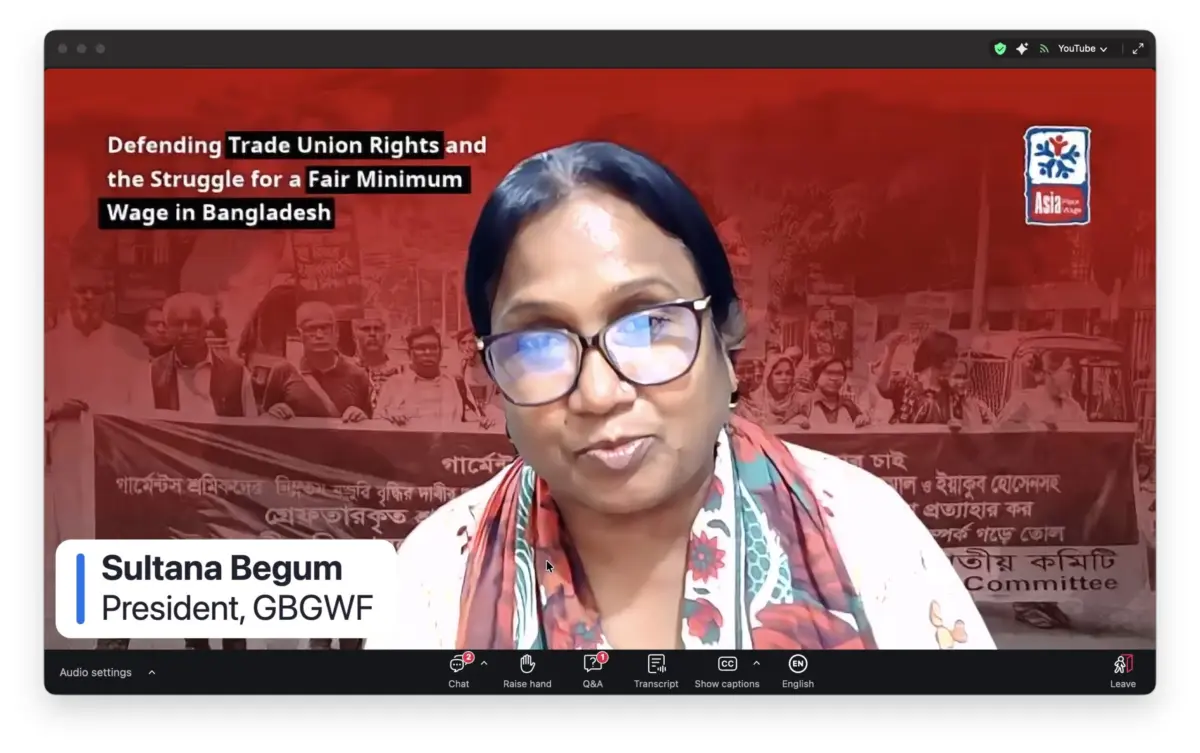
On Tuesday morning, Sultana Begum, president of the Green Bangla Garments Workers Federation, raised an urgent alarm regarding the intensifying economic precarity faced by garment workers in Bangladesh. Speaking at an Asia Floor Wage Alliance (AFWA) webinar focused on the escalating minimum-wage protests roiling the South Asian nation, she also decried what she termed an increasingly hostile environment for those seeking to exercise fundamental labor rights, including freedom of association and the right to organize.
"As a woman trade union leader, one issue deeply concerns me: the arrest, detention and harassment of trade union leaders during the ongoing workers’ movement," Begum stated through a translator. She highlighted serious concerns regarding the treatment of detained leaders, pointing to allegations of torture and persistent hurdles in securing bail. "These leaders represent thousands of workers who want to organize, raise their voices and defend their rights."
Just minutes after the webinar concluded, Begum was dragged away by police, according to the AFWA.
Before her detention, the former garment worker had articulated the critical reasoning behind workers’ demands for a monthly minimum wage of 32,000 Bangladeshi taka ($256)—a 156 percent increase from the current guaranteed baseline of 12,500 taka ($100). This figure, she emphasized, was not chosen arbitrarily. Instead, it is grounded in actual household expenditures, the surging cost of living, and the pressing need to meet essential family expenses amid persistent inflation that has continually outpaced wage growth since January 2022.
The data gathered by AFWA affiliate trade unions strongly supports these economic claims. A comprehensive survey of nearly 300 garment workers across 30 export-oriented factories revealed that while combined family incomes stood at 31,800 taka ($255), monthly household expenditures reached an average of 45,202 taka ($362). Individual workers earning 15,300 taka a month found that their income could cover only 34 percent of total household costs. Further underscoring this widespread financial insecurity, 62 percent of the surveyed workers reported carrying debt.
"Let me be clear: garment workers are not asking for luxury; they are demanding the right to live with dignity," Begum had stated. "The cost of food, housing, healthcare, transportation and education has increased significantly. Yet, workers’ wages remain insufficient to meet their basic needs."
The unrest has triggered a severe state response. At least 60 individuals, including multiple union leaders, have been arrested since the start of November amid wage demonstrations, though exact figures remain difficult to verify independently. According to the IndustriALL Bangladesh Council, 10 regional leaders from its affiliated organizations—including Ali Asgar, acting general secretary of the Garments Tailors Workers League—were taken into custody despite having no direct involvement in the ongoing unrest. Condemning the simultaneous raids on union offices and private homes, the council denounced the indiscriminate arrest of trade union leaders as fundamentally contrary to the spirit of cooperation and joint problem-solving required to navigate the crisis.
The situation on the ground has grown increasingly volatile over recent weeks. Protesting workers have blocked major highways, torched vehicles, and thrown bricks, while police and paramilitary forces have responded with water cannons, tear gas, and stun grenades. The widespread chaos, which has already resulted in the death of at least one garment worker, has forced the closure of hundreds of manufacturing facilities in key industrial enclaves such as Ashulia, Gazipur, and Savar. Among these, 65 factories have been shut down indefinitely under the "no work, no pay" provision permitted by national labor law.
The crisis deepened further on Monday when the government’s minimum wage board postponed a crucial meeting because an essential worker representative fell ill. The delay further inflamed tensions, as employers had been expected to table their formal wage proposals during the session. The rescheduled meeting is now set for Nov. 23, with a final decision on the new minimum wage structure anticipated in December. Under the timeline, workers are scheduled to receive their first revised salary payments in January 2027.
Legal experts warn that the judicial fallout is compounding the crisis. Tayebur Rahman, assistant director at the Bangladesh Legal Aid and Services Trust, described many of the criminal charges filed against workers and union leaders as fabricated. He noted that a lack of clarity regarding specific allegations has significantly complicated legal defense efforts. "Whatever I have seen from some fabricated cases, after being arrested, they are charged with an old criminal charge," Rahman explained during the webinar. "We have seen workers charged with a case that happened three months prior to the main incident."
International pressure is also mounting. On Sunday, the American Apparel & Footwear Association (AAFA)—which represents major global apparel buyers including H&M Group, Gap Inc., PVH Corp., Levi Strauss & Co., VF Corp., and Inditex—sent a letter to Prime Minister Tarique Rahman. The association urged the government to secure a fair and sustainable outcome through a credible and inclusive process, ensuring that representative employers and workers can participate meaningfully while workers express their views freely and safely.
"AAFA and its members encourage the government to ensure that the minimum wage review is conducted through effective tripartite consultation, with full respect for freedom of association and collective bargaining rights," wrote Stephen Lamar, the organization’s president and CEO. "AAFA and its members also urge all parties to ensure appropriate safeguards against violence, intimidation, and discrimination both during and after the review process."
This international intervention echoes similar appeals made by the AAFA to the government of former Prime Minister Sheikh Hasina in late 2023. During that period, protests over an 8,000-taka ($64) minimum wage reached a boiling point just months before Hasina’s ouster following mass student-led anti-government demonstrations. That upheaval resulted in four worker deaths, hundreds of injuries, and the arrest of more than 130 individuals, including union leaders. Furthermore, factory owners and authorities filed dozens of criminal cases alleging arson, vandalism, and attempted murder, placing roughly 40,000 unnamed workers at continuous risk of arrest until the charges were eventually dropped by the interim government in 2025.
What’s at Stake
Industry analysts warn that the current round of protests could escalate significantly if the final wage increase fails to meet worker expectations. Joseph Parkes, senior Asia analyst at risk intelligence firm Verisk Maplecroft, noted that Bangladesh has ranked among the 10 highest-risk countries on its Civil Unrest Index over the past three years.
Beyond domestic stability, prolonged turmoil threatens Bangladesh’s broader economic competitiveness within the regional apparel market, as neighboring manufacturing hubs like India and Vietnam increasingly position themselves as more reliable alternatives for international brands.
"The wage protests will further test the faith of international buyers after consecutive years of political turmoil," Parkes said. "Christmas ordering has already been upended by the cumulative impact of power cuts and gas shortages, and the current unrest will push delays and disruption into next year."
Parkes added that the potential return of ousted leader Sheikh Hasina from India next month introduces another layer of political risk, noting that recent demonstrations by her supporters demonstrate that her potential return, despite facing the death penalty, could prove incendiary and spark additional operational disruptions.
Pearl Pandya, senior analyst for South Asia at the Armed Conflict Location & Event Data project, suggested that ongoing labor unrest remains more consequential than the wage adjustment itself. Given the wide gap between worker expectations and employer concessions, achieving a swift and satisfactory resolution will prove difficult.
"With the timing coinciding with peak production cycles for spring/summer 2027 orders, factory owners would ordinarily be keen to resume normal operations soon," Pandya said. "If they miss shipments, they have to bear significantly higher air freight costs. However, both sides—workers and factory owners—are feeling the squeeze from rising inflation, and that makes coming to an agreement even harder." She cautioned that any heavy-handed suppression of demonstrators through factory closures or police action would likely escalate tensions further.
During a panel discussion at The Daily Star on Sunday, Towfiqul Islam Khan, additional research director at the Dhaka-based Centre for Policy Dialogue, argued that wage determination should rely on objective economic data rather than serving as a purely adversarial bargaining game between workers and employers where the government intervenes arbitrarily. He pointed to a severe lack of reliable data on regional inflation and living costs as a primary structural obstacle. Consequently, workers have concluded that mass mobilization is their only viable tool for securing higher pay.
"Workers have learned from past experience that meaningful wage decisions only happen after taking to the streets, turning disruptive street protests into an unfortunate, ingrained part of our industrial culture," Khan observed.
During the AFWA webinar, workers voiced their profound exhaustion with the status quo. Laily Begum questioned how much longer she and her colleagues could endure under current economic constraints. Emphasizing that workers are not asking for unreasonable sums, she stated that the minimum wage must guarantee access to nutritious food, decent housing, healthcare, children’s education, and a life of dignity, rather than merely sustaining survival until the end of the month.
"We have to sacrifice our own health and compromise our own personal needs," Laily Begum said through a translator. "It had been very hard surviving." Echoing Sultana Begum’s concerns about state retaliation, she added, "I want to live without fear. I want a better future for my family and the next generation of garment workers. We don’t want violence. We don’t want anyone to lose their life or freedom for demanding a fair wage. We want our government, factory owners and international buyers to listen and take responsibility."
Wiranta Ginting, international coordinator at the AFWA, asserted that any suppression of the freedom to organize inherently undermines the legitimacy of the wage-setting process itself. Genuine fairness cannot exist when workers face intimidation for exercising their fundamental rights, he argued.
"What happened to her and other trade union leaders and workers is not only a Bangladesh problem; this is happening inside the global supply chains that fill fashion retail stores," Ginting said. "Every fashion brand profiting from Bangladeshi garment workers owns a share of this responsibility, and they must use it to demand the release of every arrested union leader and worker."
Sultana Begum issued a similar final appeal to global fashion brands that reap profits from the labor of millions of Bangladeshi workers, the majority of whom are women.
"Where is their responsibility towards the people who make their products?" she asked. "International brands cannot continue to demand lower prices, shorter production lead times and higher productivity, while ignoring the poverty wages of workers. They cannot speak about sustainability, ethical sourcing, and responsible business practices while women producing their clothes struggle to afford food, rent and medical treatment."