Every website reaches its absolute peak on the day it launches. The final code branch is merged into production, the deployment pipeline completes without errors, and the digital experience goes live exactly as designed. For a brief moment, the site is perfect.
Then, the quiet decline begins.
It rarely happens because anything technically breaks. The servers remain online, the databases respond, and the front-end code continues to render cleanly. Instead, the surrounding world simply moves on. The target market evolves, brand messaging shifts, competitors release new offerings, and the carefully crafted digital footprint slowly loses alignment with the organization it represents. Within twelve months, a freshly minted website often feels like a period piece—not technically broken, but noticeably behind. Digital production teams across industries recognize this gradual decay, yet most treat it as an inevitable law of web development.
It does not have to be an unavoidable rule. In theory, a modern website could continuously improve after launch rather than drifting away from its initial standards, optimizing its own performance, code quality, and compliance while its creators focus on new initiatives.
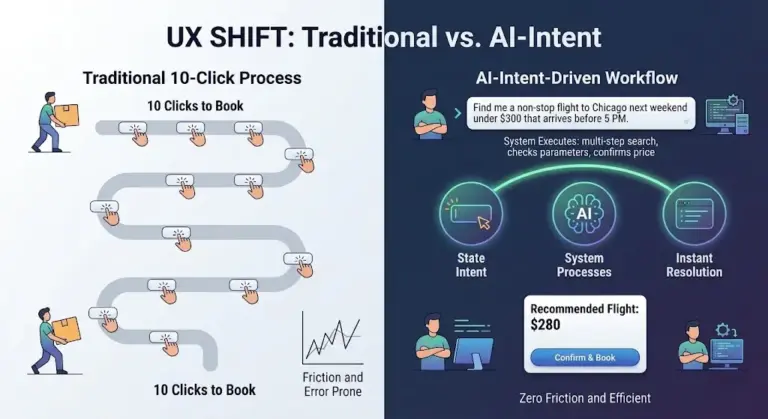
Consider how such an ecosystem operates in practice: while a development team is off-duty, an artificial intelligence agent detects that a design-system update from the previous week was never fully applied to a critical pricing page, and automatically resolves the inconsistency. A second agent scans recent assets, identifies a cluster of uncompressed images introduced during a rushed feature push, and optimizes them for faster load times. A third agent flags an accessibility regression caused by a newly added component, either repairing the code directly or queueing it for human review. The team wakes up to a platform that is measurably superior to the one they left the evening before, accompanied by a brief summary of the exact decisions that required human sign-off.
That vision represents a compelling case for autonomous digital platforms. Yet, the moment that vision is put into real-world practice, builders encounter an obstacle that has very little to do with technological capabilities: virtually nobody actually wants a corporate website that updates itself entirely on its own.
Why “Just Make It Autonomous” Is The Wrong Goal
When building with high-capability AI agents, the most obvious architectural decision appears to be delegating the entire platform to them. The theoretical goal is to allow autonomous systems to write, edit, design, optimize, and publish content continuously without human intervention. To many technology leaders, this total hands-off automation represents the logical end state of digital management—and it is typically the first concept people imagine when discussing an autonomous website.
However, real-world deployment reveals that complete autonomy is precisely what teams resist once it becomes an operational reality.
This structural disconnect became evident during the development of Fimo, an autonomous website platform created to explore the limits of continuous web optimization. Pierre Burgy and the team building Fimo initially set out with the assumption that total website autonomy was the ultimate objective. But as early users interacted with the technology, patterns of hesitation emerged.
The hesitation did not stem from a basic distrust of artificial intelligence. Rather, it arose from the organizational structure of web platforms: a modern business website has no single owner. Different sections of a single site fall under the purview of distinct teams—designers, software engineers, content marketers, brand managers, and compliance officers—and each stakeholder requires a radically different degree of operational control.
Consequently, the core engineering challenge was never simply deciding whether to trust AI agents with digital management. The real challenge lay in determining where to draw the boundary of control, and for whom. When viewed through this organizational lens, website maintenance tasks naturally divide into three distinct operational tiers.
Most Of It Is A No-brainer
The largest operational tier encompasses the mundane maintenance work that keeps a web property functioning correctly. This category represents a surprisingly massive proportion of daily site operations, consisting primarily of rule-bound, highly repetitive tasks that require no creative license.
Examples include maintaining web accessibility standards across changing templates, propagating design-system updates whenever foundational tokens are updated, identifying broken meta tags, compressing oversized media files, and updating broken links caused by historical URL updates.
+-------------------------------------------------------------------+
|                     TASKS SUBJECT TO TASTE                        |
|   (Creative direction, brand identity, messaging, visual feel)    |
|                     -> STRICTLY HUMAN CONTROL                     |
+-------------------------------------------------------------------+
|                        THE CONTEXTUAL ZONE                        |
|    (Theme defaults, layout tweaks, structural configuration)      |
|             -> USER & ROLE-DEPENDENT AUTONOMY LINE                |
+-------------------------------------------------------------------+
|                     THE 80% MAINTENANCE LAYER                     |
|  (Accessibility fixes, design token propagation, image compression)|
|               -> FULLY DELEGATED TO AUTONOMOUS AGENTS             |
+-------------------------------------------------------------------+
None of these tasks represent the core creative talent of a design or engineering team. Web professionals are not hired for their personal passion for auditing missing alt attributes on secondary pages. This category represents work that teams are relieved to pass off to automated workflows.
Furthermore, agents excel at these exact tasks because the parameters are governed strictly by unambiguous rules rather than subjective taste. An agent operating continuously in the background to enforce programmatic standards across a large digital footprint poses no threat to human creative judgment. Instead, it systematically absorbs the tedious 80 percent of web maintenance that typically falls into backlogs.
Quantifying how much routine maintenance sits within this operational layer makes the concept of an autonomous platform significantly more practical. Organizations are not relinquishing strategic judgment; they are delegating administrative chores.
Some Of It You’d Never Hand Over
On the opposite end of the spectrum sits a compact yet vital layer of creative responsibility that teams would never hand over to an autonomous system, regardless of technical capability. Though this tier comprises a small percentage of overall site modifications, it accounts for the core value of human professionals.
An AI agent can effortlessly evaluate a new web page against every configured technical rule. It can verify color contrast ratios, confirm heading hierarchy, validate design tokens, and evaluate copy against a documented style guide. What it cannot do is evaluate how a web page makes a visitor feel, nor can it determine whether a complex creative direction aligns with human taste.
That subjective assessment is precisely why professional designers and strategists exist. No level of algorithmic sophistication strips that responsibility from human oversight.
When critics resist the push toward web autonomy, this taste-driven layer is usually the first thing they cite, arguing that brand identity cannot be left to software logic. That protection is justified; the mistake lies in assuming that an entire website consists of taste-driven decisions. In reality, very little of daily maintenance involves strategic brand positioning. However, because that small fraction dictates how an organization presents itself to the world, attempting to automate every aspect of a site inevitably feels wrong to digital teams.
And A Lot Of It Depends On Who You Are
Positioned between basic operational chores and untouchable creative decisions is a broad grey zone that software platforms cannot easily standardize, because the boundary between routine work and strategic decision-making varies dramatically depending on who is managing the platform.
Consider a practical scenario: changing a website’s global default display theme to dark mode. From a technical standpoint, an AI agent can execute this configuration change across an entire front-end codebase in seconds. The operational conflict arises when deciding who holds the authority to approve that change.
For a principal designer who owns the visual identity of a platform, the default color theme is far more than a simple technical setting. It serves as a foundational brand statement regarding how the company presents itself to new visitors, meaning the designer will demand direct control over the decision.
Conversely, for a lead software engineer deploying the change, updating the default theme might be viewed as a routine single-line configuration change supported by user analytics—the exact type of task they would happily delegate to an agent so they can focus on complex application logic.
This scenario highlights a fundamental challenge in automated systems: the exact same change, executed on the exact same platform, carries entirely different levels of strategic weight depending on the stakeholder. For one team member, the task represents a high-stakes creative decision; for another, it is a routine technical update.
As a result, no default platform setting can satisfy every team simultaneously, because correctness is determined by where an individual’s professional value sits rather than the technical nature of the task itself. This reality explains why autonomy settings must be configurable on a per-task and per-person basis.
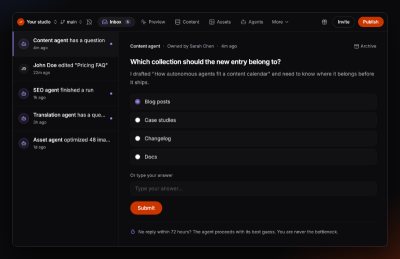
You Don’t Just Set The Autonomy: You Build The Agent
When an organization recognizes that autonomy boundaries are inherently personal and role-dependent, simple binary toggles—such as choosing between "always approve" and "fully delegate"—become insufficient. Because the location of the boundary depends on the specific nature of the operation, the fundamental unit of administrative control must be the agent itself.
This structural realization reshaped the architecture of the Fimo platform. Rather than forcing teams to select options from a static menu of pre-programmed platform behaviors, the architecture shifted toward composable agents. Under this model, teams construct and customize individual agents, explicitly defining the scope of files, components, and code systems each agent is authorized to modify.
Digital teams can build specialized agents from scratch or adapt existing frameworks to align with their specific operational boundaries:
- Accessibility Agents: Configured to run entirely unattended to maintain code compliance across public-facing templates.
- Asset Optimization Agents: Assigned to quietly compress, convert, and re-format media assets across global repositories.
- Translation Agents: Set up to automatically process multi-language localization files based on updated master strings.
- Content Agents: Kept under tight human review for any changes affecting brand messaging, customer-facing copy, or positioning.
Crucially, these agents are not static scripts. They continuously adapt based on real-world task execution and direct human feedback, meaning an operational boundary established during initial onboarding does not remain locked forever.
A modification that required explicit human approval during early deployments can eventually be transitioned to automated execution as the agent consistently demonstrates compliance with team standards. This evolution does not stem from a team lowering its quality bar, but rather from the agent earning operational trust. Autonomy becomes a dynamic boundary that gradually reduces manual workloads over time.
Start Narrow, and Widen As You Trust It
Deploying an autonomous website platform does not require turning over full operational control on day one. In enterprise environments, deployment follows the opposite trajectory: teams delegate minor, low-risk chores, observe system behavior, and progressively expand the agent’s scope as confidence builds.
To support this gradual trust-building process, complete visibility into agent activities is essential. Effective autonomous platforms maintain detailed execution logs, audit trails, and visual before-and-after diffs for every automated modification.
Trust develops not through theoretical reassurances, but through transparent inspection mechanisms that allow human operators to review exact code and content changes. When an agent silently fixes a minor visual bug or broken dependency that would have otherwise gone unnoticed, and the engineering lead can review the precise change history, subsequent delegation decisions become straightforward.
To prevent human review from creating new workflow bottlenecks, modern platforms introduce time-boxed approval windows. If a human reviewer does not intervene within a specified timeframe for a low-risk change, the platform proceeds with automated deployment based on pre-configured parameters. This balance ensures that human oversight remains available for strategic decisions without stalling continuous maintenance schedules.
The Frozen Site Is The Real Risk
The most common concern voiced by digital teams contemplating autonomous architecture is the risk of an agent altering production code without direct human oversight. However, looking at the wider digital landscape reveals that the far greater commercial risk is maintaining a frozen site that never changes at all.
A static website does not remain safe over time; it simply experiences gradual decay. It progressively falls out of alignment with market realities, accumulating subtle technical debt, broken references, and outdated messaging until it represents an organization that effectively no longer exists in that form.
Ultimately, the goal of website autonomy has never been to remove human professionals from the development process. Its true purpose is to eliminate digital decay.
By automating routine maintenance, teams prevent their launch-day code from remaining the peak version of their platform. Organizations can apply their creative judgment to high-impact strategic decisions, while autonomous agents maintain the remaining 80 percent of routine operations. By establishing precise boundaries around human value and allowing software agents to earn operational trust, modern web properties can finally keep pace with the organizations they represent.