Toronto’s Financial District is defined by a striking dual personality. During the traditional workweek, its towering commercial corridors operate at a relentless, fast-paced rhythm, filled with corporate professionals navigating the streets in polished business-casual attire. By the time the weekend arrives, however, the neighborhood undergoes a complete transformation, exhaling into a much slower, more contemplative pace. Situated right in the heart of this dynamic urban landscape at 333 Bay Street, a new Japanese steakhouse named Shinji has opened its doors with the ambitious goal of bridging these two seemingly disparate worlds, effortlessly marrying a lively, highly social atmosphere with the serene, sanctuary-like calm of an immersive design environment.
Designed by the acclaimed Toronto-based architecture and multi-disciplinary design firm Odami, the restaurant envelops visitors in a rich tapestry of color, texture, and cultural narrative. Yet, despite its bold palette of deep indigo blues and the mesmerizing presence of linear lighting pendants that stretch dramatically across the ceiling, the interiors maintain a remarkable sense of restraint. The space remains firmly grounded in authentic materials and thoughtful, traditional Japanese touches that prioritize craftsmanship and longevity over fleeting design trends.
The conceptual foundation of Shinji draws unexpected yet profound inspiration from Japan’s storied denim industry. Rather than translating the material literally through obvious tropes, Odami utilized denim as the primary conceptual lens for the entire project. As a cultural artifact, denim occupies a unique space in human utility: it functions simultaneously as a luxury fashion staple and a rugged workwear basic, expertly straddling the line between high-brow and low-brow culture. Furthermore, denim is celebrated for its ability to develop a rich, personal patina over time, improving gracefully with wear and age. Keeping this philosophy at the forefront, the design team approached the architecture of Shinji with an unwavering emphasis on durability, material honesty, and the deep, evocative hues of indigo.
Shinji represents the latest hospitality endeavor from Harlo Entertainment, the prominent local restaurant group widely recognized for curating beloved culinary destinations such as Linny’s and Sunny’s Chinese. True to the operating ethos of its parent group, the steakhouse brings together an array of high-quality imports—including custom-crafted tableware and staff uniforms sourced directly from Japan—in the genuine spirit of traditional Japanese hospitality, known as omotenashi. From the meticulously planned architectural interventions down to the smallest detail on the menu, these thoughtful touches and an emphasis on shared plates combine to foster an immediate atmosphere of care and communal dining.

At the culinary helm of the operation is executive chef and partner Jia Zou, who, alongside his talented team, traveled directly to the source to secure Shinji’s seasonal ingredients and master its precise cooking techniques. During their extensive travels through Japan, Zou and his team met directly with regional producers and agricultural experts in locations such as Himeji and Kobe to deepen their understanding of authentic Kobe beef and other top-tier gastronomic products. The resulting menu reflects this uncompromising dedication to authenticity, featuring standout dishes that showcase both traditional preparation and contemporary flair. Diners can experience offerings such as the mouth-watering A5 striploin, delicate matcha soba salad, and the restaurant’s signature Shinji Surf and Turf.
Reflecting on the formative research trip that shaped the restaurant’s identity, Zou explains that the team spent a considerable amount of time traveling throughout Japan, eating everywhere they possibly could, from humble neighborhood establishments to some of the country’s most celebrated fine dining institutions. What ultimately stayed with them long after returning to Canada was not merely the exceptional quality of the food, but rather the profound level of care and intention that went into every single meal. Exceptional ingredients, rigorous technique, and genuine hospitality became the foundational benchmark for everything they ultimately wanted to create at Shinji.

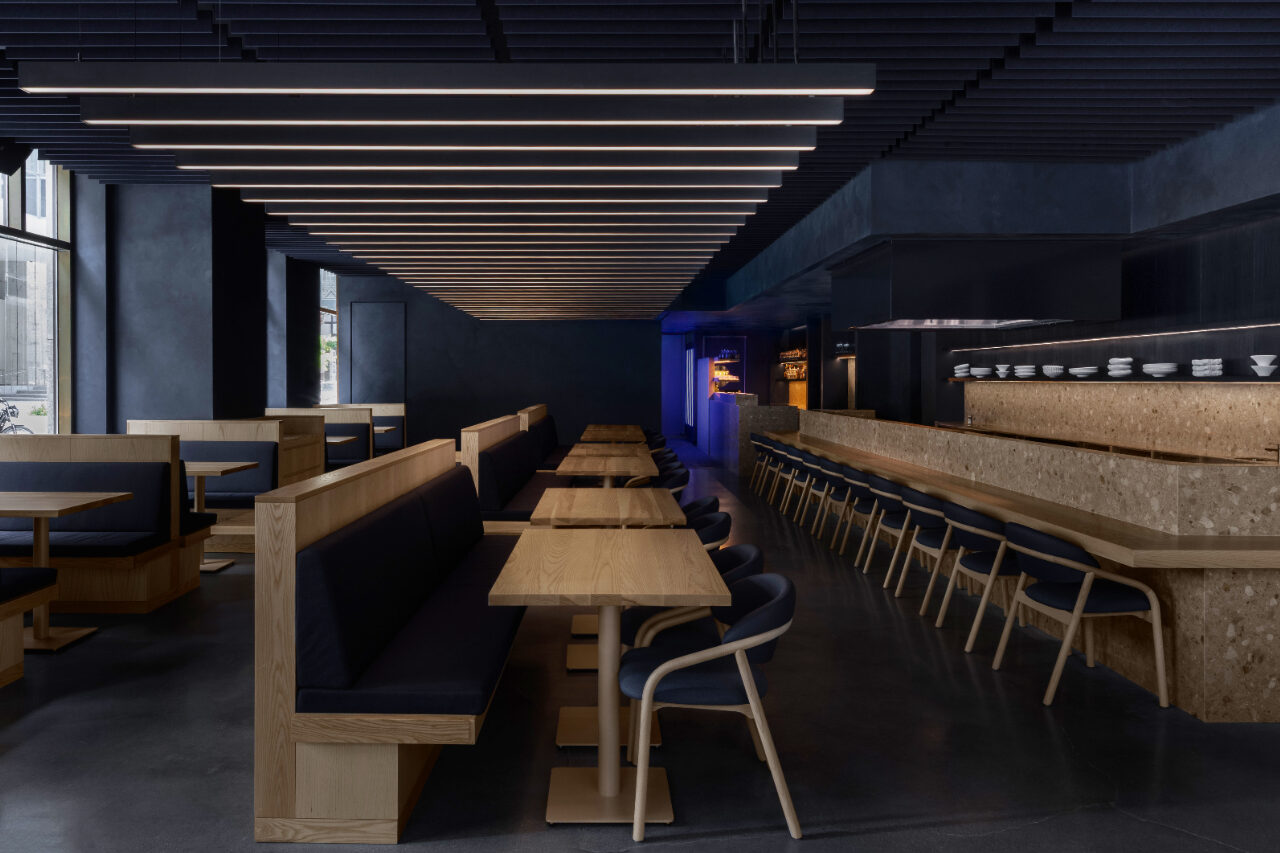
That exact attention to detail is immediately palpable from the moment guests arrive, carrying seamlessly into the physical spatial experience. Visitors enter the restaurant via a gentle, inviting ramp bordered by blue-stained wood and specialized acoustic paneling, offering a momentary threshold before catching their first unobstructed glimpse of the central dining room, where the culinary team works in full view of the patrons. Inside this main gathering space, the structural walls are drenched in a moody, dark blue limewash, while the overhead ceilings are fitted with matching blue acoustic baffles. Upholstery in the exact same inky shade covers both the comfortable banquettes and the locally sourced ash wood seating. Pale, neutral stone surfaces and warm, ambient lighting provide a sophisticated counterpoint to the dominant indigo, resulting in an interior environment that feels intensely tactile and subtly elegant.
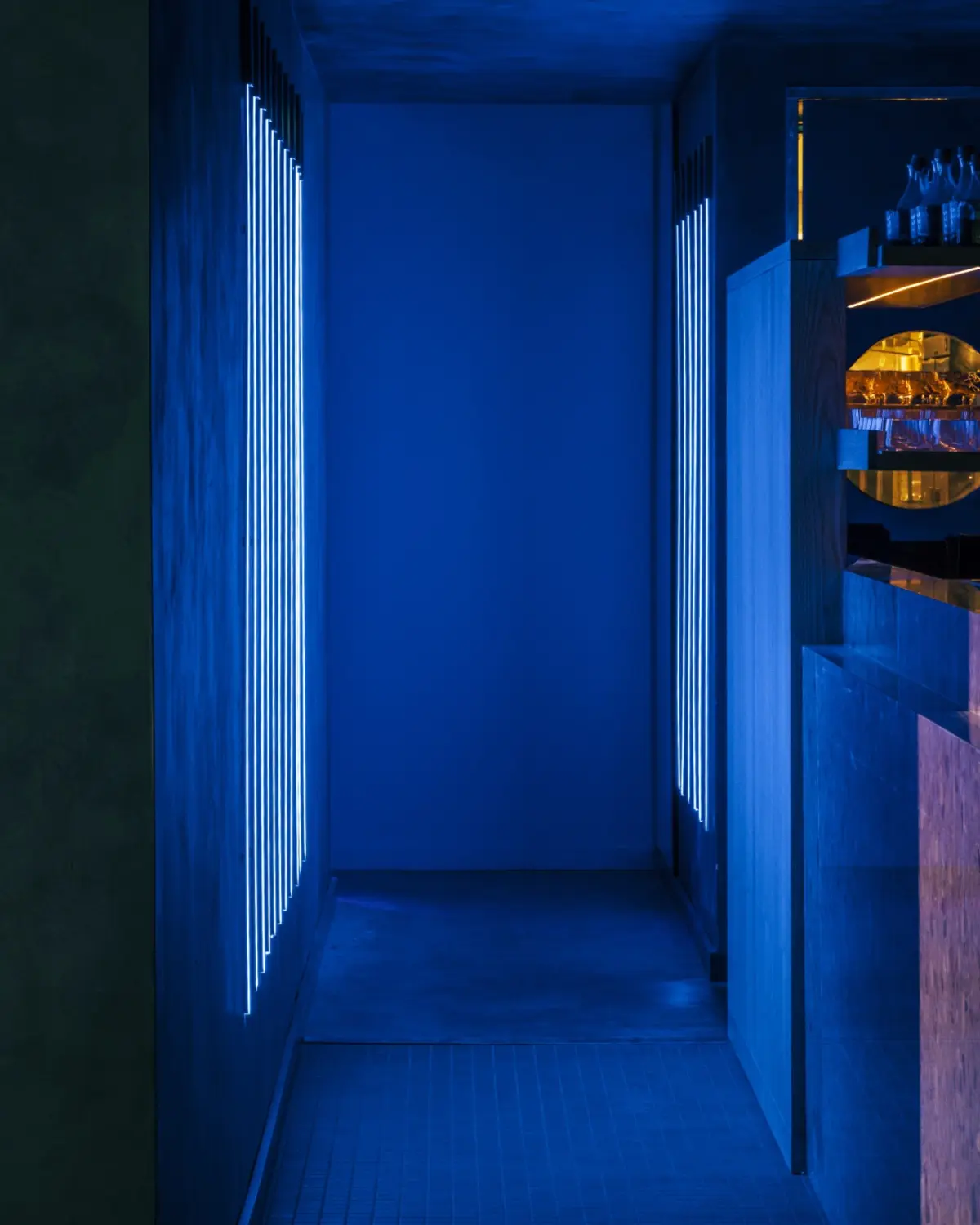
As guests move deeper into the restaurant, the spatial journey unfolds as a sequence of gradual discoveries. Among these, the trip down the hallway toward the restroom emerges as one of the most surprising and delightful architectural moments within the venue. As visitors traverse the corridor, the deep, dark walls gradually brighten into a more vivid, saturated shade of blue, ultimately culminating in a striking, magenta-tinted bathroom. This vibrant space is directly inspired by the neon-drenched atmosphere of karaoke bars and the electric energy of Japan’s nocturnal nightlife culture. True to the overarching design philosophy of the restaurant, this unexpected burst of color is never treated as a cheap spectacle or a superficial gimmick; rather, it stands as a deeply considered, respectful nod to the multifaceted culture that originally inspired the project.

The integration of these thoughtful spatial transitions, combined with an uncompromising culinary program rooted in direct relationships with Japanese producers, establishes Shinji as a significant new addition to Toronto’s evolving dining scene. By successfully channeling the dualities of its Financial District home and the nuanced cultural narratives of Japanese craft, the restaurant offers an environment where urban professionals and weekend diners alike can experience a harmonious blend of sophisticated design, rigorous culinary execution, and authentic hospitality.