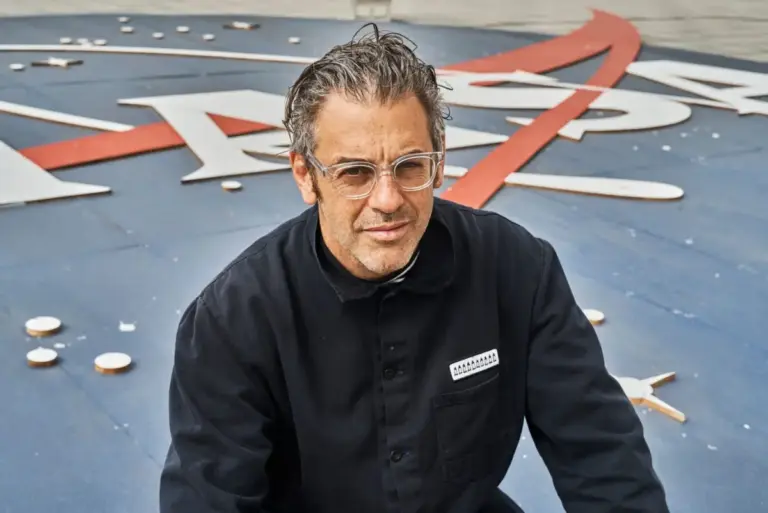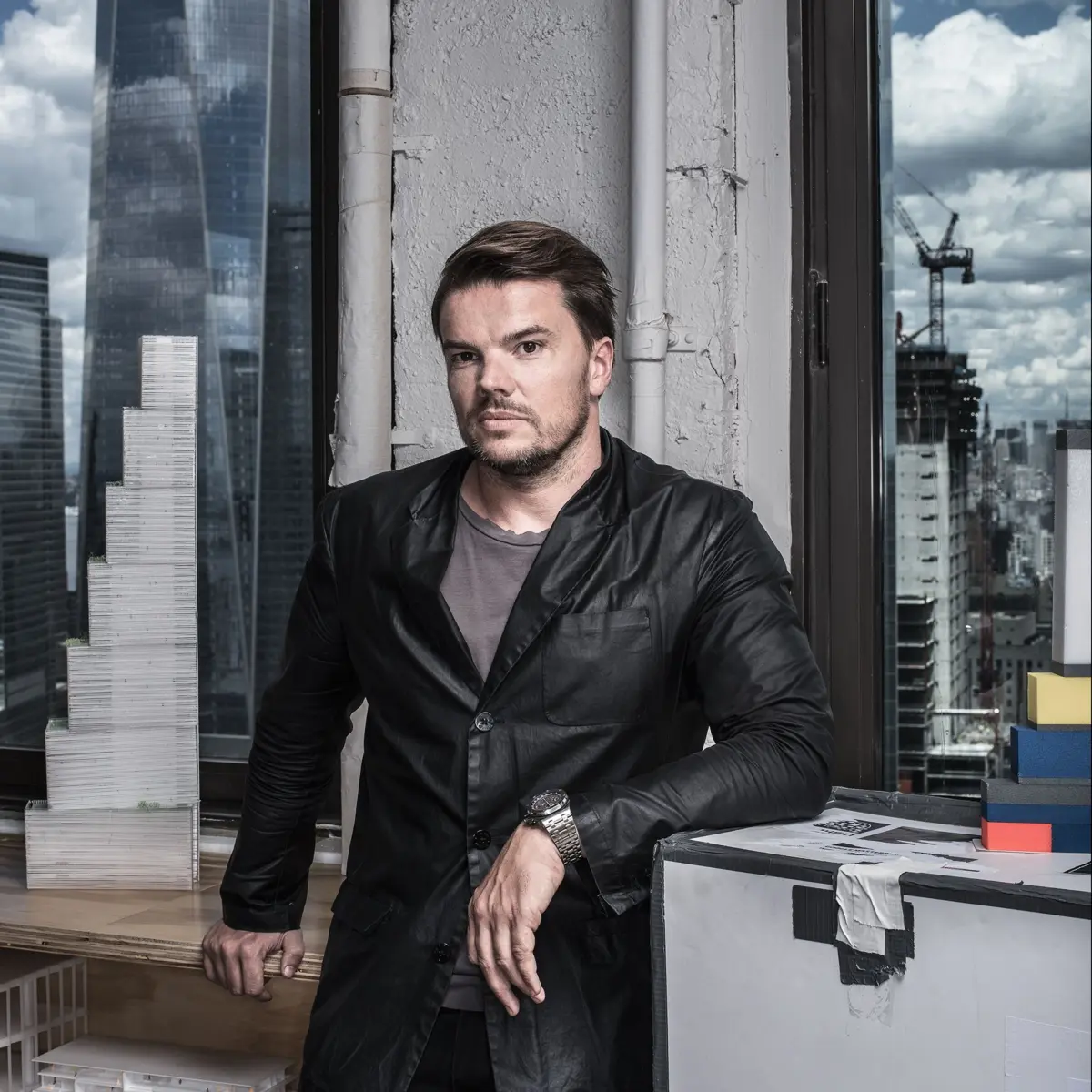
On a misty April day in Lower Manhattan, Bjarke Ingels stood on the roof of an old brick building above a cobblestoned street, the collar of his black coat rakishly popped. The 40-year-old Danish architect was shooting a promotional film for the most important commission of his young career: his design for the skyscraper known as Two World Trade Center.
At the time, the project was still a work in progress, and his primary client—media magnate Rupert Murdoch—had yet to formally sign off. Yet Ingels refused to let doubt stand in the way of his vision. He had obsessed over every line and image, telling his director that he wanted viewers to swoon. While Murdoch’s plan to relocate his companies was still one of New York real estate’s best-kept secrets, Ingels could not wait to share the news.
Between takes, Ingels pointed to a void in the densely packed Manhattan skyline, tracing the profile of a skyscraper that, for the moment, only he could see. From this perspective, his design resembled a stack of seven blocks, ascending like a staircase toward One World Trade Center, its monolithic neighbor.

"In a way, it is almost like a physical manifestation of the spirit of America," he said. "Out of many, one."
If completed, the tower will stand among the tallest buildings in New York City and serve as the final addition to the master plan for the redeveloped World Trade Center site. The ensemble of buildings rings two cascading pools that pay tribute to the roughly 3,000 people who died in the terrorist attacks of September 11, 2001. But Ingels was focused on making his own history rather than dwelling on the past. "The memorial is about the memorial," he noted. "The tower should be about the living city."
Eclecticism on Demand
Ingels is fond of saying that architecture is "the art of turning fiction into fact." He boasts many talents—as a draftsman, a salesman, and the charming cultivator of his own winning image—but his greatest asset is a gift for storytelling: an exceptional ability to construct a narrative around practical necessities.

Often, his designs careen in fantastical directions. He designed a waste-to-energy plant in Copenhagen featuring a slanted roof that doubles as a recreational ski slope, complete with a smokestack engineered to puff a symbolic ring of steam each time it emits a ton of carbon dioxide. For a proposed expansion of Google’s campus in Mountain View, California, Ingels—collaborating with designer Thomas Heatherwick—envisioned a wildly elaborate complex of geodesic domes, imagining a lifestyle of biking, hiking, and coding inside a sunlit glass terrarium.
Such imaginative flights have made Ingels famous and highly sought-after at an age considered precocious by architecture standards. Yet fame can be a deceptive indicator in his profession, where an architect’s work often reaches the eye only after a years-long journey.
Ingels’ largest project to date at the time, a striking pyramidal apartment building under construction along Manhattan’s West Side Highway at 57th Street known as Via 57 West, was just about one-third the size of Two World Trade Center. "At the moment we are working seriously on one of the most daunting buildings in downtown New York," Ingels acknowledged. "We still haven’t completed a skyscraper."

With Two World Trade Center, Ingels believed he had found a way to create a new kind of high-rise work environment, one that turns a form fundamentally vertical and hierarchical into a space for horizontal interaction. Then came the laborious part: proving he could transform that captivating story into hard facts on the ground.
To realize his design, Ingels had to continually prove its value to a pair of hard-nosed octogenarians: Rupert Murdoch and Larry Silverstein, the developer who has controlled much of the World Trade Center rebuilding. Murdoch and Silverstein still had to agree on a long-term lease that would allow the $4 billion skyscraper to be financed.
"There’s a lot of drama with the deal right now," Ingels said during his film shoot. "I don’t know how worried I should be."

Even if the parties came to an agreement, there were other hazards to navigate: a volatile real estate market, the political melodrama inherent in building on a scene of mass murder, and an often inflexible government agency in the Port Authority of New York and New Jersey, which owns the land beneath the Trade Center buildings.
For 14 years, these factors had conspired to keep the redevelopment process lurching along unpredictably, leveling many an architectural ambition. Ingels’ design had displaced an earlier one by Lord Norman Foster. To avoid his predecessor’s fate, Ingels had to balance the sometimes conflicting demands of Murdoch and Silverstein, who would be marketing the top half of the building as office space. And he had to do it while juggling other high-profile clients who had recently retained his firm, Bjarke Ingels Group (BIG).
Ingels’ dazzlingly swift rise has inspired awe and envy among his peers. Just as one triumphant building can make an architect’s reputation, however, it takes only one disaster to ruin it. Yet Ingels, never short on bravado, said he relished the pressure, comparing it to a Zen exercise of turning the force of an adversary into one’s own strength.

Negotiating Obstacles and Realities
The first force Ingels had to overcome at the World Trade Center was inertia. Silverstein thought he had a perfectly good design from Foster and harbored serious concerns about Ingels’ early drawings, fearing the stacked structure would look asymmetrical and teetering from certain perspectives. Silverstein nearly rejected the entire deal until an endorsement from the architects of other World Trade Center buildings changed his mind.
Shortly after, Ingels faced a rigorous grilling from Rupert Murdoch himself in a conference room overlooking the site. Murdoch’s deepest concern boiled down to a fundamental question: Why doesn’t it fall over?
With assistance from David Childs, the architect of One World Trade Center, Ingels explained that the leaning effect was an optical illusion. The unorthodox stepped form of the building resulted from placing the inner core—which houses a high-rise’s elevators—in an off-center position. This layout produced expansive interior spaces for newsrooms, views of the Trade Center plaza for Fox News studios, and outdoor terraces. Murdoch was ultimately sold on the concept.

Ingels also counted on a powerful ally in James Murdoch, Rupert’s son and corporate heir apparent. As the moving force behind the decision to relocate 21st Century Fox and News Corp. from an aging building near Rockefeller Center, James sought an open, loftlike, creative workplace rather than a traditional starchitect tower. Ultimately, they ended up at the World Trade Center with Ingels, praising his ability to take a complex set of constraints and create something surprising and effective.
However, bridging the gap between imaginative design and engineering reality proved grueling. Piggybacking a new skyscraper onto Foster’s preexisting foundation—built to accommodate a $4 billion underground transportation hub—created tricky structural problems in the lobby and lower floors. Furthermore, security standards mandated by the New York Police Department required all facades at the World Trade Center to be made of heavier laminated safety glass, driving up estimated construction costs significantly.
For weeks, as Silverstein and Murdoch navigated tense lease negotiations, the fate of the project remained in doubt. Engineers remained anxious about the massing and structural loads, putting drastic alterations on the table. Ingels managed to avert disaster by agreeing to painful structural changes, eventually winning praise from Silverstein executives for turning the design around.

As BIG continued to expand—opening new offices on Broadway near Wall Street and growing to hundreds of employees across New York and Copenhagen—Ingels maintained his signature optimism. By June, a tentative deal between Silverstein and Murdoch was in place, allowing the design for Two World Trade Center to be publicly unveiled after receiving a final blessing from master planner Daniel Libeskind.
While initial public reviews of the design were largely positive, Libeskind and other industry veterans noted that the true challenge of architecture lies in navigating the complex space filled with economics, society, power brokers, and politicians. Changes to the design continued to emerge, including shifts in height and critiques from fellow developers like Douglas Durst.
Despite the hurdles, Ingels remained steadfast in his belief that pragmatic boundaries and utopian ambitions are not mutually exclusive. Whether designing flood defense systems like the Dryline, expansive campus master plans for the Smithsonian, or revolutionary corporate office towers, Ingels continued to view architecture as an intricate equation waiting to be solved.

"I really like this idea that architecture is the art and science of trying to make everybody happy," Ingels reflected. "Potentially, somewhere out there, there’s a design that can actually satisfy every dream, by being different."