Every web project follows a familiar trajectory. On the day a website launches, the final code branch merges, the design system aligns perfectly, and the site enters the public domain in its most pristine state. Briefly, it is exact, polished, and fully representative of the company’s vision. Yet, almost immediately after going live, that ideal state begins to deteriorate.
The degradation is rarely caused by broken infrastructure or server crashes. Instead, it stems from a quieter, more pervasive challenge: a lack of time and resources to keep the digital storefront current. Markets move, corporate messaging shifts, competitors launch new features, and subtle design token changes fail to propagate across every page. Within a year, a site that was once cutting-edge turns into an unintentional period piece—technically functional, but fundamentally left behind.
While web teams historically accepted this post-launch decay as an inevitable law of nature, the emergence of autonomous AI agents promises a different future. The concept envisions websites that continuously optimize themselves in the background, updating accessibility attributes, compressing forgotten assets, and maintaining design integrity while human teams focus on higher-level priorities. However, as Pierre Burgy, developer of the autonomous website platform Fimo, discovered during the platform’s development, realizing this vision reveals a fundamental hurdle that has little to do with technology: almost nobody actually wants a website that changes entirely on its own.
Why “Just Make It Autonomous” Is The Wrong Goal
When building with capable AI agents, the initial impulse is often to grant them sweeping authority across an entire digital ecosystem. The idea of letting autonomous systems write copy, modify components, optimize performance, and publish updates directly without human intervention sounds like the natural destination for modern digital operations. It is precisely what most people visualize when introduced to the concept of an autonomous website.
In practice, however, complete hands-off automation is the very thing stakeholders resist once faced with its reality. Burgy and his team at Fimo uncovered this insight by initially attempting to build for total site autonomy, only to witness how real-world teams interacted with the platform. When handed a fully autonomous system, users did not enthusiastically embrace complete automation; instead, they hesitated.
This hesitation did not stem from inherent technical skepticism or distrust of AI performance. Rather, it pointed to a core structural reality of modern organization design: an enterprise website rarely has a single owner. Different sections of a digital platform belong to distinct stakeholders—marketing managers, brand strategists, engineering leads, and product designers—and each individual holds a vastly different comfort level regarding automated updates. Consequently, the primary engineering challenge was not proving whether agents could execute changes reliably, but determining precisely where to draw the boundary of control for every specific user and task.
Once framed around human ownership, the maintenance workload splits cleanly into three distinct categories.
Most Of It Is A No-brainer
When evaluating the work required to maintain a digital property, the vast majority of tasks fall into a predictable, rule-bound category. A significant portion of website upkeep consists of tedious, highly repetitive maintenance that provides little creative fulfillment.
Consider the daily mechanics of site maintenance: verifying color contrast and markup structure to maintain accessibility compliance across shifting pages; propagating design system updates across legacy templates whenever a design token moves; repairing broken meta tags; detecting rot in internal links following URL changes; or compressing large asset files pushed during rushed deployment cycles.
None of these tasks represent the core creative talent for which digital teams are hired. No designer or engineer measures their professional contribution by their ability to manually locate missing image alt attributes or fix broken canonical tags. Because these operational responsibilities are governed by strict technical rules rather than subjective taste, they represent the exact domain where automated agents excel.
Delegating this mundane workload to autonomous agents offers immediate operational relief without threatening creative autonomy. By allowing background agents to quietly keep this foundational layer correct across an entire site, teams can offload roughly 80 percent of their maintenance burden. Recognizing that the bulk of site degradation happens within these mechanical details makes the prospect of an autonomous platform significantly less intimidating. It shifts the paradigm from surrendering executive control to simply delegating digital chores.
Some Of It You’d Never Hand Over
At the opposite end of the spectrum sits a critical subset of work that creative professionals would never hand off to an automated system, regardless of the technology’s sophistication. Though it accounts for a smaller percentage of overall page maintenance, this domain represents the central reason creative roles exist.
An advanced AI agent can effortlessly audit a newly designed landing page against every quantitative rule supplied to it. It can verify that text-to-background contrast passes standards, ensure proper heading hierarchies, confirm token accuracy, and cross-reference body copy against a corporate style guide. What the agent cannot do is decide how a page should feel, or evaluate whether a visual layout succeeds in terms of artistic taste and brand expression.
This subjective judgment remains firmly human. When designers and brand directors voice skepticism toward autonomous websites, this high-taste domain is invariably what they are working to protect. The mistake in early automation models was assuming that an entire site consists of high-taste decisions, or conversely, that high-taste decisions could be reduced to rule-bound calculations. Protecting this small, high-value core is essential, and it explains why absolute site-wide automation feels inherently flawed.
And A Lot Of It Depends On Who You Are
Between mundane technical maintenance and high-level creative vision lies a complex middle ground where task authority cannot be universally defined. In this space, the boundary between automated execution and human oversight depends entirely on who is evaluating the task.
To illustrate this dynamic, Burgy points to a common operational choice: changing a website’s default appearance to dark mode for incoming visitors. From a purely technical perspective, an AI agent can execute this transition across a codebase in a matter of seconds. The critical friction lies in who has the authority to approve the change.
For a lead brand designer who guards the organization’s visual identity, the default color theme is far more than a technical setting. It represents a fundamental brand statement regarding how the company introduces itself to the world, making it a decision that demands human oversight. Conversely, for a software developer focused on shipping feature updates, changing a site default based on clear operational rationale feels like a straightforward technical adjustment—a routine task best handled by an agent so the developer can move on to other priorities.
This dilemma highlights why standardized automation settings consistently fail across multidisciplinary teams. The exact same modification carries entirely different levels of strategic weight depending on the stakeholder involved. What one professional views as a quick administrative chore, another views as a critical expression of brand strategy. Because a single product configuration cannot reconcile these conflicting perspectives, control mechanisms must be structured granularly around individual roles and specific tasks.
You Don’t Just Set The Autonomy: You Build The Agent
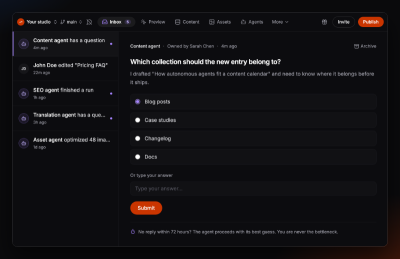
Recognizing that operational boundaries vary by individual led the team behind Fimo to rethink how automation is configured. Rather than offering a simple binary toggle between "approve" and "delegate," modern autonomous architectures require modular control mechanisms where users shape the agents themselves.
In this model, control shifts from site-wide toggles to customizable, domain-specific agents. Teams do not select from a static list of automated behaviors; instead, they compose specialized agents, explicitly defining what each module can inspect, modify, or publish. An engineering team might deploy an accessibility agent authorized to run entirely unattended, while maintaining a strict content agent that flags all brand messaging changes for manual human review.
Crucially, these specialized agents are designed to learn and adapt over time. As an agent executes tasks and absorbs feedback from human reviews, the boundary of what it is allowed to handle autonomously can evolve. A task that initially required explicit human approval can gradually be shifted to full delegation as the agent demonstrates consistent accuracy. The boundary between automated execution and human sign-off becomes a dynamic threshold that expands as trust is earned, continuously reducing operational friction for the human team.
Start Narrow, and Widen As You Trust It
Transitioning a site toward autonomous maintenance is rarely an all-or-nothing event. Instead, adoption occurs incrementally as teams establish confidence in agent behavior through clear operational transparency.
To build this trust, autonomous platforms provide detailed execution logs, historical run records, and side-by-side before-and-after visual comparisons of every proposed change. Rather than asking teams to trust AI updates blindly, the system allows users to inspect exactly how an agent evaluated and resolved a technical issue. When a user observes an agent quietly correcting an obscure accessibility flaw or optimizing an uncompressed asset without breaking layout integrity, delegating subsequent maintenance tasks becomes a natural progression.
Furthermore, configurable deadlines prevent human approvals from creating persistent operational bottlenecks. If an assigned reviewer does not intervene within a specified timeframe for routine updates, the agent can proceed according to pre-established rules. This framework ensures that while human oversight remains available, critical site maintenance is no longer delayed by approval queues.
The Frozen Site Is The Real Risk
Concerns regarding autonomous websites typically center on the fear of an agent publishing an unauthorized change. However, when viewed against the reality of digital lifecycle management, the greater operational threat is a static, unchanging site.
A website that remains completely frozen post-launch does not maintain its quality or authority; it steadily drifts into irrelevance. It fails to reflect evolving product capabilities, allows subtle technical bugs to compound, and gradually misrepresents the organization it was built to serve.
Ultimately, the objective of web autonomy is not to eliminate human oversight or displace creative design teams. The goal is to eliminate systemic site decay. By delegating repetitive maintenance chores to specialized AI agents while reserving strategic decisions for human judgment, organizations can ensure their websites continuously improve long after launch day.