The rapid evolution of web standards and front-end capabilities continues to reshape how developers build user interfaces. As browser vendors introduce new specs and community engineers push the limits of modern layout engines, a fresh wave of techniques has emerged to address long-standing challenges in user experience, accessibility, dynamic styling, and feature detection. From native HTML elements replacing legacy JavaScript APIs to innovative CSS functions that extract grid metrics directly into custom properties, the modern web platform is providing developers with more declarative, performant, and maintainable options than ever before.
Recent technical disclosures and discussions across the web development community highlight how these new specifications are taking root. Key updates include refined hover behaviors using interest invokers, declarative location permissions, low-overhead syntax highlighting via the Custom Highlight API, and upcoming layout utilities like balanced flex wrapping and class prefix selection.
Tooltip Interaction Design and the Rise of Interest Invokers
Tooltip user experience has long been a tricky puzzle for interface designers. Standard tooltips frequently trigger accidentally when a user inadvertently sweeps their cursor across an interactive page, cluttering the view and disrupting reading flow. To solve this, web developer Abhishek Jakhar recently analyzed why tooltips benefit from a deliberate trigger delay paired with instantaneous dismissal.
Under this design pattern, a brief delay prevents accidental activations during casual pointer movements across the screen. However, once the user intentionally hovers over a target long enough to reveal the tooltip, moving away should dismiss the element immediately so it does not obscure adjacent content. Jakhar demonstrated practical implementation strategies for this model, while noting a crucial edge case: if the hoverable interactive region is excessively small, micro-movements of the cursor can accidentally trigger a premature exit, suggesting that small hit targets may still require a slight dismissal delay to prevent flickering.
Building upon Jakhar’s interaction model, CSS pioneer Chris Coyier introduced a modern, native approach leveraging HTML interest invokers. This emerging web specification introduces two specialized CSS properties: interest-delay-start and interest-delay-end. These properties grant developers direct control over the activation and deactivation timing of interest-driven UI components entirely in HTML and CSS, eliminating the need for complex JavaScript event listeners and timer management.
While interest invokers are currently supported natively only within Chrome, the implementation serves as a prime example of progressive enhancement. Developers can implement these standard declarative properties today, allowing modern browsers to render optimal tooltip timing automatically while maintaining functional fallbacks for older client environments.
<geolocation> and How to Use It Today
Obtaining user location data through the traditional JavaScript Geolocation API has historically presented significant developer experience friction. The legacy process involves navigating complex hardware dependencies—including GPS satellites, local Wi-Fi networks, and cellular towers—while simultaneously managing rigid, browser-level permission dialogs. Once a user denies a location request in traditional browser prompts, re-prompting or changing that permission status requires cumbersome user manual navigation through browser security settings.
The introduction of the experimental <geolocation> HTML element aims to streamline this process by turning location requests into a declarative, permission-aware user interface element. However, because native location prompts carry sensitive privacy and security implications, the <geolocation> element introduces specific styling restrictions to prevent UI spoofing, clickjacking, and unauthorized visual overlays.
Because native support for the <geolocation> element is currently confined to Chrome, recent technical analyses have focused on strategies for integrating the element alongside the legacy Geolocation API. By employing progressive enhancement, front-end engineers can implement the new <geolocation> tag for modern Chrome instances while seamlessly falling back to standard JavaScript API calls in other browsers, enabling immediate production adoption without compromising cross-browser compatibility.
MicroLighter: A ::highlight()-Based Syntax Highlighter
Code syntax highlighting on the web has traditionally relied on heavy DOM manipulations. Legacy highlighters typically parse raw code strings and wrap every token, keyword, and string literal in dozens or hundreds of individual <span> elements. This approach bloats the DOM tree, increases memory usage, and negatively impacts rendering performance on complex or lengthy code blocks.
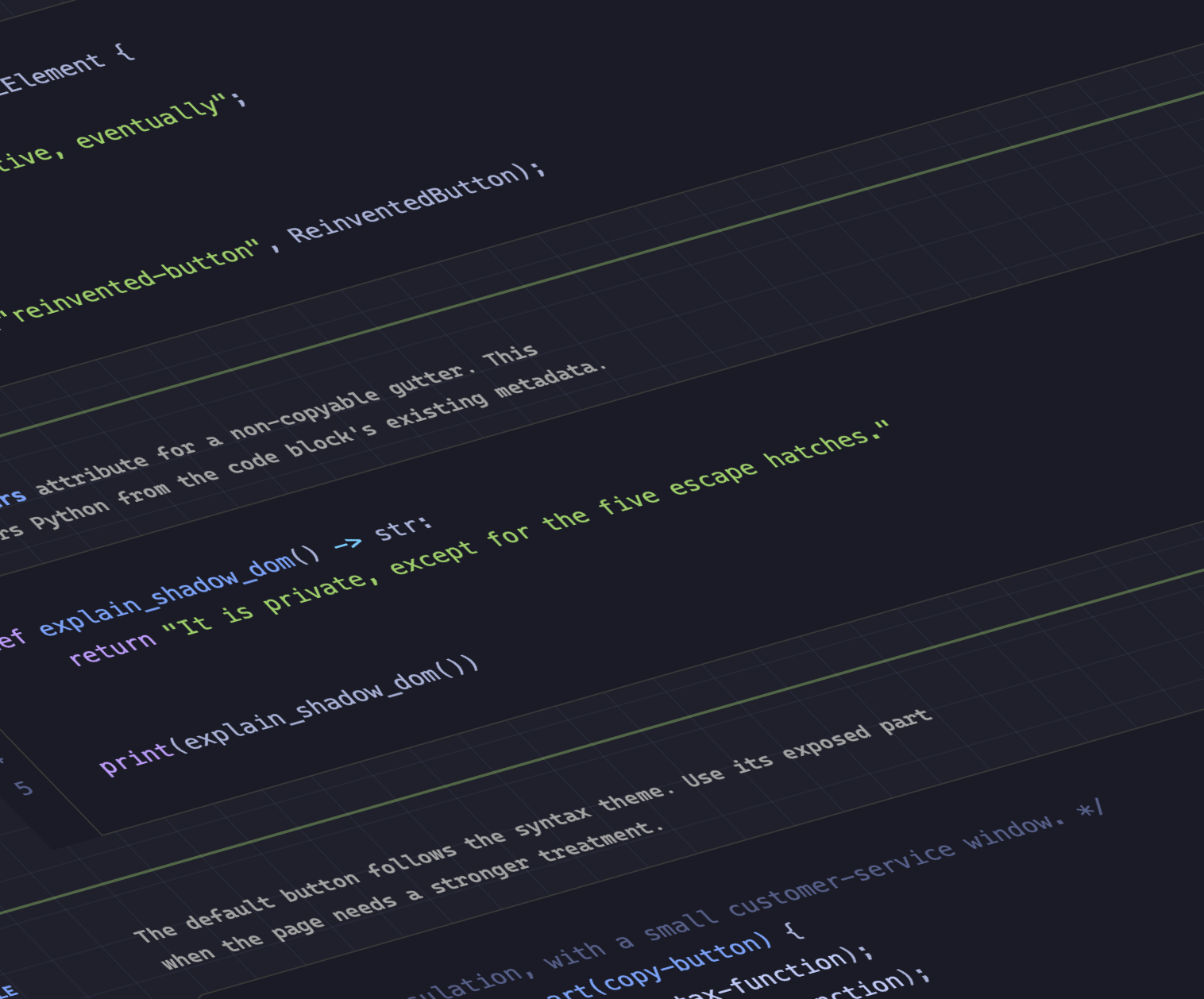
To address these performance bottlenecks, web developer Dave Rupert created MicroLighter, a lightweight syntax highlighting utility built directly on top of the browser’s native Custom Highlight API and the ::highlight() CSS pseudo-element. The Custom Highlight API allows developers to programmatically define text ranges within the document and apply arbitrary CSS styles to those ranges without adding structural HTML nodes to the DOM.
Rupert’s implementation, alongside detailed commentary from web developer Geoff Graham, demonstrates how the Custom Highlight API significantly streamlines client-side syntax highlighting. By shifting the rendering workload from DOM node creation to engine-level text painting, tools like MicroLighter offer significant performance benefits, particularly for content-heavy sites, documentation portals, and interactive code sandboxes.
How to Get CSS Grid Information into CSS Variables
CSS custom properties have radically expanded the capabilities of modern stylesheet architectures, but retrieving structural metadata directly from layout engines has traditionally required JavaScript calculations. In a novel CSS technique, developer Temani Afif demonstrated a method for extracting structural CSS Grid metrics directly into CSS custom properties using pure CSS.
Afif’s approach allows stylesheets to capture dynamic grid information, including the total count of rows and columns, as well as the exact spatial coordinates (x and y index positions) of individual grid cells. Currently, this technique requires the target grid layout to utilize equal-width columns. However, as CSS layout specifications and calc functions continue to mature, browser support for flexible column grid tracking is expected to expand.
A notable practical application of this technique is the calculation of hover proximity using modern CSS alone. By exposing grid cell coordinates as custom properties, stylesheets can dynamically evaluate the relative physical distance between the user’s cursor and surrounding elements, enabling proximity-based visual feedback and interactive grid effects without attached JavaScript hover event listeners.
Dark Mode Architecture: Evaluating Two-State Versus Tri-State Implementations
The implementation of dark mode interface toggles remains a subject of active architectural debate among web standards advocates. The primary point of contention centers on whether application themes should offer a strict two-state choice or a flexible tri-state selection model.
Web developer Lea Verou advocates for a streamlined two-state system (Light / Dark), emphasizing UI simplicity and reducing cognitive load for end users. Conversely, developer Bramus argues in favor of a tri-state approach (Light / Dark / System Default), which explicitly grants users the ability to delegate color schemes to their underlying operating system preferences while retaining explicit manual overrides.
An alternative middle ground gaining traction within the engineering community is the "auto-until-overridden" two-state model, as outlined by developer Vale.Rocks. In this approach, the application automatically matches the user’s OS preference by default without displaying an explicit "System" option. Once the user manually interacts with the toggle, their explicit preference overrides the system default and persists going forward. This offers a middle path between mechanical simplicity and user autonomy.
An Introduction to the Class Prefix Selector
Targeting multiple HTML elements based on class naming conventions has traditionally required verbose and potentially costly CSS attribute selectors. To streamline class pattern matching, Bramus recently introduced the proposed Class Prefix Selector syntax.
Currently, targeting a group of elements sharing a common class prefix relies on substring matching via attribute selectors, such as:
[class^="something-"]
  /* Matches class="something-xxx" */


[class*=" something-"]
  /* Matches class="xxx something-xxx" */


[class*="something-"]
  /* Matches class="my-something-xxx" */
These attribute query patterns present performance overhead during browser style recalculations and require multiple declarations to catch edge cases involving multiple space-separated classes on a single node.
The proposed class prefix selector simplifies this syntax dramatically:
.something-*
  /* Selects any class beginning with the specified prefix */
Although the class prefix selector is not yet supported in production browser engines, CSS commentators including Geoff Graham have noted its potential to drastically improve stylesheet readability, reduce selector complexness, and optimize style matching engine performance across large-scale design systems.
Expanding Feature Queries with the named-feature() Function
Feature detection in standard CSS has long relied on the @supports rule, which typically tests whether a browser understands specific CSS property-value pairs. However, certain complex platform capabilities cannot be accurately inferred simply by checking if a property name exists in the browser engine.
To solve this gap, Bramus highlighted the newly introduced @supports named-feature() query function, which has begun rolling out in Chromium browsers. This feature allows stylesheets to directly query support for specific, underlying engine capabilities that lack distinct CSS property signatures.
For example, named-feature() enables developers to verify whether a browser properly accounts for CSS transform matrices when calculating positions for anchor-positioned elements—an edge case that standard property-value @supports checks cannot detect. By providing granular capability querying, named-feature() significantly enhances the reliability of progressive enhancement strategies in modern CSS architecture.
How to Balance Wrapped Flex Items Across Rows or Columns
Following the widespread adoption of text-wrap: balance for typographic layout, Chrome has introduced experimental support for flex-wrap: balance. This property brings similar visual balancing algorithms to flexbox layout containers.
When flex items wrap across multiple lines or columns, standard wrapping behavior often produces uneven distribution, leaving isolated "orphan" elements on the final row. As highlighted by front-end designer Ahmad Shadeed, flex-wrap: balance automatically calculates item distribution across available wrap tracks, balancing the count and dimensions of flex items across rows or columns to produce cohesive grid-like layouts without explicit grid markup.
As browser engines continue to adopt these standards, front-end developers are gaining access to a highly declarative toolkit that eliminates traditional layout hacks, reduces reliance on bulky JavaScript libraries, and improves performance across the web ecosystem.