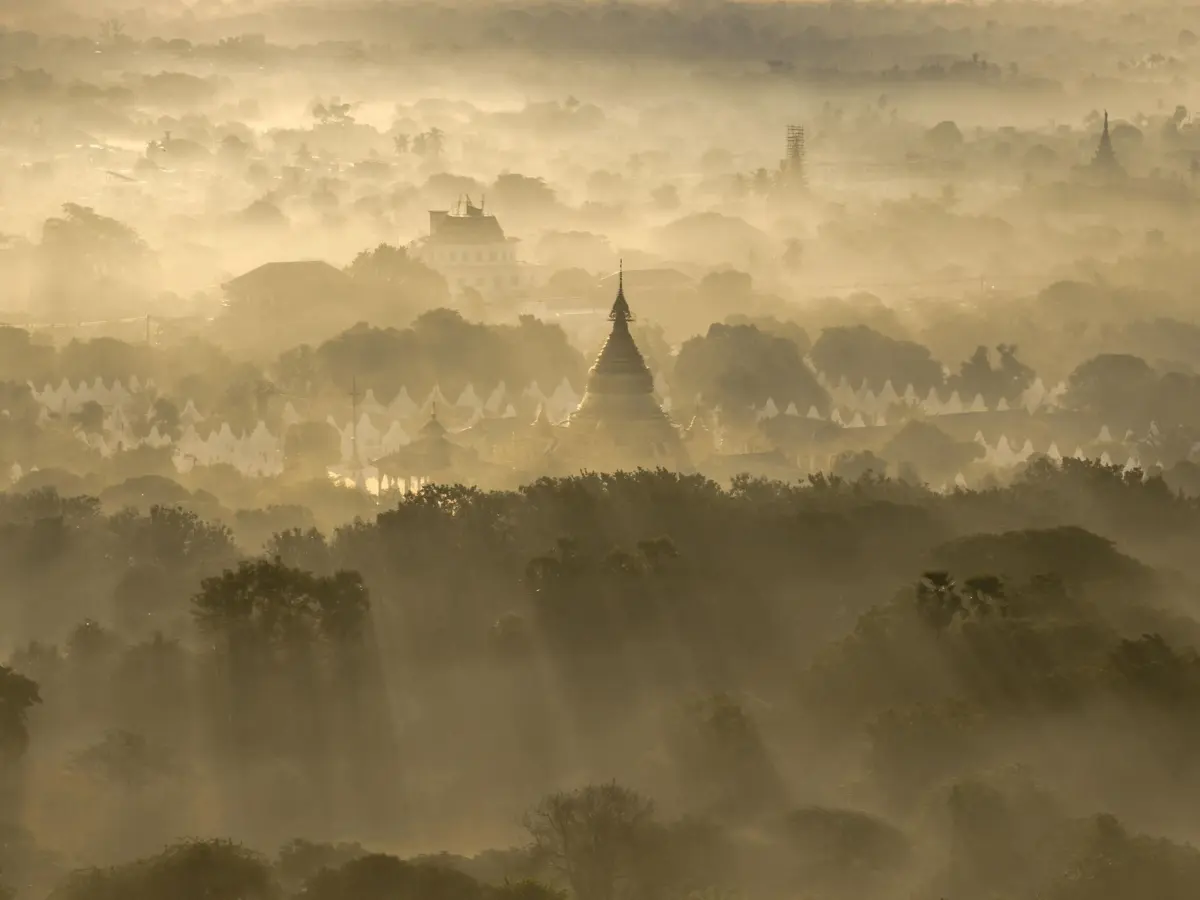
When photographer and videographer Aung Soe Min journeyed to the historic Kuthodaw Pagoda in Myanmar on a crisp winter morning, he was looking to document the subtle shifts of the landscape at dawn. What he ended up capturing was a breathtaking atmospheric composition that would go on to captivate the judges of an international photography competition, proving once again that professional-grade vision transcends traditional equipment. Using nothing more than a handheld smartphone—specifically the Vivo X300 Pro—Min framed a scene defined by soft golden light, deep layers of mist, and the timeless architectural silhouette of one of Myanmar’s most revered cultural landmarks.
The resulting image, titled A Winter Morning, has officially claimed the top prize in the Mobile category at the prestigious Royal Meteorological Society (RMetS) Weather Photographer of the Year 2026 competition. In a field increasingly crowded with sophisticated mirrorless cameras and massive telephoto lenses, Min’s victory with a mobile device underscores how far computational photography and modern smartphone sensors have advanced. More importantly, the award highlights an extraordinary convergence of geography, meteorology, and human patience, transforming a fleeting local weather phenomenon into a globally celebrated work of art.
The story behind the photograph began well before sunrise. Describing the effort required to secure the shot, Min explained that he climbed Mandalay Hill during the early hours of a winter morning, positioning himself to overlook the sprawling expanse of the ancient city below. He then waited patiently for the first rays of sunlight to pierce the gloom. As dawn broke, a thick, heavy veil of mist hung suspended over the surrounding trees and the urban sprawl, shrouding the landscape in a blanket of cool, damp air. Rising majestically above this terrestrial sea of fog, the central Kuthodaw Pagoda caught the initial wash of the early morning sun, bathing the structure in a warm, ethereal glow that cut sharply through the hazy atmosphere.
The extreme diurnal temperature swings characteristic of the region during the winter months made this visual spectacle possible. In Myanmar, daytime temperatures frequently soar to nearly 30 degrees Celsius, offering tropical warmth under clear skies. However, as winter nights descend upon the region, the ambient temperature can plummet drastically, dropping to around 5 degrees Celsius. This rapid cooling of the ground overnight forces the moisture present in the air to condense, generating dense local mist and low-lying fog banks. When combined with the subsequent rising sun, these environmental conditions produce the distinctive golden haze that ultimately gave Min’s photograph its rich, atmospheric quality.
Judges for the RMetS Weather Photographer of the Year competition immediately recognized the unique merits of the image when evaluating the submissions for the 2026 installment. Dennis Oswald, one of the judges presiding over the contest, noted that the photograph made a powerful impression from the very first viewing, standing out in a competitive pool of global entries. Oswald highlighted several specific artistic and technical elements that elevated Min’s work above the rest, pointing specifically to the grounding presence of the central monument.
According to Oswald, the central pagoda rises calmly and steadily above the dense canopy of treetops, providing the viewer’s eye with a clear, comforting visual anchor. This focal point is complemented by the natural layering of the composition, where distinct planes of fog, clusters of trees, and distant urban buildings interact to create an exceptional and convincing sense of depth. Furthermore, the warm, almost monochromatic palette employed by the natural lighting lends the entire scene a quiet, timeless mood that feels both serene and deeply contemplative.
The judge also praised the authenticity of the framing, observing that the composition feels entirely balanced without ever appearing forced, staged, or overly manipulated. It is, in essence, a photograph that rewards a longer, more deliberate look from the viewer, successfully conveying the immersive feeling of standing on Mandalay Hill at that exact physical moment. Oswald characterized the piece as a true mastery of light, depth, and emotional pull, proving that atmospheric photography relies as much on a deep appreciation of environmental conditions and timing as it does on the gear used to capture them.
The recognition of A Winter Morning arrives as mobile photography continues to carve out a respected space within mainstream and professional creative communities. Devices like the Vivo X300 Pro, equipped with advanced multi-lens arrays, large sensors, and sophisticated internal image processing software, allow visual artists to capture dynamic ranges and low-light scenes that were once exclusively the domain of heavy DSLR and mirrorless camera systems. By leveraging these technological advancements, photographers are increasingly able to travel light while still producing gallery-worthy images capable of competing on the international stage.
The Royal Meteorological Society’s annual competition serves as a global showcase for imagery that captures the Earth’s weather, climate, and atmospheric conditions in all their diverse forms. By highlighting works like Min’s winning mobile entry, the competition bridges the gap between scientific observation and artistic expression, encouraging the public to look closer at the sky, the air, and the environmental factors shaping the world around them.
For Aung Soe Min, an expedition up a misty hill in Mandalay has culminated in international acclaim, cementing his place among the world’s top weather photographers. As nature lovers, meteorologists, and photography enthusiasts alike continue to study the winning entries of the 2026 competition, A Winter Morning stands as a reminder of how patience, observation, and a pocket-sized device can come together to freeze a fleeting moment of natural beauty in time.