A recent technical discussion within the front-end development community has sparked a fresh debate over the balance between custom mathematical abstractions and native browser capabilities. The conversation began when front-end designer Danny Schwartz shared an article by developer Ashutosh Biswas published on Frontend Masters. In the piece, Biswas explored a method for creating scrubbable, staggered CSS scroll animations utilizing a combination of emerging CSS features and an intricate mathematical formula—an approach Biswas himself acknowledged as a massive and potentially intimidating equation.
While the mathematical formula offers a generalized solution to synchronize staggered elements, it raises an important question for modern web performance and developer ergonomics: Are such complex mathematical abstractions necessary when modern CSS provides built-in mechanisms designed specifically for scroll-driven timelines?
A Staggering Technical Complexity
The community reaction to Biswas’s approach highlights the tension between creative engineering and standard specifications. Described by some developers in community discussions as "CSS on drugs," the math-heavy implementation attempts to solve a common user interface design pattern: staggering the entrance of characters or elements as a page scrolls into view.
Biswas’s formula was designed as an all-encompassing engine. The core intention was to build a generic architecture capable of linking a single progress value—whether derived from scroll position, an animation timeline, or an external arbitrary input—to drive a collection of interrelated animations as a holistic effect.
There are specialized user experience scenarios where such a custom progress engine becomes essential. For instance, consider a web-based karaoke interface where a indicator bounces across lyrics while individual characters dynamically highlight based on a user’s vocal pacing, tracked through the browser’s Speech Recognition API. In an application like that, where the animation progress is controlled by an external dynamic input not natively bound to scroll parameters or simple time offsets, driving the whole sequence through a single custom progress variable makes technical sense.
However, when applying this logic purely to web scrolling, the web platform already offers built-in primitives. Modern CSS includes dedicated specifications for replacing time-based timelines with scroll progress. Opting to construct a bespoke mathematical progress engine for standard scroll effects risks reinventing functionality that modern web standards deliver out of the box.
Simplification Through Native Standards
The underlying specification for CSS scroll-driven animations explicitly accounts for the departure from traditional time-based execution. As web standards documentation from MDN outlines, when scroll progress replaces time, conventional animation properties behave differently. Specifically, the standard animation-delay property is primarily designed to function within traditional time-based document timelines and does not exert the same control over scroll-driven timelines.
To address this specific requirement, the CSS Working Group introduced native properties such as animation-range-start. This property allows developers to explicitly delay the trigger point of a scroll-driven animation relative to the user’s scroll container depth, eliminating the need to construct manual delay algorithms in CSS custom functions.
By refactoring complex staggering demonstrations—such as the animated donation tally footer highlighted in the Frontend Masters showcase—developers can eliminate reliance on custom functions in favor of native range properties. While scroll-driven keyframe reveals can present usability challenges if users scroll past them too quickly, simplifying the underlying codebase ensures that the visual behavior remains performant, readable, and easy to maintain.
Demonstrating this simplified approach side-by-side with complex mathematical implementations confirms that standard CSS properties achieve identical visual results. Eliminating dense algorithmic formulas reduces code complexity without sacrificing the subtle scrollytelling effect intended to engage site visitors.
A Streamlined Staggering Formula
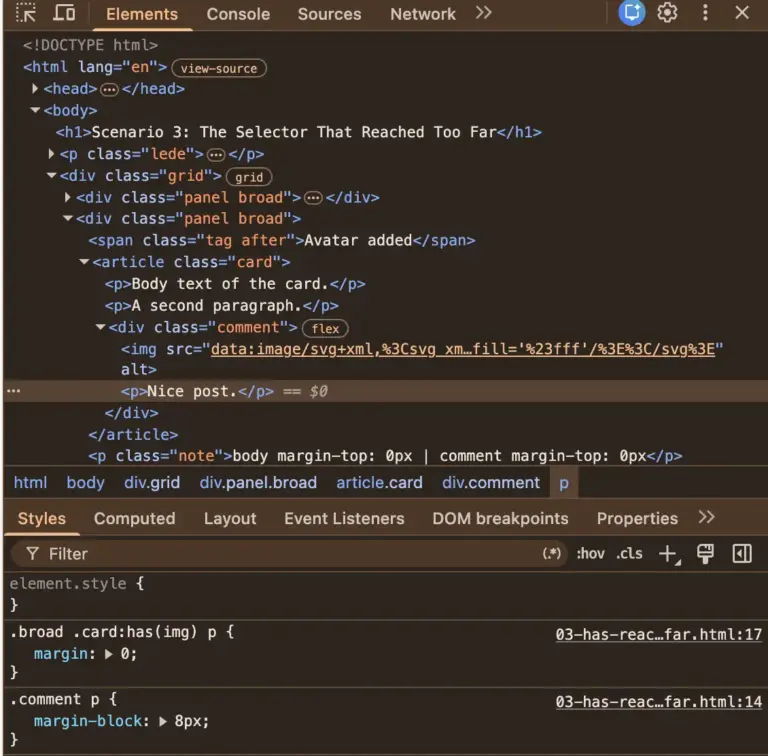
In contrast to lengthy custom formulas, standard CSS features like sibling-index() enable developers to construct concise formulas directly within native animation properties.
By combining sibling-index() with animation-range-start, a complex script can be condensed into a single line of clear, declarative CSS:
animation-range-start: contain calc(10% + 2.5% * sibling-index());
In this streamlined expression, each consecutive sibling element increments its animation offset by 2.5%. Across a sequence of eight characters, the entrance delays are evenly distributed until the final character completes its transition at the 30% mark of the scroll containment range. This pattern achieves clean choreography while relying entirely on native calculation and browser-optimized rendering pathways.

Preserving Native Easing Functions
One significant drawback of wrapping multiple element transitions into a single unified progress formula is the loss of standard CSS timing capabilities. When an animation relies on an abstracted master progress calculation, native easing functions—such as cubic-bezier(), linear(), or keyword properties—cannot be applied directly to individual elements. Instead, developers are forced to manually construct custom mathematical easing functions to control the interpolation curves.
This limitation is not an inherent flaw in CSS, but rather a direct consequence of merging independent visual elements into a single holistic progress sequence. Under standard specifications, the animation-timing-function property operates on scroll-driven timelines with the exact same precision as it does on time-based timelines.
Whether using standard bezier curves or frame-stepping functions like steps()—frequently used in sprite-based CSS games and interactive scrollytelling—keeping elements on individual scroll timelines preserves the native power of CSS timing functions without requiring custom mathematical workarounds.
Evaluating Custom Abstractions in Web Development
Reinventing underlying browser capabilities is a well-established pattern in front-end development, often yielding breakthroughs when native APIs lack necessary features or control. However, every abstraction carries trade-offs between enhanced control and architectural overhead.
For example, the React framework introduced a custom virtual DOM reconciliation layer to manage document updates. While this abstraction delivered component-driven architecture, state-driven rendering, and cross-platform capabilities, it introduced an extra layer of abstraction, increased bundle size overhead, and added complexity to direct DOM debugging.
Similarly, utilities like Pretext were created to handle browser text measurement and line-breaking outside the traditional rendering pipeline. By decoupling layout calculations from the live DOM, Pretext provides text layout measurements suitable for server-side execution and high-performance virtualized lists. The trade-off lies in maintaining layout engine logic that must stay aligned with evolving browser typography behavior.
In the tooling space, parsers like CSSTree abstract browser CSS processing into Abstract Syntax Trees (ASTs). This approach allows developers to perform programmatic analysis, transformation, linting, and performance optimization on stylesheets, though it requires continuous maintenance to remain compatible with evolving web specifications.
As these industry examples demonstrate, overriding native browser mechanisms can be justified when it yields unprecedented capabilities. However, for standard scroll-driven staggering, native CSS properties like animation-range-start already offer the necessary control without the maintenance debt of custom formulas.
Unlocking New Inputs Beyond Scroll Timelines
Despite the complexity of Biswas’s specific formula, the broader concept of linking animation timelines to arbitrary, non-temporal progress values opens up compelling design possibilities for modern web interfaces.
While native CSS scroll timelines bind visual transitions directly to user scrolling, web developers have long envisioned expanding timeline controllers to other input types. Beyond scrollbars, progressive UI elements could be driven by user interactions such as filling out form fields, meeting complex password validation criteria, or navigating multi-step checkout processes.
Tools such as Adam Argyle’s Prop For That library demonstrate the growing interest in exposing field validation and form state directly to CSS custom properties. Extending these patterns to general animation timelines could transform interactive experiences, enabling dynamic progress indicators for quizzes, interactive learning modules, or audio-driven visualizers like web karaoke machines.
Until web standards introduce native primitives for non-scroll input timelines, custom mathematical progress formulas offer a glimpse into the future of input-driven CSS animation architectures.
Emerging Web APIs: Exploring the Google Prompt API
Alongside developments in CSS rendering and animation timelines, front-end architecture continues to evolve through new browser-level APIs. In a recent technical overview, CSS-Tricks editor Geoff Graham met with developer Lee Meyer to evaluate Google’s experimental Prompt API.
The discussion focused on how native client-side AI integration could alter client-side data processing, user interaction models, and the boundaries of front-end capabilities, weighing both the performance benefits and design challenges of embedding local prompt capabilities directly into modern web browsers.