Replacing dozens of lines of complex JavaScript with a clean, concise CSS rule is widely considered one of the most satisfying achievements in modern web development. When a developer swaps a cumbersome JavaScript ResizeObserver script for a native CSS container query, the resulting pull request diff turns predominantly red, code reviews pass swiftly, and the codebase appears significantly lighter.
However, as front-end engineer Gabriel Shoyombo demonstrates in a detailed technical analysis, this initial sense of accomplishment can often be deceptive. Days or weeks after such a refactoring is merged, subtle user interface regressions frequently begin to surface across application dashboards: layout cards mysteriously disappear, heading typography scales unexpectedly on tablet screens, and component internal padding suddenly breaks.
Crucially, none of these regressions stem from syntax errors within the new CSS declarations themselves. Instead, they arise from unexpected interactions between modern native CSS features and the broader architecture of the existing application. Exploring the hidden friction that occurs when application logic is split across CSS and JavaScript, Shoyombo highlights the challenges developers face when debugging conditional styles without visibility into the triggers behind layout shifts.
While modern CSS features are inherently powerful and represent a massive leap forward for web standards, Shoyombo emphasizes that local code simplification does not automatically equal application-wide simplicity. As Shoyombo notes, a CSS feature can simplify a isolated piece of code while making the wider application harder to reason about if developers do not fully understand how it relates to existing system architecture, whether written in CSS or JavaScript.
Local Simplicity vs. System Complexity
To illustrate the relationship between new CSS specifications and existing codebases, Shoyombo likens adopting a modern CSS feature to introducing a new tenant into a shared apartment. Even if the newcomer is quiet and neat, they inevitably share common facilities with everyone else already living there. In modern web architecture, CSS lives alongside JavaScript, established component layout models, the CSS Cascade, and the browser’s underlying rendering engine. The overall stability of the application depends less on the elegance of the isolated CSS feature and far more on how harmoniously these interconnected parts operate together.
This distinction highlights two distinct metrics in software development: local simplicity, which measures the clarity and line count of a specific code snippet, and system complexity, which measures the cognitive load required to understand the entire application’s behavior. A pull request diff reflects only local simplicity, masking potential spikes in overall system complexity.
This systemic friction has sparked broad discussion across the web development community. Developer Igor Roztropiński explored these architectural tensions in an essay titled "Modern Frontend Complexity: essential or accidental?", questioning whether engineering teams can return to simpler foundational approaches given recent advancements in browser capability.
The essay ignited extensive debate within technical forums such as Reddit’s r/programming. Community perspectives split down architectural lines. Pushing back against the premise that native browser updates inherently streamline applications, one commenter noted that many articles championing minimal approaches do not actually achieve more with less, but simply perform fewer tasks overall. Conversely, defenders of modern CSS specifications argued that JavaScript frameworks frequently introduce far more accidental complexity than they eliminate, expressing frustration that team workflows often remain overly centered on JavaScript despite massive performance and interactivity gains in native CSS.
Shoyombo positions his architectural analysis directly within this industry divide. Modern native browser features can indeed reduce complexity, but only when they fully replace legacy implementations without disrupting the surrounding system state. When migration is incomplete or interaction points are overlooked, hidden bugs emerge across distinct operational scenarios.
Dual Ownership of Logic Between JavaScript and CSS
The first major source of architectural complexity occurs when business logic becomes split between JavaScript and CSS, often as a consequence of incomplete refactoring.
Consider a standard user interface card component designed to switch from a single-column layout to a two-column grid when sufficient horizontal space becomes available. Historically, front-end implementations relied on JavaScript ResizeObserver instances to monitor element dimensions and toggle a state class such as .card--wide. CSS rules would then target this class to adjust layout grids and typography sizing.
With native CSS Container Queries, this interaction can be expressed entirely within stylesheet rules using @container blocks, eliminating the need for JavaScript element monitoring. However, real-world migrations across enterprise codebases rarely happen cleanly in a single pass.

During refactoring, a developer might add the CSS @container rule and remove main layout classes, while the legacy ResizeObserver remains registered in an unlinked utility file. Simultaneously, specific styling rules tied to .card--wide might persist because they were missed during project-wide searches.
Initially, the application appears to function perfectly because both the legacy JavaScript observer and the new CSS container query target the exact same breakpoint threshold, such as 480 pixels. Trouble arises when a design update modifies the breakpoint in the container query to 600 pixels while leaving the legacy script untouched. Between 480 pixels and 600 pixels, the component enters an unintended hybrid state—displaying a single-column layout alongside enlarged typography intended for wide displays.
Because no single developer intentionally wrote this state, diagnosing the bug requires recognizing that the component’s layout behavior has two separate logic owners residing in entirely different layers of the technological stack.
Similar split-ownership bugs manifest in other common scenarios, such as when JavaScript event listeners toggle expanded states while CSS :has() pseudo-classes simultaneously attempt to manage parent container states, or when script-based scroll handlers compete with native CSS scroll-driven animations. To prevent these collisions, engineering teams must conduct thorough codebase audits before migration, ensuring that legacy observers, state classes, and conditional selectors are fully purged when moving logic to native CSS.
Unexpected Layout and Containment Side Effects
The second scenario where modern CSS features introduce system-level surprises occurs when declarations trigger implicit layout side effects within the browser.
When developers declare container-type: inline-size to allow child elements to query a container’s width, the browser executes several low-level layout structural adjustments. According to official documentation from the Mozilla Developer Network (MDN), setting a container type applies both style and inline-size containment to the element. Consequently, query containers establish a new Block Formatting Context (BFC).
Establishing a new Block Formatting Context intentionally alters how an element interacts with surrounding DOM nodes, leading to three major visual changes that developers may not anticipate:
- Margin Collapsing Changes: In standard flow layout, vertical margins between adjacent elements collapse into a single margin space. Establishing a BFC on a container prevents internal element margins from collapsing outside the container boundary. For instance, if a heading inside a container has a top margin of 24 pixels and a paragraph above the container has a bottom margin of 16 pixels, their margins previously collapsed to 24 pixels. Once the container query is applied, the heading’s margin becomes contained within the element, forcing the combined spacing to sum to 40 pixels and unexpectedly expanding the container’s height.
- Float Interaction Shifts: Standard block elements normally flow behind floated siblings, allowing child text to wrap around the floated box. Creating a BFC forces the container to form a independent layout box that sits entirely alongside floated elements rather than under them, suddenly altering container widths and horizontal positions.
- Container Sizing Collapses: Inline-size containment prevents an element from deriving its width from its internal content. MDN explicitly cautions that if an explicit or contextual size is unavailable, elements with size containment will collapse entirely. In flexible layouts—such as tags residing within inline-block contexts, auto-fit CSS grid tracks, or flex containers—applying container queries without explicit structural widths can instantly shrink elements to zero pixels wide, effectively causing UI components to vanish from the screen.
Because a component rarely exists in total isolation, applying layout containment requires evaluating whether the target element sits near floated elements, relies on content-based flex sizing, or relies on vertical margin collapsing to align with surrounding typography.
Specificity Borrowing and Cascade Conflicts
The third operational hurdle stems from the CSS Cascade itself. While modern selectors like :has() and native CSS Nesting allow developers to construct expressive conditional styling rules, they can unintentionally introduce high specificity or match far broader DOM scopes than intended.
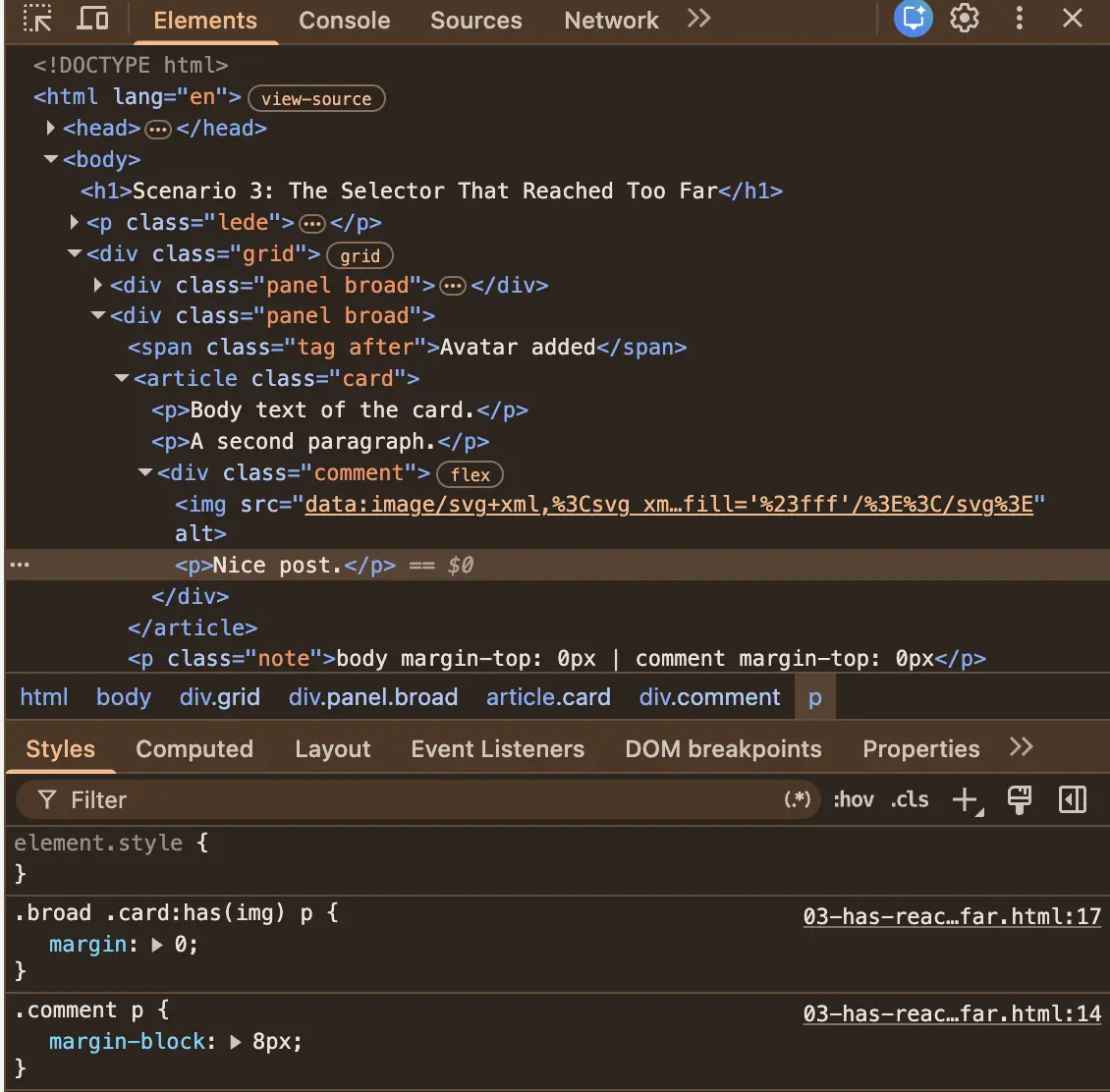
For example, a developer aiming to remove bottom paragraph margins on cards that contain imagery might write a broad relational selector such as .card:has(img) p. If that card component contains nested sub-components—such as a user comment thread featuring author avatar images—the broad :has() rule will unintentionally match every paragraph inside the comment sub-component as well. Furthermore, because state changes occur dynamically at runtime, a card’s layout could suddenly break only when a user posts a comment containing an image avatar, creating intermittent bugs that are notoriously difficult to reproduce from standard user reports.
Fixing such issues requires strict scoping using direct child combinators, such as .card:has(> img) > p, restricting relational styling exclusively to immediate descendants.
A similar specificity trap occurs within native CSS Nesting. According to browser specifications, nesting selectors using the & symbol adopt the highest specificity weight among selector lists present in parent blocks, operating identically to the :is() pseudo-class.

Consider a nested structure where a generic .card selector is listed alongside a high-specificity selector like #featured:
.card, #featured
  & a
    color: blue;


.button
  color: red;
In this context, the nested anchor rule & a automatically inherits the specificity weight of the #featured ID selector (1-0-1). As a result, a .button element (specificity 0-1-0) rendered as a link inside a standard .card will turn blue instead of red, despite the #featured ID nowhere present on that specific card instance. Developers often respond by escalating button specificity elsewhere, launching an unintended cascade specificity war. To neutralize this specificity inflation, engineering teams can wrap parent selector lists inside the zero-specificity :where() pseudo-class.
Furthermore, introducing CSS Cascade Layers (@layer) into existing software architectures presents distinct ordering challenges. While cascade layers successfully eliminate specificity wars between layered stylesheets, normal unlayered styles automatically take precedence over normal layered styles regardless of specificity scores. If a team migrates new component rules into an @layer components block while legacy stylesheets remain unlayered, the legacy unlayered CSS will override the modern layered styles in every direct rule conflict.
This operational reality highlights a recurring theme in web architecture discussions on technical forums like Reddit’s r/webdev. Developers refactoring CSS-in-JS or legacy stylesheets frequently note that build tool output orders and cascade appearance rules create complex runtime styling bugs, emphasizing that tools perform strictly according to specification, leaving systems vulnerable to integration errors when legacy rules conflict with modern paradigms.
The Rendering Performance Equation
A widespread assumption among engineering teams is that shifting logic from JavaScript to native CSS guarantees instant performance improvements. However, moving execution from script runtimes to native CSS simply changes which browser subsystem processes the work. The underlying rendering engine must still execute style calculations, layout layouts, and paint updates.
Browser engine developers have long voiced caution regarding complex relational selectors. During CSS Working Group discussions regarding the specification for :has(), Emilio Cobos Álvarez highlighted the necessity of structural restrictions to prevent severe performance bottlenecks and algorithmic complexity within browser matching engines.
MDN performance guidelines advise developers that relational selectors anchored to broad parent containers like body can force the browser engine to evaluate expansive DOM subtrees during state updates. To quantify these rendering impacts, Shoyombo conducted benchmark testing on an interactive list containing 5,000 DOM rows in Chrome, measuring re-style execution timing across multiple rule configurations:
- Baseline JavaScript Class Toggle: Toggling a state class directly on a target toolbar via script required under 0.1 milliseconds and triggered a restyle on exactly 1 DOM element.
- Body-Anchored Relational Selector: Utilizing
body:has(.row.is-selected) .toolbarto style the toolbar increased restyle processing time to approximately 1.4 milliseconds while still isolating restyles to 1 DOM element. - Row-Filtering Relational Selector: Applying
.list:has(.cell > b) .rowto style internal rows independently cost under 0.1 milliseconds and restyled 1 DOM element. - Combined Relational Selectors: When both relational rules were active simultaneously within the same stylesheet, changing a single selected row forced Chromium to restyle all 5,001 DOM elements on every toggle, spiking execution time to approximately 7 milliseconds.
- JavaScript Full-List Iteration: For comparison, manually iterating through JavaScript to restyle all 5,000 rows on every interaction took approximately 6 milliseconds and restyled 5,001 elements.
When the dataset was expanded to 20,000 rows, the combined CSS relational rules forced 20,001 element restyles, taking roughly 31 milliseconds per interaction—consuming nearly two full rendering frames at 60Hz.
This behavior demonstrates systemic complexity in practice: neither CSS rule appeared suspicious in isolation, yet their combination triggered exponential restyle workloads within the browser engine. Shoyombo documented and reported this issue to the Chromium engineering team for investigation.
A parallel principle applies to CSS transitions and animations. Shifting element movement from JavaScript to CSS transitions on properties like top, left, width, or height still forces the browser engine to run full layout recalculated passes on every frame. True performance gains occur only when animations are restricted to GPU-accelerated layout properties like transform and opacity, regardless of whether the controlling logic is authored in JavaScript or CSS.
A Structured Checklist for CSS Migrations
When refactoring component logic from JavaScript to native modern CSS, engineering teams can mitigate application complexity by working through a structured six-point evaluation framework prior to merging pull requests:
- Audit Legacy Logic Remnants: Identify whether any legacy JavaScript observers, event handlers, or state classes remain active in secondary files or utility suites.
- Evaluate Structural Layout Impact: Determine whether introducing containment properties like
container-typealters Block Formatting Contexts, prevents margin collapsing, or breaks content-sized flex/grid track elements. - Verify Selector Scope and Combinators: Ensure relational selectors like
:has()use direct child combinators to prevent styles from spilling into deeply nested sub-components. - Inspect Specificity Inheritance: Check whether CSS Nesting or parent selector lists borrow excessive specificity weight, utilizing
:where()wrappers to maintain neutral specificity baselines. - Review Cascade Layer Integration: Verify how new styles interact with existing unlayered legacy stylesheets to avoid unexpected rule overrides.
- Benchmark Rendering Engine Work: Measure DOM restyle counts and execution frame rates using browser profiling toolsets under realistic data scale conditions.
Modern CSS specifications provide unprecedented power to build flexible, highly expressive user interfaces entirely within native browser standards. However, transitioning logic from scripts to stylesheets represents an architectural migration rather than a simple syntax cleanup. By treating native CSS features as interconnected elements within a broader rendering system, developers can leverage modern features without introducing hidden operational complexity.