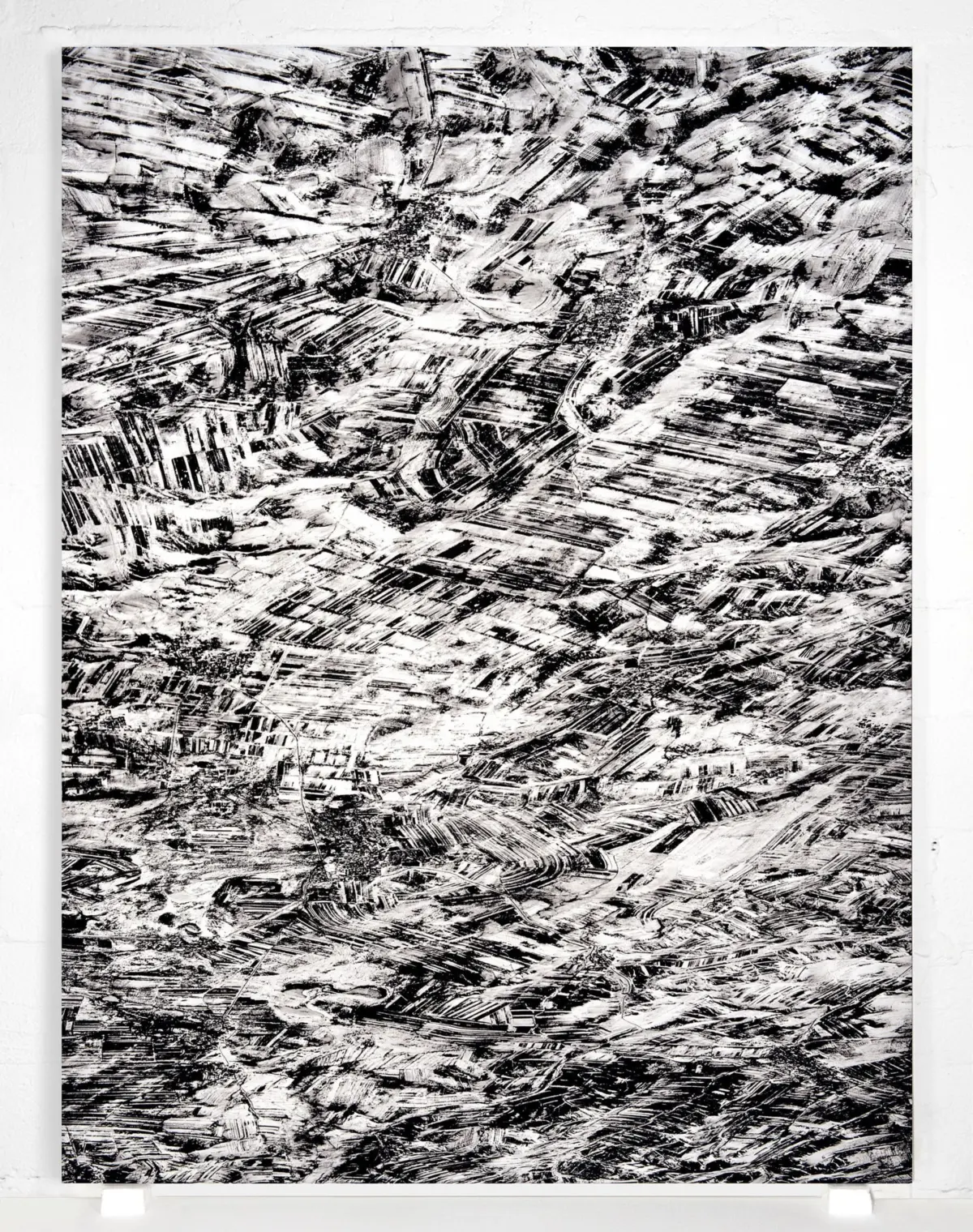
From a certain vantage point inside Justin Brice Guariglia’s sprawling Brooklyn studio, it is nearly impossible to tell what exactly is hanging on the back wall. At a distance, the massive 16-foot print resembles a heavily textured painting, complete with jagged, physical edges that almost invite a viewer to reach out and touch them. Yet, upon closer inspection, the illusion shifts; the eye realizes the image is entirely flat, functioning more like a traditional photograph. In reality, this masterful exercise in trompe l’oeil exists somewhere fascinatingly in between the two mediums.
"They’re paintings derived from photographs," Guariglia explains, describing the complex visual identity of his large-scale works.
This particular monumental piece traces its origins back to a recent, high-stakes flight alongside NASA’s Operation IceBridge mission. It captures a stunning, haunting aerial shot of the Jakobshavn Glacier, widely recognized as Greenland’s largest and fastest-melting mass of ice. The striking image forms a core part of an expansive series of landscape prints that Guariglia meticulously prepared for his major solo exhibition, Earth Works: Mapping The Anthropocene, which opens to the public at the Norton Museum of Art in Palm Beach, Florida.
Guariglia’s journey to this intersection of fine art, environmental science, and cutting-edge technology was far from conventional. He originally established himself professionally as a freelance magazine photographer working extensively across Asia. Over a decade ago, however, he made a decisive pivot toward the world of fine art. The motivation behind this transition was rooted in a profound frustration with the transient nature of traditional media publishing. Photographs printed in magazines and newspapers are, by their very nature, disposable—ephemeral objects destined to be read, discarded, and ultimately thrown away. Guariglia wanted to forge a completely different path, striving to create art that could endure across vast stretches of time.
For his upcoming exhibition, Guariglia engineered a revolutionary process to print his breathtaking aerial photographs directly onto durable, unconventional canvases made of aluminum and polystyrene. The conceptual weight of this choice is central to his artistic philosophy.
"The physical object in the photo is already gone," he notes, pointing to the rapid, irreversible disappearance of the very landscapes he documents. "But the actual image will last forever—as long as we don’t recycle it."
The photographs that anchor the exhibition were captured at dizzying altitudes ranging from 1,500 all the way up to 40,000 feet. From these stratospheric viewpoints, Guariglia’s camera transforms sprawling Asian countrysides and fragile arctic landmasses into mesmerizing, complex abstract forms. He visually bends and reinterprets farmland into shimmering, gilded geometries, while treating towering glaciers as ambiguous, minimalist vistas of pure, blinding white.
Many of the most striking photographs featured in the exhibition were captured during his missions with NASA’s Operation IceBridge. The ongoing scientific initiative deploys low-elevation research aircraft over the remote expanses of Greenland to gather critical, high-resolution data on the country’s rapidly deteriorating glaciers and ice sheets. Participating in these rigorous scientific flights was both an intellectual and physical challenge for the artist. During the missions, Guariglia would lay prone on the floor at the feet of the pilots, snapping rapid sequences of photographs chronicling the ever-changing, precarious landscape through the specialized drop windows of the aircraft.

Back inside his Brooklyn workspace, however, Guariglia’s artistic philosophy relies heavily on restraint rather than digital manipulation. He does not engage in heavy-handed tinkering or digital alterations of the scenes he captures from the sky.
"I mostly just trying to reduce the image to its most basic essential form," he says.
To achieve this radical simplification, he utilizes an industrial-grade printer to map the digital images directly onto sheets of polystyrene and gold-leafed aluminum. The machine itself is a marvel of modern engineering; handmade in Switzerland, its acquisition cost roughly the equivalent of a "very nice" Brooklyn apartment. In Guariglia’s studio, this multi-ton piece of industrial machinery serves the traditional function of an artist’s paintbrush. It precisely dispenses an ultra-fine layer of specialized acrylic ink onto the substrate before high-intensity ultraviolet lights instantly cure and bind the pigments permanently to the material.
The printer, Guariglia points out, was never designed for the fine art world; it is typically utilized in commercial industries for imaging high-end, durable architectural signage.
"I make it do things it’s not supposed to do," he says, pushing the boundaries of the technology by printing on delicate polystyrene or laying down an astonishing 150 dense layers of ink at 900 percent saturation. "I’ve logged about 1,500 hours testing material and printing processes."
The resulting end product is a photographic print that is engineered to effectively last forever—a striking, permanent monument standing in stark contrast to the profound ephemerality of the rapidly vanishing subject matter it depicts.
Every deliberate element of Guariglia’s artistic process, from his raw subject matter down to his unconventional choice of industrial materials, is purposefully designed to represent and interrogate the Anthropocene. This current, unofficial geological age is defined entirely by humanity’s profound and often devastating impact on the planet’s ecosystems, climate, and geology.
The ultimate goal of the exhibition, as the artist explains it, is to actively implicate not just himself as a creator utilizing materials that will inevitably become part of the future fossil record of the Anthropocene age, but also every single viewer who stands before the work. The towering, pristine prints serve as an uncompromising reminder that the immense environmental crises humanity currently faces are driven overwhelmingly by our own collective actions. Yet, once captured, carefully cropped, and printed onto these monumental rectangular panels, the overwhelming reality of climate change is brought into sharper, undeniable focus, making it at last easier for the human eye to truly see and comprehend.